

 Vegas Golden Knights
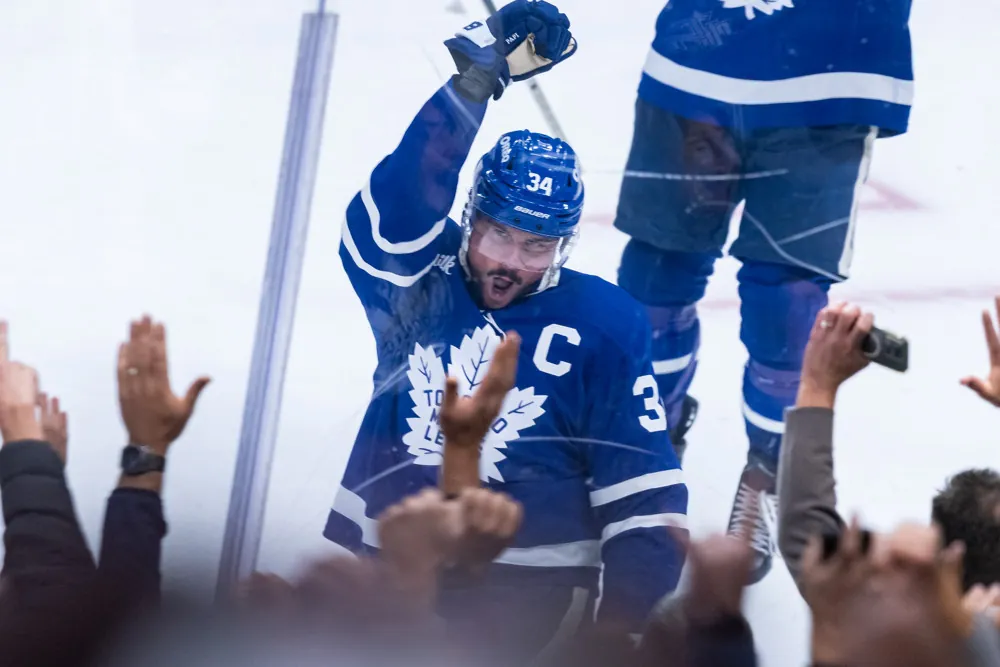
The story out of Toronto this autumn is that Auston Matthews looks like himself. General manager John Chayka said in camp that the team's internal data had him skating better than at any point in the last five years, and the captain arrived lighter after a knee injury ended his 2025-26 season early. Through his first four games he had two goals and three assists, before the shootout loss in Vegas on Wednesday, and the "turning back the clock" headlines have started.
The skating is real, and the early numbers back it up. But skating was never really the problem. Matthews spent the last two seasons getting excellent chances and not finishing them. That is the part of his game Toronto needs back, and it is the part nobody can see yet.
What actually went wrong for Matthews?
Start with the drop, because it was steep. Matthews scored 69 goals in 2023-24. He scored 33 in 2024-25 and 27 in 60 games last season.
The easy explanation is that injuries took away his speed and with it his chances. The numbers say otherwise. Last season Matthews generated 1.10 individual expected goals per 60 minutes at five-on-five, sixth among the 412 forwards who played at least 40 games. He took 17.4 shot attempts per 60, 23rd. He was still getting to the places goals come from.
What disappeared was the finish. Through 2023-24, Matthews converted 16.2 per cent of his shots across his career. Over the last two seasons he has converted 12.3 per cent.
| Matthews | Goals | Shots | Shooting % |
|---|---|---|---|
| 2016-17 to 2023-24 | 368 | 2,273 | 16.2% |
| 2024-25 | 33 | 261 | 12.6% |
| 2025-26 | 27 | 227 | 11.9% |
At his old rate, last season's 227 shots would have produced about 37 goals rather than 27. Ten goals is the difference between a disappointing season and a very good one. Last season he scored 27 times on 28.7 expected goals across all situations, so he was not unlucky either. He finished like an average shooter, which for Matthews is a decline.
What did the first four games show?
A better player, with a different shape. With Matthews on the ice at five-on-five, Toronto has taken 63.5 per cent of the expected goals, up from 46.9 per cent last season, when the team as a whole ranked 30th. He is driving play and setting others up, with three assists.
His own shooting is down, though. He is attempting 13.4 shots per 60 minutes at five-on-five, against 17.4 last season, and generating 0.65 expected goals per 60, against 1.10. He has 14 shots on goal in four games, 3.5 a game, below the 3.78 he averaged last season and well below the 4.56 of his 69-goal year.
| Matthews at 5-on-5 | 2025-26 | 2026-27, four games |
|---|---|---|
| Expected goals per 60 | 1.10 | 0.65 |
| Shot attempts per 60 | 17.4 | 13.4 |
| On-ice xG share | 46.9% | 63.5% |
Four games is about an hour of five-on-five ice time, so none of this is settled. But it is the opposite of the story being told. The team play around him has improved. The scoring threat that made him one of the best goal scorers of his era has not yet returned.
Why does the finish matter more than the skating?
Because Toronto rebuilt around it. New management, a new coach in Jim Hiller, Sergei Bobrovsky in goal and Gavin McKenna on the roster all assume a top centre who scores 45 to 50 goals. A Matthews who drives play but scores 30 is still very good. He is not what Toronto is paying for, and he does not turn a team that finished 30th at five-on-five into a contender.
He also passed Mats Sundin last season to become Toronto's all-time leading goal scorer. He had 430 career goals going into the Vegas game. Five hundred is 70 away, about a season and a half at his old scoring rate and more than two seasons at his recent one.
The case for Matthews being back, stated fairly
The optimistic read goes like this. Shooting percentage is the noisiest number in hockey, and two seasons of playing hurt is the obvious explanation for 12.3 per cent. Healthy, lighter and skating better than in five years, Matthews should see his finishing recover with the rest of his game. A 63.5 per cent on-ice share in the first week is exactly what a dominant centre looks like, and the goals usually follow the play.
The other side is that two full seasons is a long time for a pure shooter to sit four points below his career rate, and that the first four games show fewer shots, not more.
Toronto has the skater back. The question for the next month is whether it has the shooter.
What to watch
Shots per game first, then shooting percentage. If Matthews is back above four shots a game by November and converting near 15 per cent, the old Matthews is back. Both are on his player page. For the rest of Toronto's rebuild, see the bet on Bobrovsky and Hiller and the Knies trade with Columbus.