
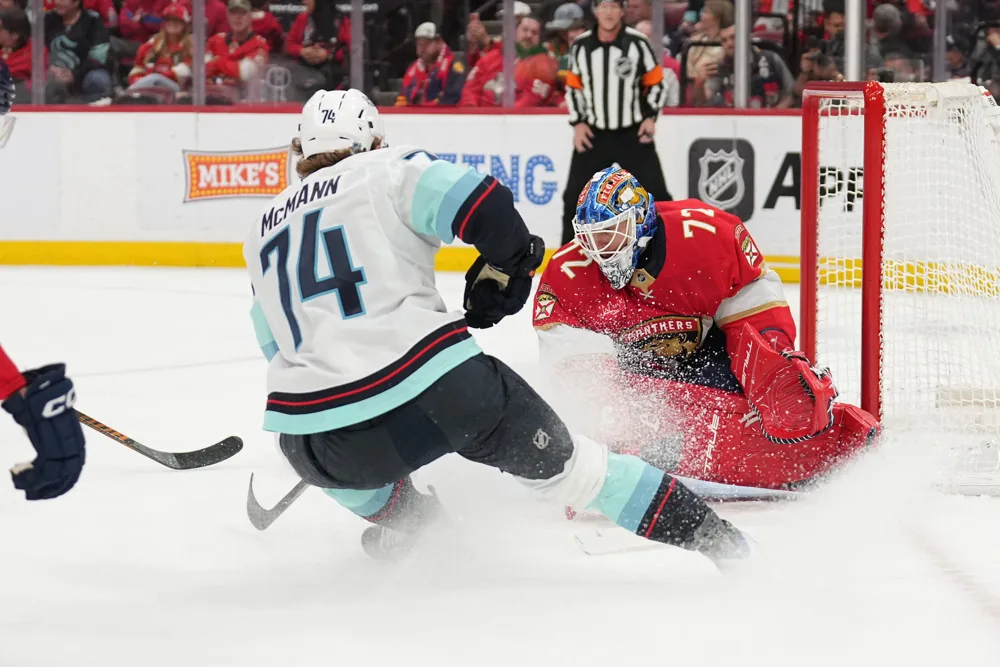

On July 1, John Chayka signed a 37-year-old goaltender coming off the worst season of his career to a three-year, $21 million contract, and called it a message. "Certainly a player of Sergei Bobrovsky's caliber, I think, sends a message that we're serious about moving this team ahead," Toronto's new general manager told NHL.com. The message landed. The Toronto Maple Leafs allowed 295 goals last season, the second-most in the league, and the city has spent the summer treating the crease as the place where that number was born. It was not. The crease was where the number was delivered. Toronto's real problem was the 285 goals it was expected to allow before a single puck was stopped, and the person who has to fix that is not the man in the pads. It is the man who spent the last three years running the stingiest defensive structure in the sport.
Start with what actually happened to the Leafs, because the collapse has been narrated through the goaltenders and the goaltenders were only the last link in the chain. Per MoneyPuck, Toronto's expected goals against across all situations was 285.5, second-worst in the NHL and two tenths of a goal behind a Vancouver Canucks team that finished with 58 points. The Leafs allowed 32.0 shots per 60 minutes, the most in the league. At five-on-five they ranked 29th in expected goals against per 60, 29th in expected goals for, and 29th in share, a 46 percent team by process before anyone in a mask had a chance to make it worse. The goalies did make it worse, by 23 goals at five-on-five. But the 285 was the disease. The 23 was the fever.
The worst season of his career, in one line
Now put the signing beside that diagnosis. Sergei Bobrovsky played 52 games for the Florida Panthers last season and posted a .877 save percentage, a 3.07 goals-against average and 154 goals allowed on 1,250 shots. Against the 141.9 goals MoneyPuck's model expected from that workload, he finished 12.2 goals below expected, 58th of the 66 goaltenders who played 20 or more games. He turns 38 on September 20, nine days before opening night.
The instinct in Toronto is to wave that season away, and the instinct has a real argument behind it. Florida's year was a medical file, as this site argued in August, and goaltending is the noisiest position in hockey. A single bad year at 37 is not a verdict. But look at the shape of Bobrovsky's last seven seasons against the league, because the shape is the thing the contract is pricing.
Two of those seven seasons were outstanding. Three were below the league's average goaltender. One was roughly average, and the seventh was 19 points below, a gap larger than any of the good years were above. Bobrovsky has never been the goalie who gives you a steady .915 for a decade; he is a goalie who gives you a Vezina-shaped year and then makes you wait through one or two ordinary ones for the next. Florida's two Cups happened to land on the good ones. Toronto is paying $7 million a year, through his age-40 season, for the probability that the next good one arrives on schedule.
What the Leafs traded away to make room
The part of the summer that gets less attention is the arithmetic of who left. Toronto used three goaltenders of consequence last season. Here is what each did, with the league's best and worst for scale, and where each is now.
Dennis Hildeby was the only Toronto goaltender above water. In 20 games he saved 10.5 goals more than expected, 17th in the league, on a .913 save percentage behind the same blue line that dragged everyone else under. On July 1, the same day Bobrovsky signed, Hildeby went to the Tampa Bay Lightning with a 2027 fourth-round pick and a 2028 third for Nick Paul, a 31-year-old winger who scored 15 points in 51 games. Two weeks earlier, Joseph Woll had gone to Philadelphia in the package that returned Emil Andrae. What remains is Anthony Stolarz, who was 6.7 goals below expected in 26 games, and Bobrovsky, who was 12.2 below in 52. The tandem that opens the season combined for minus 18.9 last year. The goaltender the Leafs gave away was plus 10.5.
Twenty games is a small sample and Hildeby is 25 with a six-game .878 cameo as his only prior NHL record, so nobody should pretend Toronto traded away a franchise goalie. But that is not the point. The point is that a front office declaring the crease its emergency chose, in the same week, to pay reputation and sell performance. That is the same trade the Buffalo Sabres are being urged to make with Connor Hellebuyck, and the same logic that runs through half the goalie market every summer: a famous name arrives, the recent numbers get filed under "context," and the price gets set by the year everyone remembers.
The fix that will actually work has a different name
Here is where I part from the Toronto skeptics, because the Leafs did make one move that addresses the 285, and it was not the goalie. On June 17 they hired Jim Hiller, who spent the last three seasons running the Los Angeles Kings, and the Kings under Hiller were the most suffocating defensive team in the NHL by the measure that matters most.
Los Angeles allowed 46.6 fewer expected goals than Toronto across the season, 5.4 fewer shots per 60, and the fewest high-danger shots per 60 in the entire league. That is not a goaltending effect; the Kings' starter, Darcy Kuemper, finished 5.8 goals below expected and the team still allowed 238. It is a structural effect, the product of a coach who would rather win 2-1 than trade chances, and it travels. Transplant even half of that gap onto Toronto and the Leafs stop being the team that gives up the most shots in hockey.
The blue line helps the same argument. Chris Tanev played 11 games last season, and on-ice the difference was stark: Toronto conceded 2.19 expected goals per 60 with Tanev on the ice at five-on-five, against 2.69 with Morgan Rielly, 2.68 with Oliver Ekman-Larsson and 2.56 with Jake McCabe. A healthy Tanev is worth more to the goals-against column than any goaltender on the market. Darren Raddysh, acquired from Tampa on an eight-year deal after a 70-point season, drove a 56 percent share for the Lightning and conceded 2.32 per 60, though he did it behind the third-best defensive structure in the league, so some of that number belongs to his old coach rather than his own stick. Add Andrae's puck movement and the Leafs have, on paper, replaced two of the four defenders who sank last season and reinstated the one who never sank at all.
So the crease is going to look better. Bobrovsky is going to face 27 or 28 shots a night instead of 32, and fewer of them from the slot, and a goaltender who saved 12 fewer than expected at 32 a night can very plausibly sit at league average at 27. When that happens, Chayka's "message" signing will be credited with the turnaround, and the credit will belong to a coach and a defenceman coming back from injury.
The best case for Toronto's plan is Boston, and that should worry Toronto
There is a version of the summer where the Leafs are right and I am wrong, and it looks like the 2025-26 Boston Bruins. Boston's expected goals against was 277.6, third-worst in the league, one notch better than Toronto. The Bruins allowed 247 actual goals and finished with 100 points because Jeremy Swayman saved 28.8 goals above expected, the second-best goaltending season in the NHL. Toronto's plan, whether Chayka would describe it this way or not, is to buy a Swayman year from a 38-year-old.
That is the trouble with the model, and this site said it about Boston in August: a team that fixes 285 expected goals with goaltending needs a top-two goaltending season every year, and top-two goaltending seasons are the least repeatable asset in the sport. Bobrovsky has produced two seasons that would qualify in the last seven. Betting on the third to arrive at 38, on a three-year term, behind a defence that has not yet proven the new structure works, is a bet on the tail of the distribution. If Hiller cuts the shot volume, the Leafs will not need it. If he does not, Bobrovsky facing 32 a night is the same goaltender who posted .877 facing 26.5 in Florida, only older.
The honest counter
Give the signing its due. Bobrovsky's playoff record is the reason the contract exists, and it is not nothing: three straight Cup finals, two rings, a track record in the games that decide seasons that no other available goaltender could match. Stolarz played behind him in 2023-24 and the familiarity is real. The high-danger numbers were not the problem last season; Bobrovsky's collapse came on the shots a goalie is supposed to stop, and that is the kind of failure that age explains but that a shorter workload and a tighter structure can also mask. If the Leafs are a 52 percent team under Hiller, a league-average Bobrovsky is more than enough, and a league-average Bobrovsky is the median outcome, not the optimistic one. The contract is expensive insurance on a rebound that probably happens anyway.
But "probably happens anyway" is exactly why the price is wrong. Toronto is paying $7 million a year, on term, for regression to the mean. It is the most expensive way to buy the thing you were going to get for free from the coach.
What would prove me wrong
By the 30-game mark, roughly the start of December, two numbers settle this. First, Toronto's shots against per 60: if it is below 28, Hiller has done the job and the goaltending debate is academic. If it is still above 30, the structure did not travel and the Leafs are back to needing a Swayman year. Second, Bobrovsky's goals saved above expected. If he is at zero or better behind a 28-shot team, the crease is fine and the coach fixed it. If he is at plus-8 or better behind a 30-shot team, then the goalie really was the answer, the 2025-26 season really was a fluke, and this column owes John Chayka an apology. If he is below zero behind a 30-shot team, Florida's .877 was not an outlier. It was a preview.
Where this lands
Three straight Cup finals, two rings, and a career that has produced two elite seasons in seven. Behind a Hiller structure that cuts five shots a night, a league-average Bobrovsky is the median outcome and enough to make Toronto a playoff team.
Toronto's 295 goals were built on 285 expected, second-worst in the NHL. The Leafs paid $21 million on term to a 38-year-old coming off 12.2 goals below expected, and traded away the one goaltender in the building who was above water, to fix a problem the coach was hired to solve.
Rankings of summer moves will call the Bobrovsky signing the headline of Toronto's offseason, and by name recognition it is. By goals, the headline was June 17, when the Leafs hired the coach who allowed 238. Everything that goes right in the Toronto crease this season starts there, and everything that goes wrong will be blamed on the goalie who was signed to take the credit.