

 San Jose Sharks
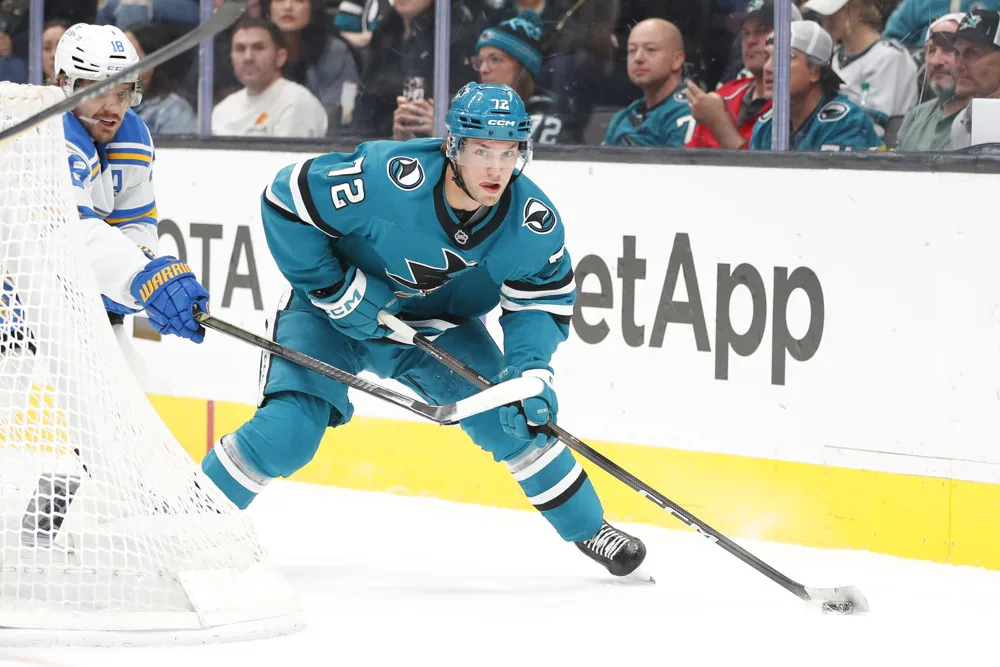
Two days after the Ottawa Senators sent Brady Tkachuk to the Florida Panthers, they took the best piece of the return, the ninth pick in the 2026 draft, and sent it to the San Jose Sharks for William Eklund, Kasper Halttunen and the rights to Brandon Svoboda. Put the two trades side by side and the summer reads as one transaction: Tkachuk out, Eklund in, and a 25th pick, a conditional 2029 first and a 2027 second left over as change. General manager Steve Staios told reporters the draft capital "opens the door for many different possibilities." The door he walked through was a 23-year-old winger with 53 points and two years left at $5.6 million.
Here is the number that should frame every conversation about that swap. At 5-on-5 last season, Tkachuk scored 11 goals and 31 points. Eklund scored 11 goals and 31 points. Identical. The box score says Ottawa replaced its captain with a younger, cheaper version of the same player, and if that were true, this would be the smartest trade of the offseason. It is not true, and the gap between the two identical stat lines is the gap between the Senators team that finished top three in the league in possession and whatever they are about to become.
One of these players was the reason for the stat line. The other was riding it.
Start with the minutes, because the minutes are the tell. Tkachuk's 31 points came in 759 minutes of 5-on-5 time. Eklund's came in 1,132. That is 2.45 points per 60 against 1.64, and 2.45 points per 60 is a first-line rate on a good team. A rate of 1.64 is a second-line rate on a bad one, which is exactly where Eklund played.
Then look at what happened when each of them was on the ice, which is the number that survives a change of jersey. With Tkachuk out there, the Senators generated 3.48 expected goals per 60 and conceded 2.15. That is a 62 percent share, and it was the best mark among every Ottawa forward who played real minutes. With Eklund out there, the Sharks generated 2.51 and conceded 2.63, a 49 percent share. San Jose as a team was a 48 percent team at 5-on-5. Eklund was, almost exactly, San Jose.
That distinction matters more than any of the counting stats. When I wrote that Tkachuk tilts the ice like almost no one in hockey, the point was that his value lives in where the game is played, not in his point total. He scored 22 goals in 60 games, which is a good year and not a great one, and still drove a 67 percent expected-goal share across all situations because the puck lived in the other team's end whenever he was out there. Eklund's 53 points look like the same tier of production. They came from a player who had roughly no effect on which end of the rink the puck was in.
Where Eklund would have ranked on last year's Senators
The fairest way to show what Ottawa gave up is to put Eklund's number next to the group he is joining. Ottawa's forwards were, up and down the lineup, on the right side of the puck. The worst regular among them was Lars Eller, a veteran fourth-line centre who has since left for Florida, at 48 percent. Eklund's 49 in San Jose would have slotted in one place above him.
There is a reasonable defence of Eklund here, and it deserves airing before it gets dismissed. San Jose was a bad team with bad goaltending, and a 49 percent player on a 48 percent team is holding his head above water. Macklin Celebrini, the best young player in the league, was a 50 percent player on the same team. Will Smith was 48. Nobody in San Jose drove play, because San Jose could not drive play, and Eklund cannot be blamed for the roster around him.
Fine. But then the argument has to be that he was at least as good as his environment, and the goals say otherwise. Eklund was on the ice for 47 goals for and 62 against at 5-on-5, minus-15. Celebrini, with the same defence and the same goaltending behind him, was plus-17. Smith was plus-13. Whether that is Eklund's fault or a quirk of who he shared the ice with, the Sharks were a worse team at 5-on-5 with him on the ice than with either of the two kids they built the rebuild around. Ottawa is not buying a play-driver who was trapped on a bad team. It is buying a talented secondary scorer whose results, on a team that had two other young forwards producing real results, were the worst of the top six.
The production is real, and it has already peaked once
None of this means Eklund is a bad player. He is a good one, a former seventh overall pick who put up 45, 58 and 53 points in his three full seasons, and there is a version of this trade where a 24-year-old with 58-point upside becomes a 70-point player once he is surrounded by Tim Stutzle and Drake Batherson instead of a rebuilding San Jose roster. That is the bet, and it is not a stupid one.
It is worth being honest about the shape of that production, though, because "23 years old with 53 points" carries an implied growth curve that the last two seasons do not support. Eklund's best year was 2024-25, when he had 58 points in 77 games. Last season, with more shots and slightly less ice time, he had 53 in 78. Assists fell from 41 to 38 and goals from 17 to 15. That is not a collapse, and it is not a breakout either. It is a player whose production flattened out at exactly the moment the narrative says it should have taken off.
Compare that to the player he is replacing. Tkachuk's worst full season in the last four years, the 55-point 2024-25, prorates to 63 points per 82 games. Eklund's best year prorates to 62. Ottawa traded the floor of one player for the ceiling of another, and did it while the first player was entering his prime.
The physical identity leaves with him
There is a second thing Ottawa loses that no version of Eklund replaces, and it is the thing the Senators were built around. Tkachuk had 162 hits last season in 60 games. Eklund had 72 in 78. Dylan Cozens, the other engine of Ottawa's possession game, had 215. This was a heavy, forechecking, net-front team, and the possession numbers were a product of the style, not a coincidence next to it. Tkachuk won the puck on the forecheck and did not give it back, and the 62 percent share was what that looked like on a spreadsheet.
Eklund is a different kind of player entirely, a skilled, pass-first winger who does his work on the perimeter and the power play. That is a legitimate way to be good at hockey, and it is not the way Ottawa was good at hockey. Head coach Travis Green has spent two seasons building a team that hits everything that moves and lives in the offensive zone as a result. Its captain was the template. Its replacement is a stylistic outlier on his own new roster, and the reasonable question is whether he lifts the system or the system has to bend to fit him.
What Ottawa actually needed to buy
The frustrating part is that Ottawa's problem was never on the wing. The Senators finished with 99 points and a wild-card spot despite controlling 56 percent of the expected goals at 5-on-5, a top-three mark in the league, because their goaltending gave back almost everything the skaters built. At 5-on-5 Ottawa should have allowed about 141 goals on the quality of chances it conceded. It allowed 163. Linus Ullmark finished 13 goals worse than expected across all situations.
Ottawa's answer to that, the same week it moved Tkachuk, was Samuel Ersson from the Toronto Maple Leafs for a 2027 fifth-round pick. Ersson played 33 games for the Philadelphia Flyers last season with a .870 save percentage and finished 16.5 goals worse than expected, a deeper hole per game than the goaltender he is supposed to support. Philadelphia fixed its crease by moving on from him. Ottawa's crease is now Ullmark, coming off a poor year, backed by the goaltender Philadelphia decided it could not live with.
So the full picture of the summer is this. A team whose only real flaw was in net sold the player who created its biggest strength, used the best asset from that sale on a winger who does not replicate the strength, and addressed the flaw with a fifth-round pick. The remaining picks are real, and the 2029 first could become something. But picks do not play in October, and the team that takes the ice in October has less of what made it good and the same thing that made it lose.
The case for Ottawa, stated fairly
The best argument for what Staios did is about time and money, not hockey. Tkachuk turns 27 this month, is paid $8.2 million through 2027-28, and due a substantial raise on his next deal. Eklund is 23, paid $5.6 million through 2027-28, and will be a restricted free agent when it ends. Ottawa has Stutzle, Cozens and Batherson to pay, a captaincy to fill, and a roster whose real window is 2028 rather than 2027. If you believe Tkachuk's game ages badly, which is a fair thing to believe about a player who hits 160 people a year, then selling at 27 for two firsts, a second and Eklund is the kind of move a rebuilding team makes to reset its timeline.
Ottawa is not a rebuilding team. It was a 99-point team with a top-three possession profile and a fixable weakness, and it has chosen to act like a team that needs to get younger and cheaper rather than a team that needs one goaltender. The Eklund bet is that a 24-year-old's production grows into the environment. History says production follows possession, not the other way round, and Eklund has never been a possession player anywhere.
Where this lands
Eklund is 23, has already had a 58-point season, costs $2.6 million less than Tkachuk and arrives in the best environment of his career. Add the 25th pick, a 2027 second and a conditional 2029 first, and Ottawa converted a 27-year-old at peak value into four assets and a longer window.
The identical 5-on-5 stat line is a mirage. Tkachuk produced his in 373 fewer minutes while owning 62 percent of the ice; Eklund produced his as a 49 percent player whose on-ice goal differential was the worst in San Jose's top six. Ottawa's identity was territorial and physical and its problem was in net. It sold the identity and bought a fifth-round goalie.
What it means
The trade will be judged on Eklund's point total, because that is how trades get judged, and there is a good chance he clears 55 and the swap gets called a win. Watch the share instead. If Ottawa is still a 55 percent team at 5-on-5 in January with Eklund in Tkachuk's spot, then Staios found a driver hiding in a bad situation and this piece was wrong. If the Senators slide toward 52 while Eklund's points hold up, then what happened this summer is exactly what the numbers said would happen: Ottawa traded the thing that was working to pay for the thing that was not, and put the difference in a drawer marked 2029.