
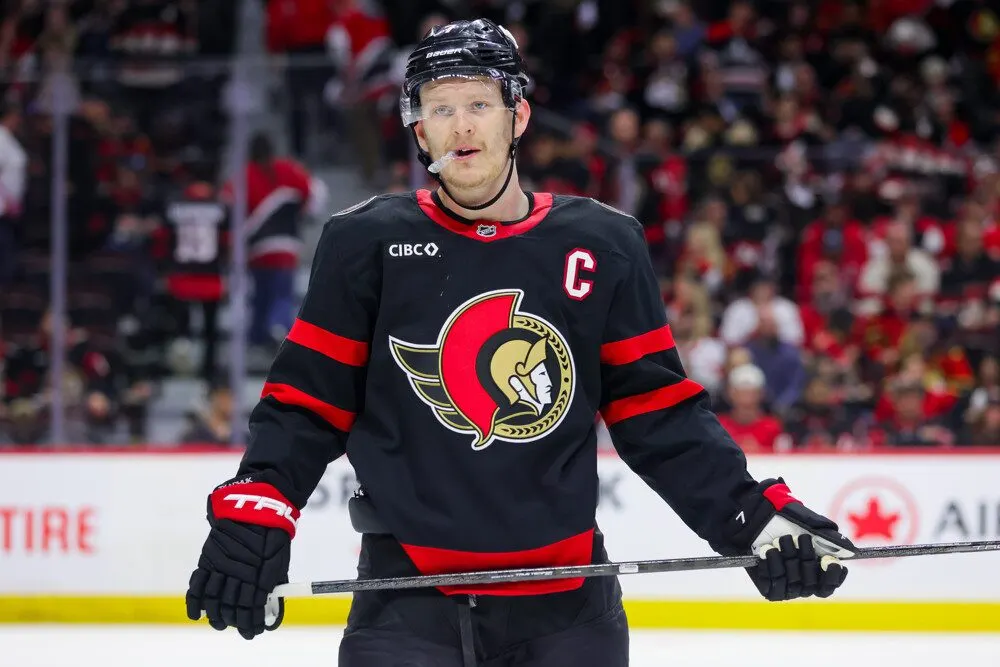

When I wrote that Ottawa was a top-three possession team held back by its goaltending, the engine of that possession did not get its due. This is the correction, in two senses: Brady Tkachuk is one of the best power forwards alive, and the way he bends a hockey game shows up in a number most players never touch. He also no longer plays for Ottawa. The Senators traded him to the Florida Panthers on June 21 for the ninth and 25th picks in the 2026 draft, a conditional 2029 first and a 2027 second, after what general manager Steve Staios described to reporters as a trade request. The original version of this piece, published August 17, treated him as Ottawa's captain going into the season. That was wrong, and the note at the bottom explains what changed.
| Metric | Number | The read |
|---|---|---|
| Tkachuk on-ice xGF% (all situations) | 67% | Among the very best marks in the league |
| Points | 59 | Elite impact without a huge point total |
| Team 5-on-5 share | 55% | 3rd in the NHL |
| Goaltending vs expected | -24 | What actually held the Senators back |
With Tkachuk on the ice last season, the Senators controlled 67 percent of the expected goals across all situations, a figure that sits among the very best in the entire league. Sixty-seven percent means that when Tkachuk was out there, the game was being played in the other team's end roughly two-thirds of the time. He does it the hard way, with a physical, north-south, net-front game that wins the puck on the forecheck and refuses to give it back, the kind of style that ages well and travels into the playoffs where space disappears. His 59 points understate him, because a large chunk of his value never touches the box score. It lives in the territorial stranglehold he applies every shift.
The supporting cast is real
Ottawa was not a one-man possession team, which is what made the underlying profile so trustworthy. Dylan Cozens drove a 65 percent share, Claude Giroux in his veteran years still tilted the ice at 54, and the Senators as a whole controlled 55 percent of the expected goals, third-best in the entire NHL. This was a genuine, deep, deliberate possession team, a young group that had quietly become one of the best in the league at controlling the run of play. On the measures that predict future success, Ottawa graded out like a contender, not a bubble team.
The one thing that broke
So why did a top-three possession team finish with 99 points and a wild-card seed rather than a division title? The crease, and it is not close. Ottawa allowed roughly 24 more goals than the quality of the chances it surrendered would predict, with Linus Ullmark, a former Vezina winner, posting a genuinely poor season by his standard. A team that suppresses chances at a top-three rate and still bleeds two dozen goals to its own goaltending is a team whose flaw is entirely fixable, because goaltending is the input most likely to correct itself. Tkachuk and the possession machine did their job. The net gave it back.
What Ottawa sold, and what it kept
That was the case for the Senators as the sleeper of the East, and it depended on the engine staying in the building. It did not. The return for Tkachuk is real, two first-round picks in a strong draft plus a conditional first and a second, and it is the kind of package a rebuilding team dreams about. Ottawa is not a rebuilding team. It was a 99-point, top-three possession club whose only flaw was in net, and it has answered that by removing the player who created the possession while the crease remains the open question it was in April.
The honest read on what remains is that the structure was never only Tkachuk. Cozens at 65 percent and a team-wide 55 percent share are evidence of a system, not a single player, and the Senators will still control the run of play more than most teams. But the drop from a 67 percent winger to whoever takes his minutes is enormous, and the identity was his. A heavy, forechecking, net-front team built around a captain who hit everything that moved is now a team that has to find out whether the style survives without the player it was copied from. The picks will answer that question in 2029. The standings will ask it in October.
Why Florida paid two firsts
For Florida the logic is the mirror image, and it is why the price was so high. The Panthers finished last season with a 19-goal finishing shortfall and a season without Aleksander Barkov, and a player who drives 67 percent of expected goals and 3.48 expected goals for per 60 at five-on-five is the single most direct fix to that problem on the market. Put him with Barkov and Sam Reinhart and Florida's top line becomes the most territorially dominant unit in the league. Whether the rest of Florida's summer addressed the right half of the rink is a separate question, but on the wing, Zito bought the exact thing Ottawa should never have sold.
The physical style, and the case for a forgotten kind of greatness
Two things worth adding, one caution and one credit, and both now belong to Florida. The caution is the toll: Tkachuk plays a heavy, collision-heavy game, the kind that produces the 67 percent share and also the missed nights, and a career built on hitting everything that moves rarely ages gently. The Panthers, who just watched a season disappear to injuries, need to manage his workload and hope the body holds. The credit is that he belongs in a conversation the awards rarely have. There is no trophy for the forward who most controls the run of play, but if there were, Tkachuk would be in the top handful every year, because a 67 percent on-ice share from a first-line winger is a rarer, more valuable thing than a lot of the 90-point seasons that draw Hart votes. He is not a compiler and he is not a highlight machine; he is a force who decides where the game is played, and that is the most underrated way to be great in modern hockey.
What it means
The narrative will keep chasing his goal totals and his penalty minutes, but the number that matters is the one that says his team owns the ice when he is on it. Ottawa had that and traded it for futures; Florida paid a premium for it and will find out whether it travels. Watch the share, not the points. Tkachuk is exactly the player you build a rising team around, which is the problem for the rising team that just let him go.
Correction, September 7, 2026: The original version of this article, published August 17, described Brady Tkachuk as Ottawa's captain going into the 2026-27 season and built its forward-looking argument on him remaining a Senator. He was traded to the Florida Panthers on June 21, 2026. The statistical analysis of his 2025-26 season and of Ottawa's possession profile was accurate and is unchanged; the headline, the framing and the closing sections have been rewritten to reflect the trade. Pucky regrets the error.