
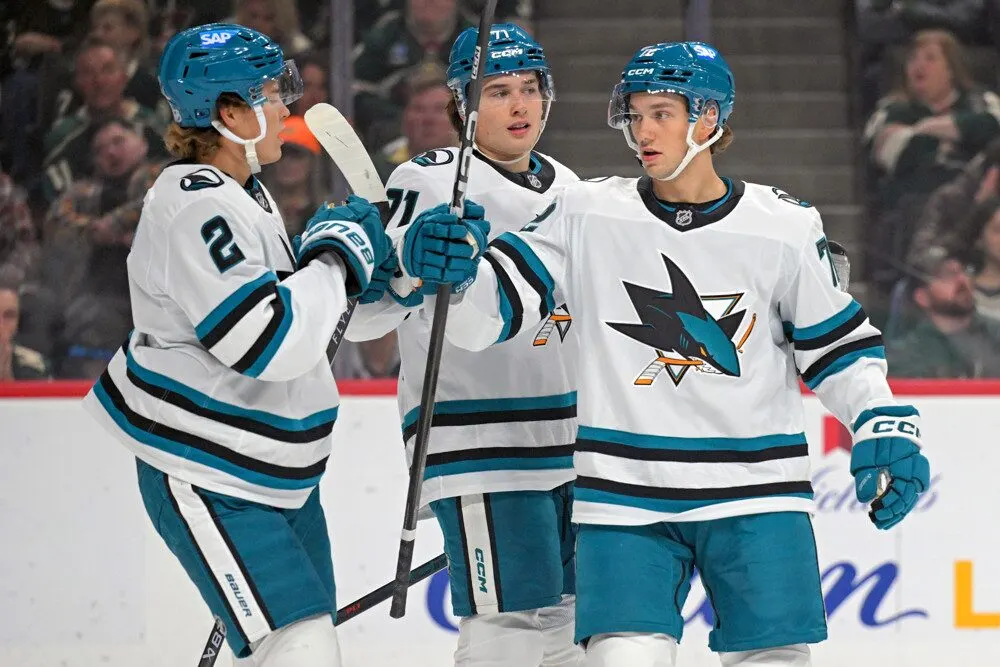

San Jose's rebuild has a face, and the face scored 115 points, so the attention is earned. But rebuilds do not graduate on the strength of one player, and the breakout-candidate lists circulating this week keep flagging the same name in teal for a reason. Will Smith put up 59 points in 69 games as a 20-year-old on one of the worst teams in hockey, drove play while doing it, and is positioned for exactly the kind of second-season leap that turns a one-star rebuild into a two-star foundation. The Celebrini show has an opening act about to steal scenes.
| Player | Games | Points | On-ice xGF% |
|---|---|---|---|
| Macklin Celebrini | 82 | 115 | 58% |
| Will Smith | 69 | 59 | 57% |
| Team baseline | 82 | 249 goals for and 290 against | 48% |
Read Smith's line against the team's, because that is where the signal lives. San Jose was a 48 percent team that gave up 290 goals, and Smith's shifts ran at 57 percent, nine points above the baseline and within a rounding error of Celebrini's own mark. A 20-year-old dragging a bad roster's numbers up rather than surfing a good one's is the single most reliable early indicator scouting analytics has, and Smith paired it with 59 points in a season shortened by 13 games. Prorate the production, layer on a normal age-21-to-22 jump, and the point-per-game version of Smith is not a hope. It is the median projection.
Why the second star matters more than the first
Here is the structural truth about rebuilds: the first franchise player gets you drafted highly and watched sympathetically; the second gets you competitive. One elite line can be matched and shut down in a seven-game series, but two drivers force opponents to choose their poison, and every modern contender is built on that fork. Celebrini's monster season established San Jose's ceiling. Whether Smith becomes a genuine co-star establishes the timeline, because the Sharks graduate from lovable to dangerous the day opponents cannot send their shutdown pair at one line and exhale.
The profile scouts quietly love
Smith's game also has the shape that translates. He is not a percentage-riding finisher waiting for a correction; he is a playmaking centre-winger hybrid whose production came on creation, vision and a maturing two-way game, the profile that compounds with strength and usage rather than depending on hot streaks. The breakout lists naming him this week are pattern-matching correctly: young forward, rising role, positive relative impact on a bad team, production suppressed by games missed. That checklist has minted most of the last decade's second-year leaps, and Smith ticks every box on it.
The honest limits of the projection
The hedges deserve their paragraph. San Jose remains a bad team, and bad teams distort development in both directions: minutes come easily, but so do losing habits, and a 48 percent environment can teach a young player to survive rather than dominate. Smith's 69-game season also flags durability as an open question, and second-year leaps, however probable, are probabilistic; the sophomore seasons that stall usually belong to players asked to carry too much too soon, which is a real risk on a roster this thin behind its top two. The projection is strong. It is not armor.
What San Jose should protect
The Sharks' one job this season is to let the two kids compound. That means resisting the urge to flip futures for veteran respectability, keeping Smith and Celebrini's development the organizing principle over any single standings goal, and quietly fixing the 290-goals-against embarrassment enough that the young forwards are not learning inside a nightly landslide. Rebuilds at this stage fail by impatience far more often than by talent shortage, and San Jose's talent question is closer to answered than anyone outside the building seems to realize.
The two-star blueprint, studied
The recent history of rebuilds is effectively a study in second stars, and it is worth walking through what the pattern predicts for San Jose. The teams that converted their teardowns into contention all hit the same inflection: the season the second elite driver emerged, opposing coaches lost the ability to solve them with one matchup, the top-six minutes stopped being survival exercises, and the whole roster's numbers lifted because the depth players finally faced depth competition. Chicago is running the same experiment with Bedard and its supporting kids, Anaheim ran it with Carlsson and Gauthier and made the playoffs, and Montreal's leap came exactly when its second and third drivers arrived together. The blueprint is not subtle. It is the most repeated pattern in modern roster construction, and Smith is San Jose's version of the hinge.
What makes the Sharks' timeline potentially faster than the comparables is the quality gap at the top. Most rebuilds pair their emerging second star with a very good first one; San Jose's first one just scored 115 points at 19 years old, a developmental head start no other rebuild in the league can match. If Celebrini is already operating at a top-five-forward level and Smith arrives even at 80 percent of the standard second-star trajectory, the Sharks' top six stops being a rebuild problem and starts being a matchup nightmare years ahead of schedule. The 48 percent team around them is bad, but bad teams with two elite drivers stop being bad with startling speed, because the hardest inputs are the ones already in place.
The asset-management corollary: everything San Jose does this season should protect that pairing's development curve, including the unglamorous work of fixing the 290 goals against enough that the kids learn winning habits. Rebuilds die of impatience or of letting their young stars marinate in losing. The Sharks control both risks, starting now.
Where this lands
The league will spend this season watching Macklin Celebrini chase 120 points, as it should. The smarter watch is the winger-centre hybrid one line over, because Will Smith at 57 percent on a 48 percent team is the early-warning signature of a second star, and second stars are what turn rebuilds into problems for everyone else. The breakout lists have the right name in teal. By spring, the Sharks may have the thing every rebuild actually needs, and it was never one franchise player. It is two.