
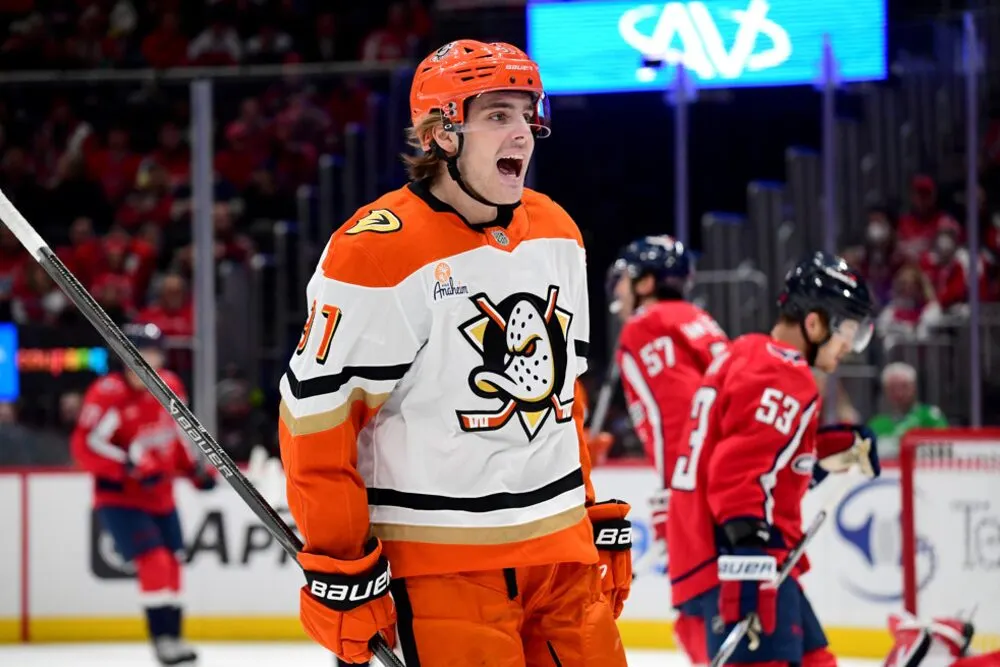


Nearly a third of the league will open training camp without a C on any sweater. Anaheim, Boston, Chicago, Columbus, Los Angeles, the Islanders, Ottawa, San Jose, St. Louis and Vancouver all have the letter sitting in a drawer, which is believed to be the most simultaneous vacancies in the history of the sport. It is the kind of statistic that sounds like trivia and is actually a snapshot of a league changing hands.
| Player | Team | Points | On-ice xGF% |
|---|---|---|---|
| Zach Werenski | CBJ | 81 | 55% |
| Leo Carlsson | ANA | 67 | 57% |
| Macklin Celebrini | SJS | 115 | 58% |
| David Pastrnak | BOS | 100 | 56% |
The vacancies are not random. They cluster almost perfectly around two kinds of team: the ones whose long-serving captains have retired or moved on, and the ones whose rebuilds have produced a new generation not quite ready to be handed the room. Both categories describe a league in the middle of a handover, and the empty sweaters are the visible evidence of it.
The candidates say more than the vacancies
Look at who is next in line and the generational point makes itself. Anaheim's obvious answer is Leo Carlsson, a 21-year-old centre who drove a 57 percent share and whose contract already made him the most expensive young player in the sport. San Jose's is Macklin Celebrini, who scored 115 points at 19. Columbus has Zach Werenski, who put up 81 from the blue line. These are not veteran placeholders. They are the players the next decade belongs to, and several of them are barely old enough to rent a car.
Why teams are waiting
The delay is deliberate more often than it is indecisive. Naming a captain is a public, semi-permanent statement about who a franchise belongs to, and getting it wrong is awkward in a way that is hard to undo. Boston has openly discussed going another season without one rather than forcing the choice between Pastrnak and Charlie McAvoy. That caution is defensible: the cost of waiting a year is close to zero, and the cost of anointing the wrong player during a rebuild lingers.
The argument for naming one anyway
The counterargument is that leadership vacuums are not free, whatever the front offices say. Young teams learning how to win benefit from clarity about whose standards set the room, and the act of naming a captain accelerates the maturity it appears to require. Waiting for a player to look ready before giving him the job gets the causation backwards; most captains grow into the role rather than arriving fully formed. Chicago, San Jose and Anaheim in particular have young cores that would probably be better served by a decision than by another year of ambiguity.
What the pattern reveals about the league
Zoom out and the ten vacancies map almost exactly onto the teams in transition, which is a useful and slightly alarming picture. A third of the league is simultaneously between eras, waiting on players in their early twenties to become the figures their franchises organise around. That is a lot of uncertainty concentrated in one moment, and it explains why so much of this offseason has been about young players' contracts rather than veteran movement. The talent is arriving everywhere at once. The authority has not caught up to it.
The honest counter
It is worth resisting the temptation to over-read a letter on a jersey. Captaincy in hockey is largely ceremonial, the actual leadership in a room is distributed among a handful of veterans regardless of who wears the C, and plenty of excellent teams have gone seasons without naming one. The correlation between captaincy decisions and results is essentially nil, and a franchise that agonises over the choice is often revealing more about its own anxiety than about its roster. The vacancies are a symptom of transition, not a cause of anything.
The teams with the hardest choices
A few of these vacancies are genuinely difficult rather than merely delayed, and they are worth separating out. Boston is the clearest case: Pastrnak produced 100 points and is the face of the franchise, but a 47 percent team in transition may not want to anchor its identity to a player whose contract runs into the next era's uncertainty, and Charlie McAvoy has the traditional profile the position tends to reward. Choosing between them means choosing what the Bruins think they are.
Los Angeles faces a different version of the same problem. The Kings are managing the end of the Kopitar era while Adrian Kempe carries the scoring and Quinton Byfield auditions for the middle, and naming a captain in the middle of that would settle a question the organisation has not actually answered. St. Louis has a point-per-game centre in Robert Thomas, a near point-per-game winger in Dylan Holloway, and a roster that finished at 47 percent, which makes the leadership question secondary to a more basic one about direction.
Vancouver's vacancy is the starkest, because a team that surrendered 314 goals is not choosing a captain so much as deciding which player it intends to keep long enough for the letter to mean anything. When a franchise is in that position, the empty sweater is honest rather than indecisive, and rushing to fill it would be a cosmetic answer to a structural problem.
The through-line across all ten is that captaincy has quietly become a statement about roster certainty rather than about leadership qualities, which is why so many teams are waiting. A club that knows who it will be built around in three years names its captain without much agonising. A club that does not know leaves the letter in the drawer, and this season a third of the league is telling you, without saying it, that it has not decided yet.
Where this lands
Ten empty sweaters is a record, and records like this one usually mark a turning point rather than a coincidence. The league is handing itself over to players who were in junior hockey three years ago, and the franchises doing the handing are understandably nervous about making it official. Expect most of these to be filled within two seasons, and expect the names to be young. When the list is complete, it will be the clearest possible map of who the next decade of hockey actually belongs to.