
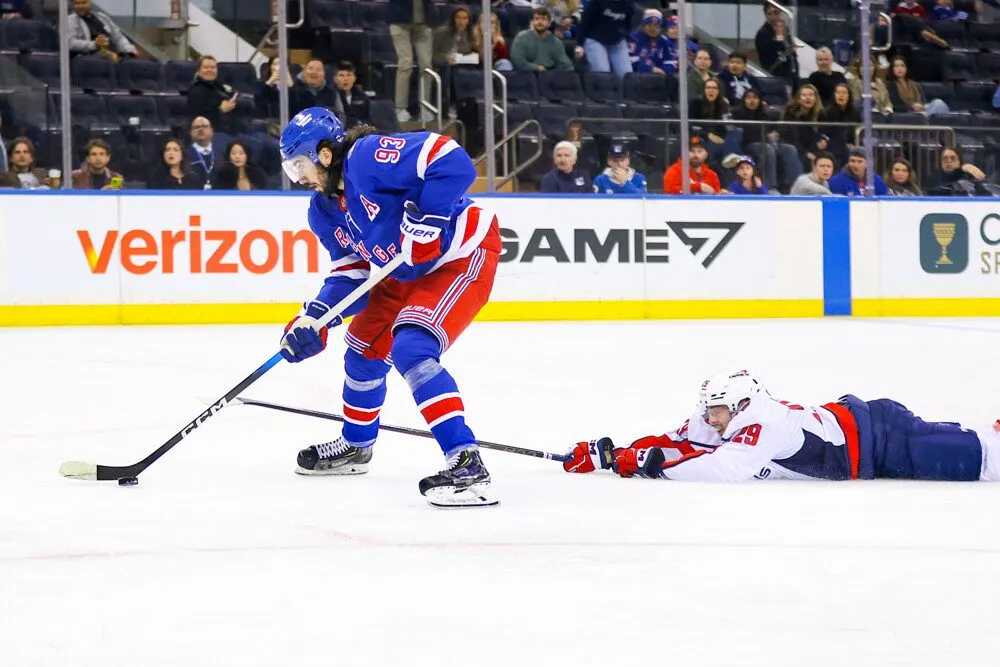

New York has spent two years conducting a public search for what went wrong, and the search keeps returning the same suspects: the veterans are too old, the contracts are too big, the core has gone stale. It is an emotionally satisfying story and it has the disadvantage of being contradicted by the box scores. The player most often named in it just scored 34 goals and led the team in points, which is a strange thing for a problem to do.
| Player | Games | Goals | Points | On-ice xGF% |
|---|---|---|---|---|
| Mika Zibanejad | 81 | 34 | 78 | 51% |
| Alexis Lafreniere | 82 | 24 | 57 | 54% |
| Adam Fox | 55 | 9 | 53 | 60% |
| J.T. Miller | 68 | 17 | 53 | 50% |
| Vincent Trocheck | 67 | 16 | 53 | 46% |
Zibanejad played 81 games, scored 34 goals, and produced 78 points on a team that managed 235 in total. He was, by a distance, the most productive forward on the roster. Meanwhile the Rangers controlled 47 percent of the expected goals and were outscored 249 to 235, which is the profile of a team with a structural problem rather than a personnel problem at the top of its lineup.
Where the season actually went
The honest accounting points at two things, neither of which is the veteran forward group. The first is availability: Adam Fox played 55 games and posted a plus-23 on-ice swing, meaning New York played like a contender when he dressed and a lottery team when he did not. The second is that Igor Shesterkin saved 21.3 goals above expected and it barely mattered, because the group in front of him bled chances. A team with an elite goaltender and a plus-23 defenceman finishing at 47 percent has a middle-of-the-roster problem, not a stars problem.
The Zibanejad case, specifically
His 51 percent on-ice share is not spectacular, and the criticism that he does not tilt the ice the way an elite centre should has some basis. But 51 percent on a 47 percent team is four points better than the group he played inside, and 34 goals across a full season at his age is genuinely valuable production that the Rangers would struggle to replace. The gap between how he is discussed and what he produced is one of the larger disconnects in the league right now.
Why the narrative sticks
Big contracts attract blame in a way that performance does not dislodge, particularly in New York, where the discourse runs hot and the veteran core has been together long enough for familiarity to curdle. Once a player becomes the symbol of a stale era, his production gets read as insufficient regardless of its actual level, and every ordinary game confirms the thesis while the good ones get filed as exceptions. That is how a 34-goal season disappears into a conversation about who needs to go.
What the Rangers should actually fix
The fixable problem is depth and structure. Vincent Trocheck's 46 percent share was the genuine concern in that table, and New York has already moved him to Utah, but the bottom six generated little and the blue line behind Fox could not hold up when he missed games. Those are addressable through targeted additions rather than a teardown of the top six, and they are considerably cheaper to solve than replacing a 34-goal centre would be. New York's roster does not need dismantling. It needs the middle rebuilt around the parts that work.
The honest counter
The case for change is not empty, and it deserves more than dismissal. This core has now had several seasons to prove it can win and has not, ageing veterans on long contracts get worse rather than better, and a 51 percent share from a top centre is good rather than great. There is a legitimate argument that the Rangers should sell high on production like Zibanejad's precisely because it is unlikely to repeat at 33, and that continuity is how teams sleepwalk into irrelevance. Betting on the current group is a bet on health and improvement rather than talent acquisition.
The trap of blowing it up
The scenario the Rangers should genuinely fear is not another disappointing season; it is an overcorrection. A team convinced its veterans are the problem trades them at their lowest reputational value, acquires futures, and discovers eighteen months later that it dismantled a top six while the actual deficiencies, the third pair and the bottom six, remained exactly where they were. New York has the assets and the market position to make that mistake at speed, and the public appetite for it is already there.
The countervailing evidence is the goaltending. A team with Igor Shesterkin in his prime does not have the luxury of a two-year retool, because elite netminding is the shortest-lived and hardest-to-replace advantage in the sport. Every season the Rangers spend rebuilding is a season of that advantage evaporating, which is why the aggressive-but-targeted path, keep the core, fix the middle, is almost certainly the correct one even for people who think this group has underachieved.
What a targeted fix looks like is not glamorous. A second-pair defenceman who can hold up when Fox is unavailable, a third-line centre who does not concede territory, and enough bottom-six competence that the 47 percent number climbs toward break-even. None of those moves generates a headline, all of them are affordable, and collectively they address the actual gap between how the Rangers played and how their talent suggests they should have.
The reason it will not happen that way, probably, is that unglamorous fixes do not satisfy a market demanding accountability. New York's discourse wants a name to blame and a big move to answer it, and the front office operates under that pressure. But the numbers keep pointing at the same conclusion: this roster's stars produced, its goaltender was excellent, and it still finished at 47 percent, which means the problem is distributed across the parts of the lineup nobody is arguing about.
Where this lands
New York's failure was a 47 percent team with an elite goaltender and an injured franchise defenceman, which is a specific and largely solvable diagnosis. Instead the conversation keeps circling the veterans, and the loudest version of it names a player who just scored 34 goals in 81 games. Mika Zibanejad is not what went wrong with the Rangers. Continuing to insist otherwise is how a team spends another summer fixing the wrong thing and wonders in April why nothing changed.