
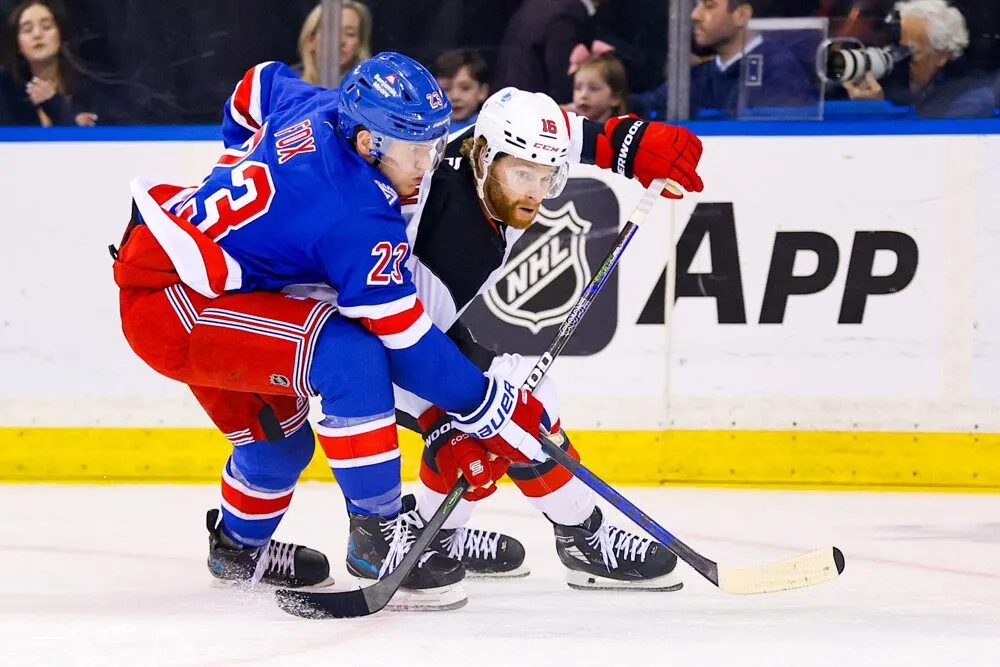

The bounce-back lists are out this week, and they are full of forwards. Scan them for the player whose return to health would actually move a team the furthest and you will not find him among the snipers. He is a defenceman in New York who played 55 games last season, and the numbers he posted in those 55 games are the quiet outline of the best comeback story of the coming season. Adam Fox, healthy, is the biggest single swing factor in the Eastern Conference, and almost no one is pricing it in.
| Metric | Number | The read |
|---|---|---|
| Points in 55 games | 53 | Point-per-game pace from the blue line |
| Rangers xGF% with Fox on ice | 60% | Contender-level hockey |
| Rangers xGF% without him | 37% | Lottery-level hockey |
| Team season share | 47% | Dragged up by one man |
Sit with the middle rows of that table, because numbers like these are rare. With Fox on the ice, the Rangers controlled 60 percent of the expected goals, hockey that would rank with the best teams in the league. Without him, 37 percent, a figure that would embarrass the worst. A plus-23 swing is not a good season; it is a statistical anomaly, the kind of gap that normally only shows up in small samples or around generational players. Fox produced it across 55 games while playing hurt on a sinking team.
The wasted season, revisited
I wrote about the Rangers' wasted season around Igor Shesterkin, and the Fox numbers complete that autopsy. New York finished at 47 percent with 235 goals for and 249 against, and the entire respectable half of that profile happened during one defenceman's shifts. The roster around the stars aged, J.T. Miller and Vincent Trocheck posted middling impact years, and the structure sagged everywhere Fox was not. The season was not wasted because the Rangers lacked talent. It was wasted because their two best players, the goalie and the defenceman, spent it holding up a building while management watched.
Why health changes the whole equation
Here is the math the bounce-back lists are missing. Twenty-seven more games of Fox is not a marginal upgrade; it converts a quarter of the season from 37 percent hockey to 60 percent hockey, which is worth more in the standings than any plausible free-agent addition. Teams spend first-round picks and cap fortunes at the deadline for rentals who move their share by two points. The Rangers get a 23-point on-ice swing back by a medical clearance. If Fox plays 75 games, New York's underlying numbers improve more than any team in the conference without making a single move, and that is the definition of a swing factor.
The fragility in the bet
The honest counterweight: this case leans on health, and health is the one thing no one can project. Fox's game is built on timing, angles and elite processing rather than raw speed, which usually ages well, but defencemen coming off injury-shortened seasons carry real risk, and another 55-game year makes all of this moot. There is also a harder question underneath: a plus-23 swing partly measures how bad the Rangers were without him, and a properly built roster should not be a lottery team the moment one defenceman sits. Fox returning fixes the ceiling. It does not fix the fragility that made his absence so catastrophic, and that part is on management.
What New York should do about it
The practical read for the Rangers is urgency. A healthy Fox and an elite Shesterkin give New York a two-man foundation most contenders would trade their futures for, and both are in their primes now, not indefinitely. The supporting structure that collapsed to 37 percent without Fox needs genuine reinforcement, a second pair that can tread water, forwards who tilt the ice on their own shifts, because the margin between a bounce-back season and another waste is whether the stars have to be perfect. Teams with foundations like this either build around them promptly or spend the following years explaining why they did not.
The Norris conversation waiting to happen
There is a version of this season that ends with Fox back in the Norris conversation, and it is less speculative than it sounds. The award has always followed a formula, point production plus narrative plus team success, and a healthy Fox checks every box at once: point-per-game pace from the blue line is already established at 53 in 55, the comeback narrative writes itself, and the team-success component arrives automatically because, as the on-off numbers prove, the Rangers winning and Fox playing are close to the same event. Voters love a redemption arc attached to elite numbers, and no defenceman in the league enters the season with a cleaner setup for one.
The tactical dimension deserves attention too, because Fox's value compounds in the specific ways New York needs. The power play that sagged without his distribution gets its quarterback back. The breakout structure that collapsed into chip-and-chase without his first pass gets its exit valve back. Shesterkin, who spent last season facing the volume of a lottery-team workload behind a 37 percent group, gets the shot suppression that makes elite goaltending sustainable rather than heroic. One player restoring three systems at once is what a plus-23 swing looks like mechanically, and it is why the bounce-back math is not linear. Fox does not add to the Rangers; he multiplies them.
The comparison worth making is with the rest of the East's improvement bets. Contenders spent the summer paying premium prices for marginal gains, while the conference's largest single upgrade costs New York nothing but health. That asymmetry is the entire preview case for the Rangers: everyone else improved by addition and hope, and New York improves by subtraction of an injury. The lists that rank offseason winners never include medical clearances. This one would top the table.
Where this lands
The preseason conversation will keep ranking forwards on the comeback lists, and the actual answer will keep being a defenceman who played 55 games. Adam Fox at full health restores point-per-game production and the best on-ice impact numbers in the sport to a team whose season died specifically in his absence. No addition available to any Eastern contender this summer moves the needle further than that. The Rangers' bounce-back case is real, it is enormous, and it rests on the health of one player the lists keep forgetting to mention.