
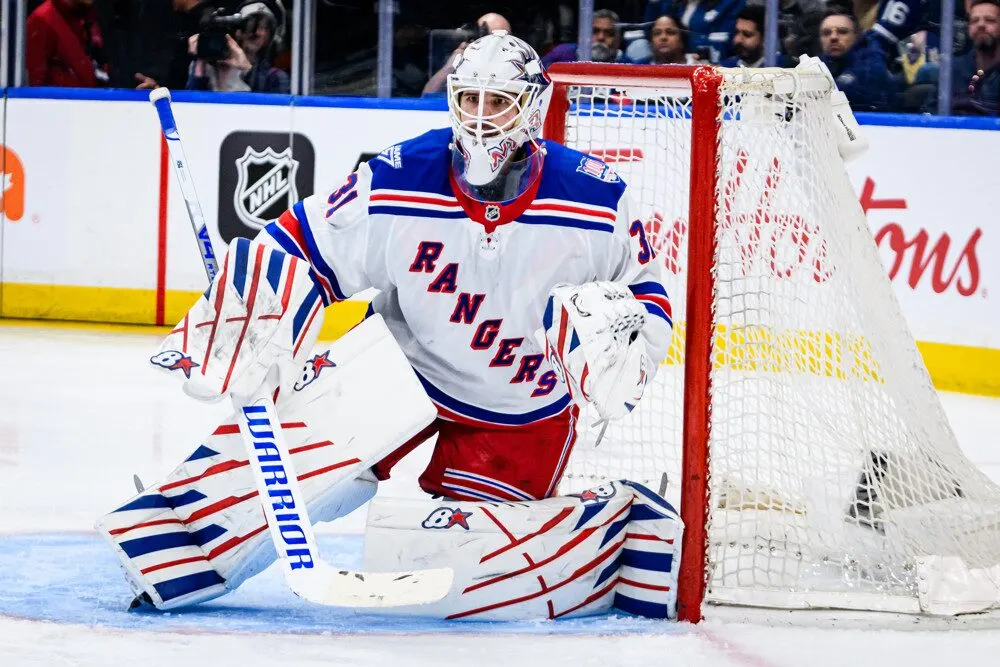

Every so often a team gets elite performances from the two hardest positions to fill and finishes nowhere, and the result is more damning than any blowout. That was the Rangers last season. Igor Shesterkin saved 21 goals above expected, one of the three or four best goaltending seasons in the league. Adam Fox, when healthy, drove a 60 percent on-ice share, a Norris-caliber number from the back end. And New York finished near the bottom of the Eastern Conference anyway, because everything in front of the goalie and around the defenceman stopped controlling the run of play.
| Piece | Number | The read |
|---|---|---|
| Igor Shesterkin goals saved above expected | +21.3 | One of the best crease seasons in the league |
| Adam Fox on-ice xGF% | 60% | Norris-level when healthy |
| Team 5-on-5 share | 47% | Bottom of the pack in the run of play |
| Result | Near the East basement | A top goalie and defenceman wasted |
The waste, quantified
Start with what New York got right, because it makes the rest worse. A goalie saving 21 above expected is the kind of season most rebuilds would trade a first-round pick to rent. Fox at a 60 percent share against a team that was 37 without him is one of the widest defenceman swings in the league, the mark of a genuine number-one blueliner. Those two did their jobs at an All-Star level. The team around them controlled just 47 percent of the expected goals, one of the worst marks among clubs with any playoff pretension. When your goalie and your best defenceman are that good and you still get outplayed most nights, the problem is not the crease or the blue line. It is the group in the middle.
The forwards stopped driving play
This is where the season died. Mika Zibanejad scored 78 points, but the Rangers were a 51 percent team with him on the ice and 44 without, respectable rather than dominant. Below him it thins fast. Vincent Trocheck sat at 46 percent. Will Cuylle, a 20-goal scorer, was on the ice for just 43 percent of the chances. The wingers who once made this team a nightly problem either aged, left, or stopped tilting the ice, and no amount of Shesterkin brilliance fixes a forward corps that surrenders more than it creates. Artemi Panarin, long the engine of the attack, is gone, and the reshape that brought in J.T. Miller (50 percent) has not yet changed the underlying math.
The trap New York has to avoid
Here is the danger, and it is a reputation trap in reverse. Washington turned a season like this into a playoff berth, riding an elite goalie to points its underlying play did not earn. The Rangers got the same gift and finished near the basement anyway, which is somehow worse, because elite goaltending papers over structural problems just enough to keep a front office from confronting them. Shesterkin is good enough to steal a fistful of games a year, which can turn a 47 percent team into one that hovers near the cut line and convinces itself it is a tweak away. It is not a tweak away. A team that gets a top-three goalie season and a Norris-level defence season and still finishes here has a foundational issue in its forward group.
Going into the season
The pieces at the hard positions are in place, which is exactly why the wasted season stings. New York does not need a goalie or a franchise defenceman; it has both, and both are excellent. What it needs is to rebuild a forward group that drives play, and the early moves have been lateral rather than transformative. Until that changes, the Rangers are a team with two of the best individual seasons in hockey and a record that makes no sense next to them. Shesterkin handed them a gift last season. They left it in the box.