
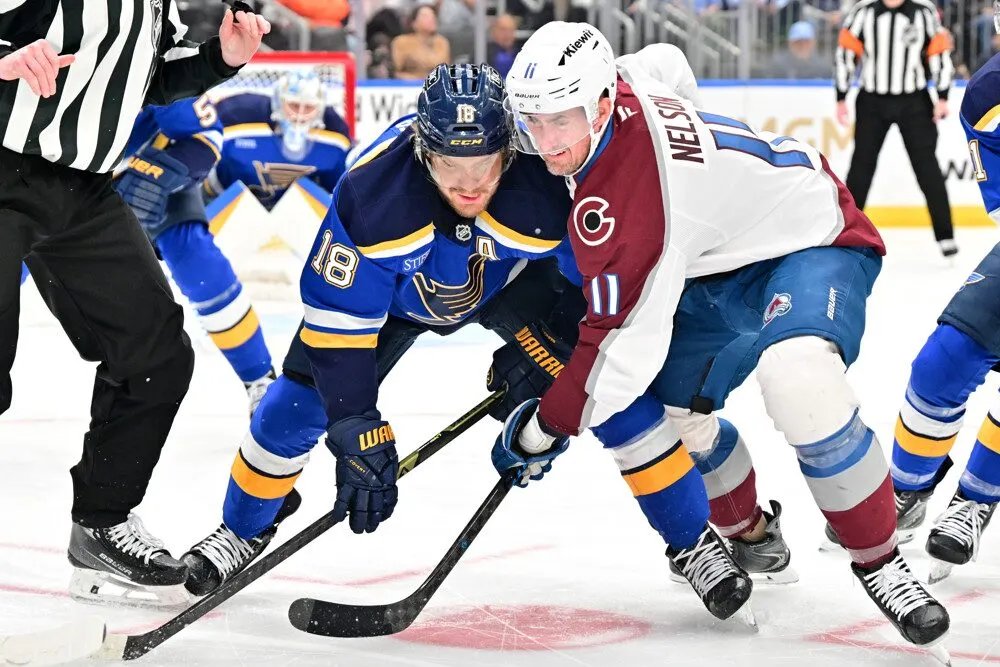

The Blues occupy a strange space in the league's imagination: a team nobody predicts anything for, good or bad, whose name surfaces mostly in goaltending jokes. That reputation is doing real work to obscure what is actually on the roster. St. Louis employed two players producing at a point per game last season, both of whom drove play at genuinely high levels, and the reason nobody talks about it is that the team around them kept losing anyway.
| Player | Games | Points | On-ice xGF% |
|---|---|---|---|
| Robert Thomas | 64 | 64 | 54% |
| Dylan Holloway | 59 | 51 | 56% |
| Pavel Buchnevich | 81 | 48 | 47% |
| Jordan Kyrou | 72 | 46 | 59% |
Robert Thomas produced 64 points in 64 games at a 54 percent share, nine points above a St. Louis team running 45 without him. Dylan Holloway went 51 in 59 with an even better 56 percent mark and a plus-12 swing. Two players, both missing time, both producing at a rate that would headline most middle-class rosters, on a team that finished at 47 percent and got outscored 254 to 230. The talent is not the problem in St. Louis. Something else is.
What the Blues actually are
Strip away the reputation and the picture is coherent: a team with a legitimate first-line centre, a genuine breakout winger, useful complementary scorers, and nothing else working. The 47 percent share says the group as a whole gets out-chanced, the goal differential says the results followed, and Jordan Binnington's season explains a good chunk of the gap between the two. A team can survive one broken component. St. Louis has a good top end sitting on top of a roster that leaks everywhere else.
The Holloway case is the interesting one
Thomas being good is not news to anyone paying attention; he has been a quality first-line centre for years. Holloway is the genuinely new information. Fifty-one points in 59 games, a 56 percent share, a plus-12 on-off swing at an age where wingers are still ascending, and he arrived in St. Louis as a player his previous organization decided it could live without. Whatever the Blues have done poorly, extracting a legitimate top-six forward out of another team's spare parts is a real piece of scouting work, and it is the kind of asset a retool gets built around.
The Kyrou complication, and how St. Louis resolved it
Then there was Jordan Kyrou, whose 59 percent on-ice share looked superb until you noticed the 46 points in 72 games. I have argued before that his reputation as a defensive liability is the myth, and the split remained awkward all season: strong territorial numbers, production that kept failing to match them. On a team with this little scoring margin, the difference between Kyrou at 46 points and Kyrou at 65 was most of the gap between missing the playoffs and making them. St. Louis decided not to wait for the gap to close. On June 23 the Blues traded Kyrou to Washington for Connor McMichael, Milton Gastrin and the No. 16 pick, and three days later they turned the No. 15 and No. 29 picks into Mason McTavish from Anaheim. The front office, in other words, read the 46 points as the signal and the 59 percent as the noise, and swapped a play-driving winger whose finishing it no longer trusted for a centre it hopes will produce. That is the bet. Whether McTavish and McMichael can replace the best on-off swing on the roster is now the most important unanswered question in the forward group.
Why the reputation lags the roster
The Blues are underrated for a boring reason: results. Preview writers work backward from the standings, and a team that finished poorly with an ugly goal differential gets sorted into the ignore pile regardless of what its best players did. That is usually correct as a heuristic and wrong in specific cases, and St. Louis is one of them, because the underlying flaw sits in the crease and the depth rather than the top of the lineup. Fix the goaltending and this becomes a team with two point-per-game players and a competitive structure, more or less overnight.
The honest counter
The caveat is availability, and it is not a small one. Thomas played 64 games and Holloway 59, so both point-per-game rates come with an asterisk about whether they can sustain that production across a full 84-game schedule, which is longer than anything either has completed. Per-game rates flatter players who miss time, and the Blues' actual problem last season was partly that their best forwards were not on the ice enough. Two healthy stars would change the math. Two frequently injured stars are how a team ends up exactly where St. Louis finished.
What St. Louis should do
The path is narrow but obvious: solve the crease, because everything else here is fixable or already fine. A 47 percent team with two point-per-game forwards does not need a teardown; it needs to stop giving away the goals its scoring earns. Beyond that, the front office should treat Holloway as a keeper rather than a trade chip, and find out quickly whether McTavish and McMichael can carry the territorial game that left for Washington with Kyrou. None of that requires another blockbuster; the Blues have already made theirs. It requires accurately identifying which parts of the roster are actually broken, which is precisely what the outside conversation has failed to do.
The cost of being ignored
There is a practical penalty for a team whose good players go unnoticed, and St. Louis is paying it. Underrated players are underrated by other front offices too, which means the Blues would struggle to get full value if they ever chose to sell, and it means their own internal evaluations risk drifting toward the outside consensus. Organisations that spend years being told they have nothing sometimes start believing it, and that is how a club trades a point-per-game centre for a package that looks reasonable at the time and disastrous three seasons later.
The inverse opportunity is more interesting. A team that correctly identifies value the market has not noticed can extend those players before the price corrects, which is exactly the position St. Louis holds with Holloway. A 24-year-old who produced 51 points in 59 games with a plus-12 swing is going to be expensive eventually; he is affordable now precisely because he plays on a team nobody watches. That gap between perception and production is the cheapest asset a front office can exploit, and the Blues are sitting on it.
The strategic question underneath all of this is whether St. Louis knows what it is. A 47 percent team with two point-per-game forwards is not a rebuild and not a contender, and the trap for clubs in that space is drifting, making moves that neither commit nor retreat. The clarifying decision is the crease: solve it and this roster is worth pushing, leave it and the top six is being wasted. What the Blues cannot afford is another season of ambiguity while Thomas and Holloway spend their best years producing for a team going nowhere in particular.
There is also a fanbase dimension that matters more than analytics people like to admit. Teams that go unnoticed lose attention, and attention is what makes young stars into marketable ones and keeps buildings full through mediocre seasons. St. Louis has two genuinely exciting players and has generated almost no excitement, which is a marketing failure layered on top of a hockey one. Winning would fix both, and the path to winning runs through the least glamorous position on the roster.
Where this lands
St. Louis is not a good team, and nothing here argues otherwise. But the reason it is not good has almost nothing to do with Robert Thomas and Dylan Holloway, who spent last season producing at a rate that would make them the story on most rosters. The Blues are a goaltending problem and a depth problem wrapped around a legitimate top six, and that is a far more fixable situation than the silence around them suggests. Somebody is going to notice these two eventually. It would be useful for St. Louis if that somebody were the people running the team.
Correction, September 7, 2026: The original version of this article discussed Jordan Kyrou as a current member of the St. Louis Blues and described improving his production as a fix that did not require a trade. That was wrong. St. Louis traded Kyrou to the Washington Capitals on June 23, 2026, for forwards Connor McMichael and Milton Gastrin and the No. 16 pick in the 2026 draft, and on June 26 acquired Mason McTavish from Anaheim for the No. 15 and No. 29 picks. The Kyrou section and the recommendations section have been rewritten to reflect the trades. The statistical analysis of the 2025-26 season is unchanged.