
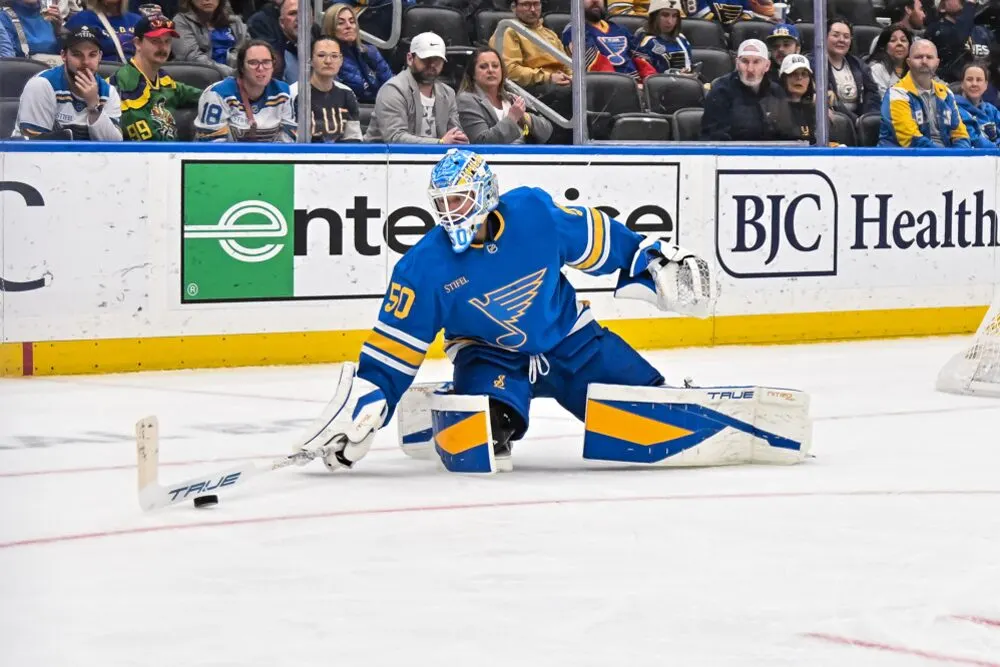

Reputation is the most powerful force in goaltending, and Jordan Binnington has one of the best in the business. A Cup-winning run, big moments on the international stage, the aura of a money goalie who rises when it matters. That reputation is why he keeps getting the net in St. Louis. The numbers from last season say the reputation and the goalie have come apart, and it is not close.
| Goalie | Games | Goals saved above expected | The read |
|---|---|---|---|
| Jordan Binnington | 41 | -22.4 | Worst mark in the NHL |
| Joel Hofer | 46 | +11.7 | One of the better seasons in the league |
Goals saved above expected is the cleanest measure of a goalie, because it accounts for the quality of every shot faced and strips out the team in front of him. By that measure, Binnington did not have a mediocre season. He had the worst season of any goalie in the NHL, allowing 22 goals more than an average netminder would have on the same shots. That is not a slump inside a good year; across 41 games it is the floor falling out, and it happened the same season I was elsewhere praising the goalies who actually stole seasons.
The soft-goal problem
Here is the detail that should worry St. Louis most. Binnington's numbers on high-danger chances, the shots from the slot and the doorstep where any goalie is expected to struggle, were essentially league-average; he allowed 36 on 37.4 expected. The damage came everywhere else. A goalie who holds his own on the hardest shots but finishes 22 goals underwater is, by definition, leaking on the medium and long-range shots he is supposed to stop, the routine pucks that quietly lose hockey games. Elite goaltending is built on stopping the stoppable, and that is exactly where he bled.
The backup is the story
None of this would sting so much if St. Louis had no alternative. It has an excellent one. Joel Hofer, the backup the Blues use sparingly, saved nearly 12 goals above expected across a similar workload, one of the better goaltending seasons in the league and a swing of more than 30 goals from Binnington's rate. Over a full season, the difference between those two crease profiles is the difference between a playoff team and a lottery one. St. Louis controlled just 47 percent of the expected goals as a team last season, a group that could not afford to be sabotaged in its own net, and it was, by the goalie it trusts most.
The honest counter
Goaltending is famously volatile, and one bad year does not erase a career; there is a real chance Binnington bounces back toward his established level, and his pedigree in the biggest games is not nothing. It is also fair to note that a 47 percent team hangs its goalies out to dry, and some of the ugly total is the roster's fault, not his. But that cuts toward the same conclusion, not away from it. A team this thin in front of its goalies cannot carry a starter who finished last in the league in the one thing a goalie is there to do, especially when a cheaper, better option is already on the roster.
What St. Louis should do
Play the goalie who stops the puck. The Blues do not need a trade or a splashy signing to fix their crease; they need to stop deferring to reputation and give Hofer the net he earned. Binnington may well rediscover his form, and if he does, a strong tandem is a luxury. But the decision to keep running out the goalie who cost the team more than any other in hockey, over the one who saved it a dozen, is the kind of loyalty to a name over a number that quietly ends seasons. The data made the call months ago. St. Louis just has to listen.