
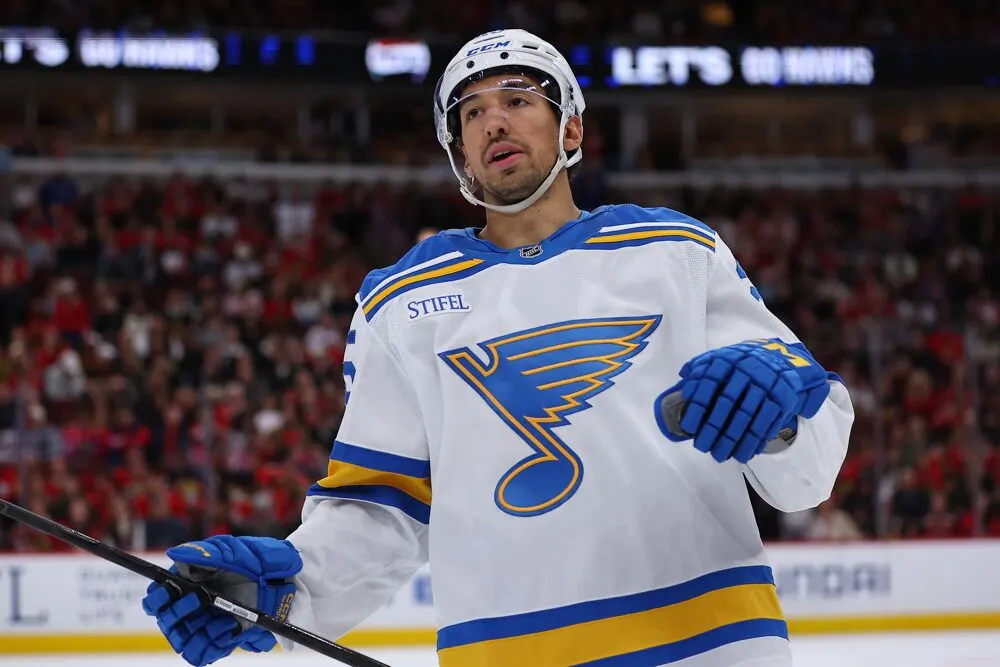

Some reputations outlive the evidence, and Jordan Kyrou has one of them. For years the book on the winger, who spent last season with St. Louis before the Blues traded him to Washington in June, has been the same: dazzling with the puck, a turnstile without it, a scorer you tolerate defensively rather than trust. It gets repeated so often it has hardened into fact. The numbers from last season say the fact is wrong, and not by a little.
| Metric | Number | The read |
|---|---|---|
| Reputation | Defensive liability | The book on him for years |
| On-ice xGF% | 59% | St. Louis controls play with him out there |
| Team without him | 44% | A fifteen-point on-off swing |
| The verdict | Driver | The tape and the data disagree with the book |
With Kyrou on the ice, the Blues controlled 59 percent of the expected goals. Without him, that fell to 44. A fifteen-point on-off swing is not what a defensive liability produces; it is what a genuine driver produces, and it put Kyrou among the more impactful wingers in the league by the measure that actually captures two-way play. The reputation was built on the occasional highlight-reel giveaway, the kind that sticks in the memory precisely because it is spectacular. What the memory misses is the ninety other shifts a night where Kyrou pushed the play the right way, and those shifts, added up across a season, are the fifteen-point swing.
This is not a fluke of a good team
The obvious objection is that on-ice numbers get flattered by weak competition or a strong supporting cast, so be clear: neither applies here. St. Louis was a 47 percent team overall, so Kyrou was not being carried by a dominant roster. If anything the reverse is true. He was one of the few Blues genuinely tilting the ice on a group that got out-chanced most nights, which makes the 59 percent more impressive rather than less. A driver on a good team is expected. A driver on a mediocre one is doing something harder.
The honest version of the criticism
To be fair to the scouting report, it is not invented out of nothing. Kyrou does have lapses, the puck-management gambles that lead to odd-man rushes the other way, and he is not a Selke-track defensive specialist who kills penalties and smothers the other team's best line. But there is a wide gulf between not elite defensively and defensive liability, and the label has him on the wrong side of it. The net of everything he did last season, the offence he generated and the chances he prevented by keeping the puck at the right end, was strongly positive. A player can be imperfect without the puck and still be one of the biggest reasons his team controlled play. Kyrou was exactly that, and the reputation flattens the nuance into something simply false.
The Blues had a good young core, and then they reshaped it
Kyrou was not alone, which was the encouraging part of St. Louis's season. Robert Thomas quietly ran the top line to 64 points at a 54 percent share. Rookie Jimmy Snuggerud arrived and immediately posted a 55 percent mark, and Dylan Holloway, the reclamation from Edmonton, added 22 goals and a 56 percent share. That was a young, cost-controlled, play-driving top six, the hard part of building a contender, and the Blues had it. Then, on June 23, they sent Kyrou to Washington for Connor McMichael, Milton Gastrin and the No. 16 pick in the 2026 draft, and three days later they spent the No. 15 and No. 29 picks on Mason McTavish from Anaheim. Read together, the two moves say the front office looked at the same winger described above and saw the 46 points rather than the 59 percent: a player whose production never caught up to his territorial game, cashed in for a centre it believes will. That is a defensible bet on McTavish. It is also a front office trading away the best on-off swing on its roster, and it does not change what St. Louis still lacks: a blue line that holds up and a starting goaltender who stops the puck.
The crease is the actual problem
| Goalie | Games | Goals saved above expected | The read |
|---|---|---|---|
| Joel Hofer | 46 | +11.7 | One of the better seasons in the league |
| Jordan Binnington | 41 | -22.4 | The worst mark in the NHL |
If you want the real reason St. Louis was a 47 percent team that missed rather than a rising one that made noise, it is not Kyrou's defence. It is the crease, and it is stark. Joel Hofer saved almost 12 goals above expected, a genuinely good season. Jordan Binnington gave back more than 22, the worst mark in the entire NHL, and I broke down that collapse in detail earlier this summer. When your nominal starter finishes 22 goals underwater and your better option is the backup, the team pays for it in exactly the standings positions that separate a playoff club from a lottery one. Kyrou drove play at a 59 percent clip and then watched stoppable pucks go in behind him. Blaming the winger for St. Louis's defensive results is looking at the wrong end of the ice entirely.
The window was there, and St. Louis chose to redraw it
There is a timeline pressure here that sharpens the point. St. Louis's best forwards are young and cost-controlled: Thomas, Snuggerud and Holloway, now joined by McTavish and McMichael, are the kind of core a team builds a five-year window around, and windows like that get wasted one year at a time when the pieces around them fail. The Blues have already spent their most valuable trade chip on reshaping the forward group; what they have not done is fix the two positions that actually sank them. They cannot afford another season of feeding starts to a goaltender who finished last in the league while a young top six enters its prime in front of him. The fix is not expensive in assets so much as in ego: commit to Joel Hofer, add a defenceman who can defend, and let the possession game the forwards already play show up on the scoreboard. A team that controlled 47 percent of the chances with this much young talent is not far from one that controls 52, and the difference is almost entirely in the crease and the top four. The clock on the young core has started. The Blues should act like it.
What it means going into the season
The Blues are a more interesting team than their record, and the path forward is clearer than the noise around it. They have a young top six that controls play, one that will now need McTavish and McMichael to replace the territorial work of a winger the league still underrates because it keeps reciting a scouting report from three years ago. What they need is not to fix a forward group they have already rebuilt. It is to give Joel Hofer the net he earned, to add a top-four defenceman who does not bleed chances, and to trust that the underlying game their forwards already produce will show up in the standings once the crease stops sabotaging it.
None of that requires a dramatic rebuild. It requires the front office to read its own team accurately, which starts with retiring the tired story about the winger it just traded. Jordan Kyrou was not the problem in St. Louis. He was one of the reasons the Blues were closer to good than anyone outside the room seemed to think, and if he spends this season in Washington proving the defensive-liability label obsolete, it will say as much about the Blues' read of him as it does about his.
Correction, September 7, 2026: The original version of this article described Jordan Kyrou as a current member of the St. Louis Blues and framed the Blues' outlook for 2026-27 around a core of Thomas, Kyrou, Snuggerud and Holloway. That was wrong. St. Louis traded Kyrou to the Washington Capitals on June 23, 2026, for forwards Connor McMichael and Milton Gastrin and the No. 16 pick in the 2026 draft, and on June 26 acquired Mason McTavish from Anaheim for the No. 15 and No. 29 picks. The excerpt, the sections on the Blues' young core and their window, and the closing section have been rewritten to reflect the trades. The statistical analysis of the 2025-26 season is unchanged.