

 Chicago Blackhawks
Dylan Larkin left the Red Wings on Thursday, and Detroit suspended him without pay. He asked for a trade in May, and the reporting this week was simple: he will not play again until he is moved. Interim general manager Shawn Horcoff said that evening he is "prepared to wait as long as necessary" for the right return, and that Larkin "no longer wants to be a Red Wing." Detroit then beat Chicago 4-1.
The obvious fear is that Detroit has just lost its captain and its No. 1 centre, has missed the playoffs ten seasons running, and now has to sell from weakness. The numbers point the other way. Detroit is one of the better five-on-five teams in the league, its best line has not included Larkin, and its real problems would still be there if he came back tomorrow.
How good is Detroit without the drama?
Good at five-on-five. The Red Wings have 55 per cent of the expected goals at five-on-five, seventh in the league, and 54 per cent of the shot attempts, sixth. They allow 2.15 expected goals per 60 minutes, fifth-fewest. That is a team that controls games.
It is 6-4-3 because it cannot finish. Detroit is shooting 7.6 per cent at five-on-five, 28th, and has scored 6.3 fewer goals than its chances were worth. It has outscored opponents only 22-20 at five-on-five despite carrying play most nights. This is a familiar story in Detroit. In September we wrote that Detroit's problem last season was finishing, and the finishing has not fixed itself yet.
Was Larkin driving that?
Some of it, but less than his role suggests. Detroit had 56 per cent of the expected goals with Larkin on the ice and outscored opponents 5-4 in his minutes, which is good without being exceptional. His most-used line, with Viktor Arvidsson and Lucas Raymond, had 55 per cent over 72 minutes and was outscored 3-1.
The line that has carried Detroit does not include him.
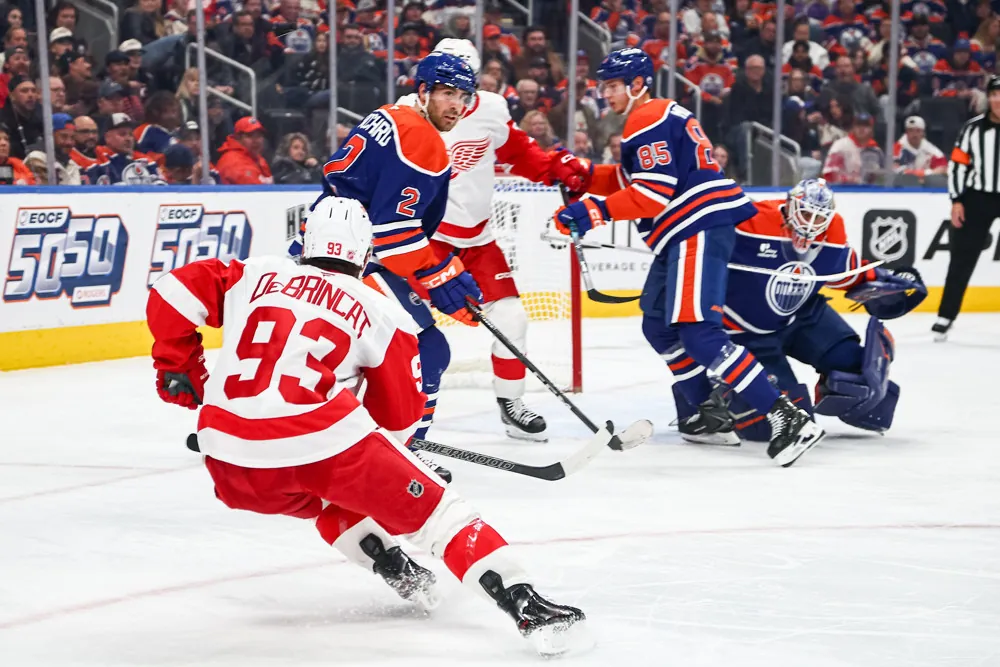
Alex DeBrincat has six goals and 15 points, and Detroit has outscored opponents 14-4 with him on the ice at five-on-five. Emmitt Finnie is at 60 per cent and Michael Brandsegg-Nygård at 64. Viktor Arvidsson leads the team with eight goals and has the sixth-most individual expected goals in the league. Lucas Raymond has 12 points.
Detroit went 5-2-3 in the ten games Larkin played and is 1-2-0 in the three he has missed. That is too small a sample to say much either way, but the five-on-five profile says this is a team with enough forwards to stay competitive while Horcoff waits.
So what does Detroit actually need?
A penalty kill. Detroit has allowed 13 goals at four-on-five, a rate of 12.20 per 60 minutes that ranks 25th, and its goaltenders have stopped 74.5 per cent of shots on the kill, 30th. The chances it allows shorthanded are 24th. It is the clearest weakness on the roster.
The crease is better than it looks in that light. John Gibson has an .874 save percentage across all situations, but at five-on-five it is .913 and 1.7 goals above expected. Most of his damage has come on the penalty kill. Daniil Tarasov has been the best goaltender on the team in four appearances, at .940 and 5.1 goals above expected.
| Detroit goaltending, 2026-27 | Games | Save % | Five-on-five save % | Goals saved above expected |
|---|---|---|---|---|
| John Gibson | 9 | .874 | .913 | -3.2 |
| Daniil Tarasov | 4 | .940 | .950 | +5.1 |
A Larkin trade that returns a defenceman who can kill penalties, or a centre who wins defensive-zone draws, would address the actual problem. A trade that simply recovers a first-round pick would not.
What is Larkin worth?
Less than a captain's reputation, more than his start. Larkin is in the fourth year of an eight-year contract worth $8.7 million a season, has a no-trade clause with a reported list of about ten teams, and had two goals and six points in ten games before leaving. In early October we wrote that the market saw Larkin as a power-play centre, and that is still the most likely buyer's view. Horcoff has said a deal would be easier if Larkin added teams to his list.
The case for patience, stated fairly
The argument for moving him quickly is that a suspended captain is a distraction, the return will not improve with time, and every week without a deal is a week without a centre in the lineup. Larkin has played 818 games for Detroit and is tenth in franchise scoring. Teams do not usually get better by sitting their best-known player.
The other side is that Detroit's five-on-five play has not needed him to be good, that the shooting will come back, and that the buyers with the most to offer are often the ones who wait until a contender loses a centre to injury in December. Horcoff has leverage because the team is playing well, and he loses it the moment he looks desperate.
Our view is that Horcoff is right to wait, and that the price should be a player who fixes the penalty kill rather than a pick. In the meantime, Todd McLellan should keep the DeBrincat line together and give Tarasov a larger share of the starts.
What to watch
St. Louis visits on Saturday afternoon and Detroit is in Florida on Monday. Watch the penalty kill in both games, and whether the shooting percentage starts to move. Every Red Wings number is on the team stats page, and the Atlantic race is on the standings.