

 Boston Bruins
 Chicago Blackhawks
The Detroit Red Wings missed the playoffs for the tenth consecutive season, the longest drought in the franchise's history, and they did it while being a roughly average hockey team. At 5-on-5 they generated 2.38 expected goals per 60 minutes and allowed 2.50, a 49 percent share, 21st in the league. Ninety-two points, sixth in the Atlantic, four short.
The gap between that team and a playoff team is one number. Detroit scored 19.1 goals fewer at even strength than the quality of its chances said it should have, 29th of 32. Correct that alone, leave everything else exactly as it was, and the Red Wings are in the field.
Which is why the summer is so strange. The one problem with an obvious fix got no attention at all, and everything else on the roster caught fire.
Who missed
The shortfall was not the stars. It was the middle of the lineup, and specifically the young middle of the lineup.
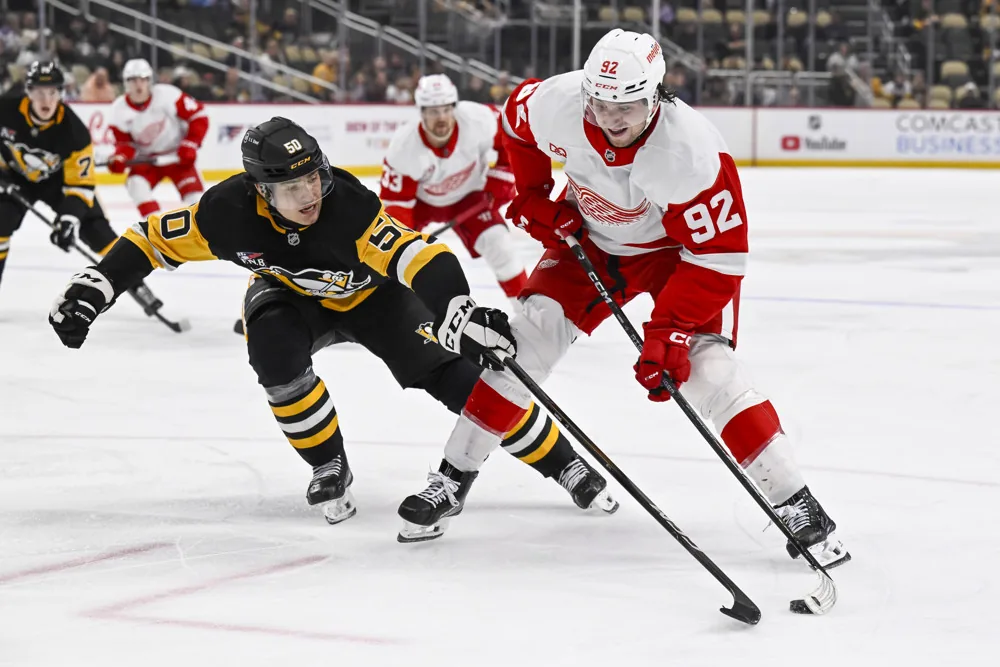
Marco Kasper is the clearest case, and the most important, because he is 22 and the club's centre of the future.
Shooting percentages at that distance from the mean come back. Kasper at his rookie rate on the same shots is a 17-goal player, Copp at league average is a 12-goal player rather than a four-goal one, and the pair of them alone is most of the four points Detroit needed. That is the argument for patience, and it is a strong one.
What Detroit did instead
Almost none of it was about even-strength scoring.
Steve Yzerman was removed as general manager on 15 July, seven years into the rebuild he was hired to run, and the job went to Shawn Horcoff on an interim basis on 15 September, two days before camp. Dylan Larkin requested a trade and is no longer the captain; Detroit opened camp without one. Simon Edvinsson, 23 and the second-best defenceman on the roster, is an unsigned restricted free agent skating in drills but sitting out scrimmages, with roughly $19.5 million of cap space set aside for him and an expected landing zone near $9 million. Patrick Kane, who at 37 posted a 62 percent expected-goal share and 57 points, signed with Chicago. Cam Talbot went to Columbus.
The hockey additions were Viktor Arvidsson on two years at $5 million, Keegan Kolesar from Vegas for a third and a seventh, and Daniil Tarasov as the backup goaltender at $2 million.
The Arvidsson question
Arvidsson is a good player and the price is reasonable. He scored 25 goals and 54 points for Boston last season, and unlike some of the finishers who moved this summer his own conversion was not absurd: 25 goals on 22.9 expected is a couple above par, not ten.
The problem is what surrounded it. Boston was the luckiest team in the NHL last season by a distance, 51 goals above expected once finishing and goaltending are combined, and Arvidsson's on-ice numbers drank deeply from it. He was on the ice for a plus-25 goal differential at 5-on-5 on a chance differential of minus-1.6. He turns 34 in April, he has played more than 70 games twice in five years, and Detroit is paying him to replace a winger who was better at driving play.
The part that quietly improved
Detroit's goaltending was minus-0.8 as a tandem last season, which hides a 25-goal spread. John Gibson saved 11.7 goals above expected in 57 games, the best season of his recent career. Cam Talbot cost 13.1 in 34. Talbot is now in Columbus and Tarasov, whatever else he is, will have to work hard to be minus-13. Subtracting the backup is the most valuable thing Detroit did all summer and it did not cost a pick.
The blue line is more mixed. Moritz Seider was a 55 percent player on 2.12 expected goals against per 60, genuinely excellent. Edvinsson was 51 percent when he played. Behind them Ben Chiarot was 45 percent on 2.80 against with a minus-17, Justin Faulk 45 percent in a season split mostly with St. Louis before a deadline trade sent him to Detroit for the final 17 games, Albert Johansson minus-20, and rookie Axel Sandin-Pellikka 46 percent on 2.83 against. Signing Edvinsson is not a luxury. It is the second-most important thing on Horcoff's desk.
The case for the summer, stated fairly
Ten years without a playoff berth is enough to justify changing the general manager, whatever the reasoning, and Horcoff has inherited a younger roster: the average age fell from 28.6 to 27.4, tenth-youngest in the league. Arvidsson at two years is short money for a winger who scores, and Detroit had cap room to spend. Letting a 37-year-old Kane walk at $8 million was correct arithmetic even if it costs play-driving. Gibson is a real starter. DeBrincat scored 41 goals on a 63 percent share, Raymond put up 76 points, Seider is a top-pair defenceman, and if Kasper and Copp simply shoot at their own career rates the team scores 20 more goals without anyone being acquired.
Where this lands
The single biggest problem, finishing, fixes itself, and the roster got younger and cheaper. Talbot's minus-13 is gone. Arvidsson at $5 million for two years is a fair price on a scorer, and the cap space for Edvinsson is there.
A team four points out, whose only real flaw was correctable, spent the summer replacing its general manager, losing its captain to a trade request, failing to sign its best young defenceman, and swapping a 62 percent play-driver for a 33-year-old whose numbers were inflated by the luckiest team in hockey.
What it means
The Red Wings will score more this season. Kasper at 6.9 percent, Copp at four goals on 12.6 expected and Finnie at eight on 14.3 will not all repeat, and that alone is worth several standings points. The question is whether the rest of it holds together long enough to collect them. Watch three things: whether Edvinsson signs before the opener, where Larkin is playing at the deadline, and Kasper's shooting percentage. If Kasper is back near 13 percent and the trade request goes quiet, Detroit ends the drought with the roster it already had. If Horcoff spends October answering questions about his captain instead, the finishing luck will come back and nobody in Detroit will notice.