

 Buffalo Sabres
 Ottawa Senators
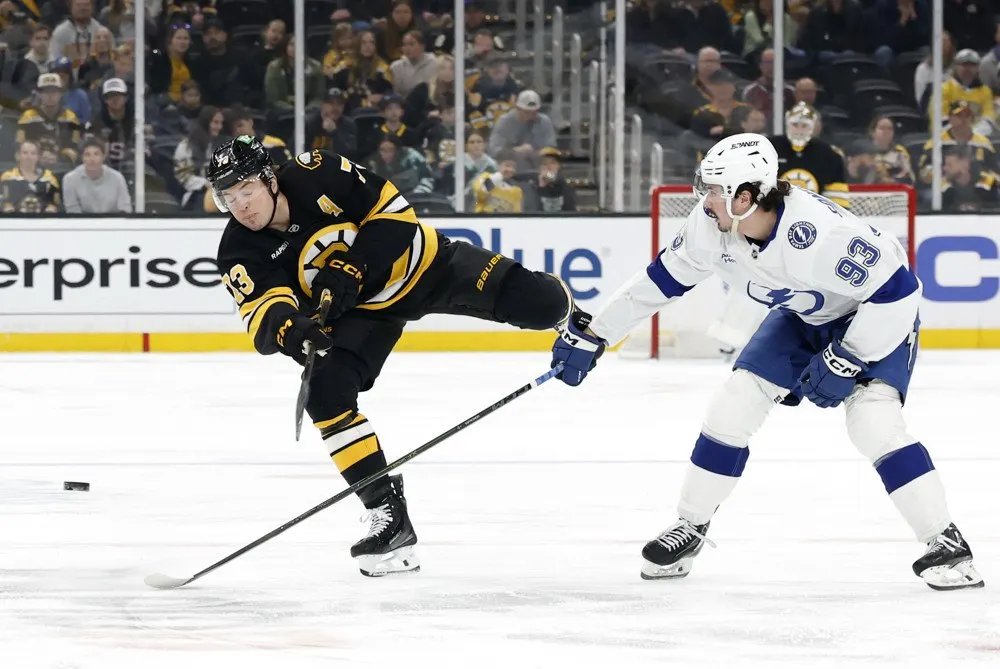
Charlie McAvoy will not play for Boston until the middle of October. He is serving a six-game suspension for a two-handed slash on Buffalo's Zach Benson, delivered in Game 6 on 1 May, outside active play, after the series had already been decided. The Department of Player Safety called it an intentional and forceful strike for the purpose of retribution. It is the third suspension of his career and it costs him more than $300,000.
Nobody is arguing it was clean. The argument worth having is about when it is being served, and what a suspension is actually for.
What Boston is actually missing
McAvoy is not a luxury on this roster. He played 69 games last season for 61 points at 24.4 minutes a night, blocked 129 shots and finished plus-13. He played more minutes per game than any other Boston defenceman, and he out-produced the rest of the group by a distance: 61 points against 26 for the next man.
Nikita Zadorov and Hampus Lindholm are the two who absorb most of what he leaves behind.
The place it should bite is the penalty kill, because that was already the weak point. Boston killed at 77.0 percent last season, 24th in the league and below the 78.9 percent league average, while the power play was ninth. Removing the defenceman who blocked 129 shots from a bottom-ten penalty kill for six games is not a rounding error.
And the six games matter more than usual because of where Boston is. This is a club that went from 109 points in 2023-24 to 76 in 2024-25, 27th in the league, and then back to 100 points and eighth last season. That is not a team with margin to spare. It is a team whose last three seasons have ranged across 33 points in the standings.
The six games he is actually missing
This is where the timing stops being abstract. Pucky holds the full 2026-27 schedule, so the six games are known, and they are not a soft landing.
| Date | Opponent | 2025-26 points |
|---|---|---|
| 30 Sep (played) | NY Rangers, home | 77 |
| 3 Oct | Winnipeg, away | 82 |
| 4 Oct | Minnesota, away | 104 |
| 5 Oct | Ottawa, home | 99 |
| 8 Oct | Utah, home | 92 |
| 10 Oct | Philadelphia, home | 98 |
The six opponents averaged 92.0 points last season, per Pucky's 2026-27 schedule and the 2025-26 standings. Three of them finished above that average and Utah landed exactly on it. McAvoy is eligible to return at San Jose on 14 October.
Three games in three nights, two of them on the road, against Winnipeg, Minnesota and Ottawa, clubs that finished on 82, 104 and 99 points. Boston will be dressing a third pair in the back half of a back-to-back-to-back while its number one sits in a suit for something that happened in the spring.
The points at stake are modest in isolation. Boston scored at 1.22 points per game last season, so six games is worth about 7.3 points of schedule. Nobody misses the playoffs by seven points in October. But they can miss by two in April, and the games where those two go missing are exactly these: road games on the second and third night, against good teams, with a thinner blue line.
The part that is genuinely odd
Here is the mechanic. A player commits an offence in the playoffs. His team is eliminated. The suspension cannot be served, so it carries to the following regular season, which begins five months later.
By the time McAvoy sits, the coaching staff has changed around the league, the roster has turned over, the cap has gone up by $8.5 million, and the season is two games longer than the one in which the offence occurred. He is serving it against opponents who had nothing to do with it, in a competition that had not started, for an act committed in a series that was already over.
There is a reasonable defence of this. If the punishment did not carry, a player on an eliminated team would face no consequence at all for exactly the sort of end-of-series retribution the DoPS described, which is the moment when deterrence is weakest and tempers are highest. Carrying it forward is the only way to make the deterrent exist at all.
But it does mean the punishment is served in a different context from the crime, and that the severity floats. Six games out of 82 is 7.3 percent of a season. Six games out of 84 is 7.1 percent. That is a small dilution, and it is not nothing: every suspension handed down in the old schedule and served in this one is quietly worth slightly less than the number attached to it.
Ottawa's Ridly Greig is serving two games from the same postseason, for two unprovoked punches at Carolina's Sean Walker in Game 4, an incident that drew no penalty on the ice at the time. The on-ice officials saw nothing. The league later found enough to suspend him. Both things being true in the same incident is its own argument about officiating, and it is being had almost nowhere.
The case for the system, stated fairly
Where this lands
Without it, there is no penalty available for an offence committed by a player whose season has just ended, which is precisely when the incentive to retaliate is highest and the deterrent is weakest. McAvoy forfeits real money, his team loses its best defenceman for six games that count, and the league has a record of the act. A suspension that cannot be served is not a suspension. Carrying it is the only version that imposes any cost at all.
The punishment lands on a different team in a different season, against opponents with no connection to it, and in Boston's case on a penalty kill that finished 24th. The severity is set in one schedule and served in another, so a six-game ban is now worth marginally less than the six-game ban it was announced as. And when the same postseason produces a two-game suspension for punches the on-ice officials did not penalise at all, the gap between what is called live and what is punished months later is doing a lot of work.
What it means
Boston's first six games are the cheapest time to lose McAvoy, which is the one mercy in the timing: no team's season is decided in the opening fortnight, and the Bruins opened with a 3-0 win over the Rangers in which Jeremy Swayman, who went 31-18 with a .908 save percentage across 55 games last season, made 24 saves. A goaltender in that form covers a lot.
The number to watch is the penalty kill, and Pucky's standings carry it alongside the record. Boston was 24th at 77.0 percent with McAvoy. If it holds near that without him, the Bruins have more defensive depth than last season's figures suggested and Zadorov and Lindholm are doing real work. If it falls into the low 70s across those six games, then the 100-point season was carrying a structural weakness that McAvoy was personally patching, and that is a bigger finding than a suspension.
And when he comes back, note that nothing about the six games will have been reported as a cost of the playoff slash. It will be reported as an early-season absence, which is exactly how a punishment loses its meaning.