

 Utah Mammoth
The Boston Bruins won 100 points last season and lost in the first round, and the front office spent the summer behaving like a team that was one scorer short. It sent the 23rd pick and a conditional 2028 first-round pick to Utah for JJ Peterka on the draft floor, added Will Borgen and Connor Clifton to the blue line, and let Viktor Arvidsson leave for Detroit. The stated plan, in general manager Don Sweeney's words, was more scoring depth on a team with defensive stability.
The numbers describe a different team. At 5-on-5 the Bruins generated 160 expected goals and allowed 178. That is a 47 percent team, 20th in the league at creating chances and 28th at preventing them, with a chance profile closer to the lottery than the playoffs. They scored 182 and allowed 149 anyway. The 51-goal gap between what the chances said and what the scoreboard said was the largest in the NHL, twelve goals clear of second place, and it is the only reason Boston was a playoff team. Sweeney has spent two first-round picks on a winger for a roster that, on the evidence of how it actually played, needs everything.
The luckiest season in the league
Finishing luck and goaltending luck are separate things, and Boston had both in a quantity no other team came close to.
The finishing half was 22 goals: 182 scored on 160 expected. Morgan Geekie's 39 goals on 22.5 expected supplied most of it and I have already made the case that they will not repeat. Arvidsson scored 18 at 5-on-5 on 14.4 expected and was on the ice for a plus-25 goal differential on chances that said minus-2. He is in Detroit now.
The goaltending half was 29 goals, and it has a name. Jeremy Swayman faced 175 expected goals across all situations and allowed 146. Only Logan Thompson in Washington saved more above expected, and I wrote last week about what happens when a team plans around that repeating. Swayman is 27, he is signed long-term, and he is a very good goaltender. But 29 goals above expected is a career year for anyone, and a team that gave up chances at the 28th-best rate in the league needed every one of them.
Put the two halves back and the Bruins were a team that got outshot on quality every night and won because the goalie and the shooting percentage bailed them out, together, for 82 games. That is not a criticism of the players. It is a description of a season that will not happen twice.
The forward group underneath
The chance data at the player level is uncomfortable. Of the 18 Bruins skaters who played 600 minutes at 5-on-5, not one was on the ice for more expected goals for than against; Fraser Minten and Jonathan Aspirot broke even at 50 percent and everyone else was underwater. David Pastrnak, who scored 100 points and had 57 primary assists, was at 48 percent. Geekie was at 46. Pavel Zacha, Elias Lindholm and Casey Mittelstadt, the three centres, were at 46, 47 and 49. Nobody in the top nine drove play, and the reason Pastrnak's 100 points look like magic is that he produced them on a line that was losing the chance battle.
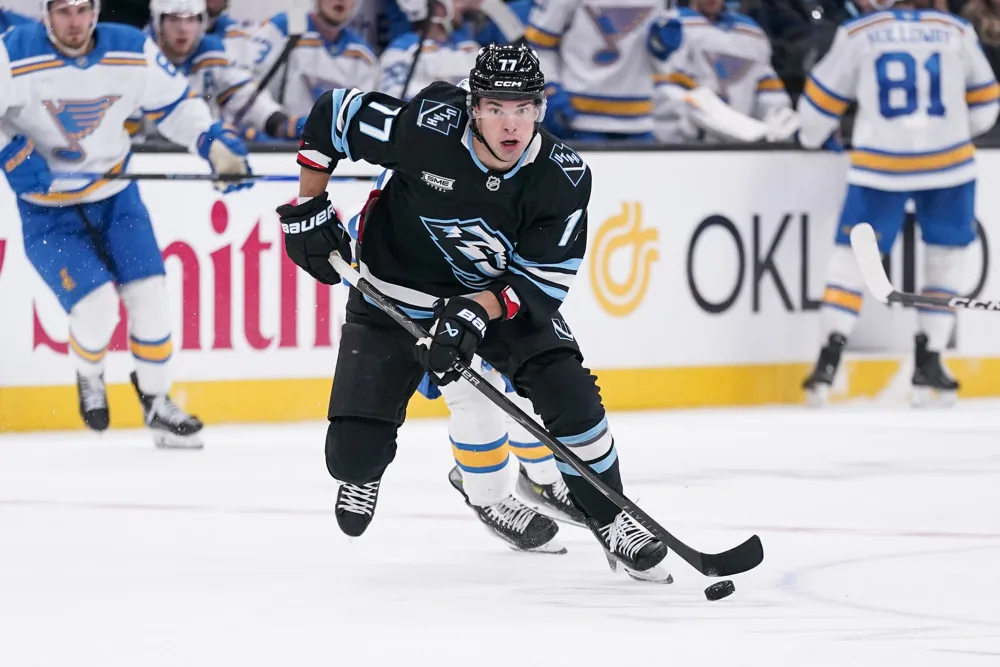
This is the context for the Peterka trade, and it is what makes the trade both defensible and insufficient. Peterka was a 53 percent player on a Utah team that was 52 percent, on the ice for 2.62 expected goals for per 60 and 2.36 against. Drop him into Boston's forward group and he is the best play-driver on the roster by a margin, and a 24-year-old at that. That part is real, and it is the best argument for the price.
What Peterka is and what he is not
Peterka scored 25 goals and 47 points in 82 games for Utah last season, which was a step back from 68 points the year before, and the goals came on 16.7 expected. At 5-on-5 he scored 20 on 11.6 expected, a 14.8 percent shooting rate on ordinary chances, and his on-ice goal differential was plus-13 on plus-5 in chances. Some of that is skill. He has shot 15.6 and 15.7 percent in consecutive seasons after 9.6 and 12.4 in his first two, and 25-goal seasons at 24 are worth paying for.
But he is not a top-line scorer and Boston did not buy one. His 47 points were fewer than Arvidsson's 54 in 13 fewer games, and Arvidsson left for nothing. Peterka's 11 primary assists in 82 games are a third-liner's total. What Boston has done is swap a 33-year-old whose production was unsustainable for a 24-year-old whose production is modest but built on better process, and paid two first-round picks for the privilege of doing what the cap would have forced anyway.
The blue line was the problem and it got older
Boston allowed 2.67 expected goals against per 60 at 5-on-5, 28th in the league. Nikita Zadorov, who played the most minutes of any Bruin, was on the ice for 2.79 against. Andrew Peeke, second in minutes, 2.79. Mason Lohrei 2.76, Charlie McAvoy 2.77, Hampus Lindholm 2.49. Peeke has gone to Utah, and in his place come Borgen, a 46 percent defenceman who was on the ice for 2.41 against on a bad Rangers team, and Clifton, a 31-year-old who played 50 games for Pittsburgh. Korpisalo, who was minus-1 in 31 games, went to New York for a fourth-round pick, so the backup crease is a question as well.
That is the whole defensive summer. A team that ranked 28th at limiting chances replaced one bottom-pair defenceman with two, and is going into the season with McAvoy, Lindholm, Zadorov and Lohrei asked to be better than they were, behind a goaltender asked to be as good as he was.
The case for the summer, stated fairly
Boston made the playoffs, and the front office's job in that position is to try to make them again, not to tear down a roster with Pastrnak, McAvoy and Swayman in their primes. Peterka is 24, signed through 2029-30 at a fair number for a 25-goal winger, and the picks that bought him were a late first and a first two drafts away. Sweeney has said the real target is a top-line centre, and the picks he kept are for that. If Swayman is a plus-15 goalie instead of plus-29 and the shooting comes back to earth, Boston is still a team with an elite goaltender, a 100-point winger and a young play-driver, and that is a wildcard team in a weak Atlantic.
Where this lands
Peterka is the best 5-on-5 driver on the roster, 24 years old, signed through 2030 and cheaper than the picks suggest. Swayman is real. Pastrnak is real. The picks were a late first and a distant first.
Boston was a 47 percent team with the 28th-ranked defence, carried by 51 goals of luck that will not repeat. It responded by adding a 25-goal winger who replaces the one it lost, two depth defencemen, and nothing at centre or in the crease behind Swayman.
What it means
The 2026-27 Bruins will be judged against 100 points, and that is the wrong benchmark. Judge them against the chance data. If the 5-on-5 expected goal share climbs to 50 percent, the summer has done something and Peterka is a big part of why. If it stays at 47 and Swayman is very good instead of historic, Boston is a team that loses more one-goal games than it wins and a front office that spent two firsts on a winger when it needed a rebuild of the middle of the ice. The first month will tell you which. Watch the shot quality against, not the standings.