
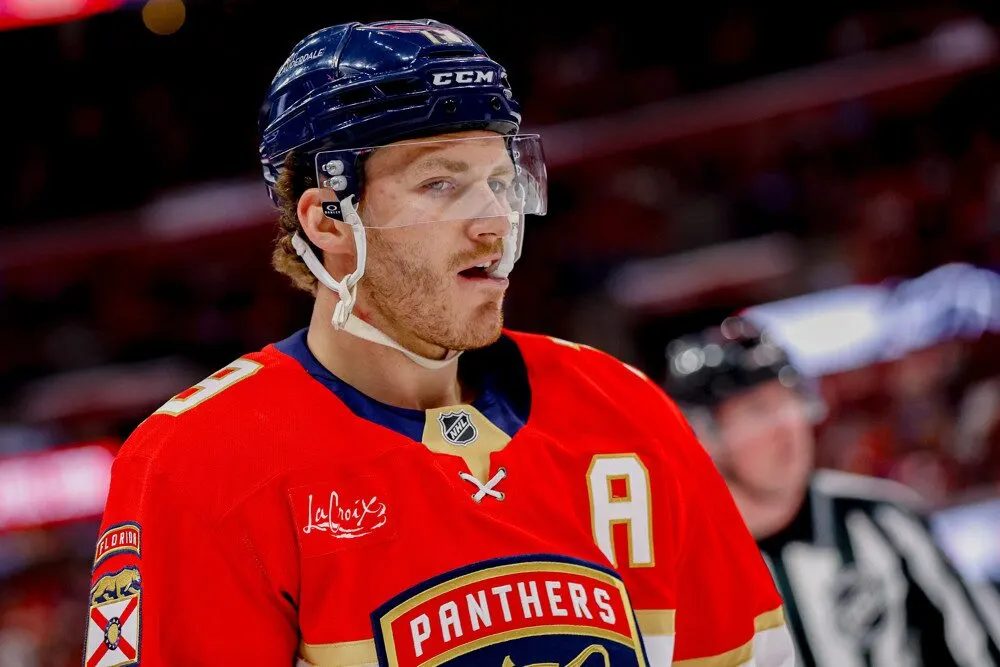

It is tempting to read Florida's step back as the end of something. Back-to-back Cup Finals take a toll, the logic goes, and eventually the bill arrives. That is not what the numbers say happened to the Panthers. What happened is simpler and more fixable: the best players kept getting hurt, and the goaltending picked the worst possible year to fall apart.
Look at the availability, because it is the entire story. Matthew Tkachuk played 31 games. Brad Marchand played 52. Sam Reinhart, the team's leading scorer, managed 64. Aleksander Barkov, the two-way heartbeat of the franchise, was limited badly enough to drop out of the qualified-minutes leaders altogether. A team does not run its usual gauntlet when its most important forwards combine to miss that much of a season.
| Player | Games played | On-ice xGF% | Points |
|---|---|---|---|
| Matthew Tkachuk | 31 | 61% | 34 |
| Brad Marchand | 52 | 54% | 54 |
| Sam Reinhart | 64 | 55% | 61 |
| Sam Bennett | 76 | 57% | 58 |
When Tkachuk played, Florida was still Florida
The most important number in that table is Tkachuk's on-ice share. In his 31 games, the Panthers controlled 61 percent of the expected goals with him on the ice and just 40 without him, a chasm that tells you exactly how much the team missed him. This is not a player in decline; it is an elite driver who was barely available. Bennett (57 percent) and Reinhart (55) posted the same kind of strong underlying numbers when healthy. The talent did not leave. It sat in the trainer's room.
The crease chose a bad year to crater
The injuries would have been survivable if the goaltending had held. It did not. Sergei Bobrovsky, long the steadying force behind Florida's runs, finished 12 goals below average, the worst full season of his Panthers tenure, and the team allowed 274 goals as a result. That combination, a depleted lineup in front and a struggling veteran behind, is how a genuine contender ends up looking ordinary in the standings while its underlying talent stays intact. Notably, Bobrovsky is now gone, which turns the crease from a known negative into an open question rather than a settled one.
The bet going into the season
Florida is the clearest health bet in the league, and health bets are the good kind. You are not hoping a bad team becomes good; you are betting that a proven, back-to-back-finalist core plays more than 31 and 52 games, and that a new goaltending arrangement clears the low bar Bobrovsky set. Both are reasonable. When this group is whole, the Tkachuk on-ice number is what it looks like, and that is a team nobody wants to see in the spring.
The one real caution
The genuine risk is that the injuries are not simply bad luck but the early tax of age and mileage on a core that has played deep into June for years. Marchand is not young, Barkov carries a lot of hard minutes, and dynasties usually end not with a cliff but with their best players available a little less each season. That is the version to watch for. But it is a slower, different worry than decline, and nothing in last season's underlying play suggests the Panthers are done. They were hurt. Healthy, they are still dangerous.