
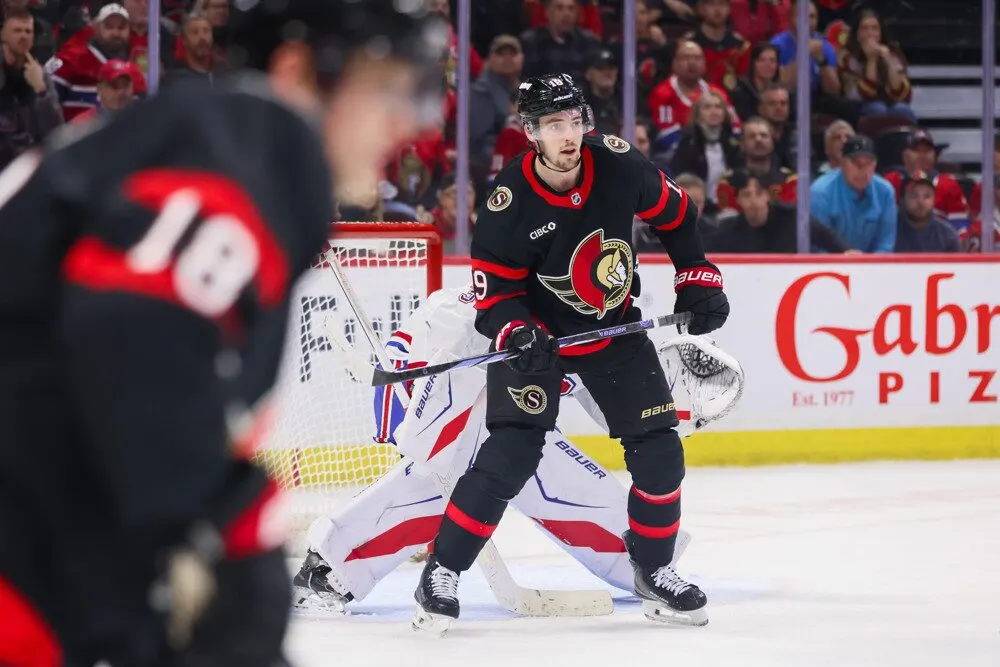

The Senators have spent the better part of a decade as somebody's dark horse, a team perpetually one step from relevance whose young players were always about to arrive. That framing has outlived its accuracy. Ottawa was one of the five best possession teams in hockey last season, and the clearest evidence is not the captain everybody writes about but the winger on the other side of the top six, who scored 33 goals and drove one of the best on-ice shares in the league.
| Player | Games | Points | On-ice xGF% |
|---|---|---|---|
| Tim Stutzle | 80 | 83 | 56% |
| Drake Batherson | 79 | 71 | 62% |
| Dylan Cozens | 82 | 59 | 65% |
| Brady Tkachuk | 60 | 59 | 67% |
| Jake Sanderson | 67 | 54 | 57% |
Every row in that table is a player driving play at a high level, and the team numbers confirm it: Ottawa controlled 55 percent of the expected goals and outscored opponents 275 to 245. That is not a sleeper profile. That is a legitimately good hockey team, and the reason it still gets discussed as a projection rather than a fact is that the Senators have been called promising for so long the label stuck past its expiry.
Batherson is the piece that makes it deep
The reason to lead with Batherson rather than Tim Stutzle or Brady Tkachuk is what he represents structurally. A team with one or two stars is solvable; Ottawa has a winger scoring 33 goals at a 62 percent share on what amounts to the second line, and Dylan Cozens posting a 65 percent mark behind him. When the third and fourth-best forwards on a roster are driving play at those rates, opposing coaches run out of answers, and that depth is what separates a good team from a dangerous one.
The Tkachuk availability question
There is a caveat sitting in that table and it belongs in the open. Tkachuk's 67 percent on-ice share was the best on the roster, but it came across 60 games, and a captain who plays a physical, punishing style carries real availability risk over an 84-game schedule. The encouraging read is that Ottawa's numbers held up anyway, which is precisely the point about depth: the Senators survived without their best player because four others were driving play in his absence.
What has actually changed
The Senators' improvement is structural rather than lucky, which is what makes it durable. This is a group that controls territory, gets scoring from four lines' worth of talent, and has a genuine number one defenceman in Jake Sanderson at 54 points and a 57 percent share. Compare that to the version of Ottawa that spent years accumulating talent without ever controlling games, and the difference is obvious. The rebuild did not just produce players. It produced a team.
The crease remains the ceiling
Which brings the argument to the one genuine problem, and it is a significant one. I flagged Ottawa as a sleeper contender whose goaltending would decide everything in July, and the numbers have not improved the picture: Linus Ullmark finished 12.8 goals below expected and Leevi Merilinen 17.3 below in 20 games. A 55 percent team getting that from its crease is leaving an enormous number of points on the table, and it is the entire gap between where Ottawa finished and where its underlying play says it belonged.
The honest counter
The skeptical case is that shot shares are not points, and Ottawa has been converting the former into the latter unreliably for years. A team can control 55 percent of the chances and still miss the playoffs if the goaltending is poor enough and the finishing cold enough, and the Senators have made a habit of underdelivering on their process. Believing this is the year the results catch up requires believing the crease improves, and there is not much in last season's numbers to support that beyond hope.
The arithmetic of a goaltending fix
It is worth quantifying what Ottawa is actually leaving on the table, because the number is startling. Between Ullmark's 12.8 goals below expected and Merilinen's 17.3 below in just 20 games, the Senators conceded roughly 30 goals more than an average netminding tandem would have. Thirty goals is conservatively worth five wins and ten standings points, which for a team that got swept out of the first round is not a marginal improvement. It is the entire difference between the season Ottawa had and the season its play deserved.
That framing changes what the Senators should be shopping for. A 55 percent team with this forward depth does not need another scorer, another top-four defenceman, or a coaching change. It needs league-average goaltending, which is the cheapest commodity on this list and the one Ottawa has repeatedly failed to secure. Every offseason spent adding to the skater group while the crease underperforms is an offseason spent making a strength stronger and ignoring the thing costing ten points.
The frustrating part is that the roster is otherwise built for a long run. Stutzle, Batherson, Cozens, Tkachuk and Sanderson are all signed, all in or entering their primes, and all driving play at rates that contenders envy. Windows like that stay open for perhaps four or five years, and burning one of them on a goaltending problem that a mid-tier acquisition could fix is the kind of front-office failure that gets remembered when the core eventually gets expensive and breaks up.
Which is why this season carries more weight than a standard preview suggests. If Ottawa gets even neutral goaltending and the skater numbers hold, the Senators are not just a playoff team but a dangerous one. If the crease costs them another thirty goals, the conversation next August will be about whether this group can win together, and the answer will have been decided by a position the front office addressed only by signing Samuel Ersson, who finished 16.5 goals below expected in Philadelphia last season.
Where this lands
Ottawa is not a sleeper, a dark horse, or a team on the verge. It is a genuinely good possession club with four forwards driving play at elite rates, a number one defenceman, and a goaltending problem that has been eating its season for years. Drake Batherson's 33 goals and 62 percent share are the cleanest illustration of how far the skater group has come and how little of it has translated. Fix the crease and this team is a real problem for the East. Leave it and Ottawa will keep being called promising, which by now is starting to sound like an insult.