
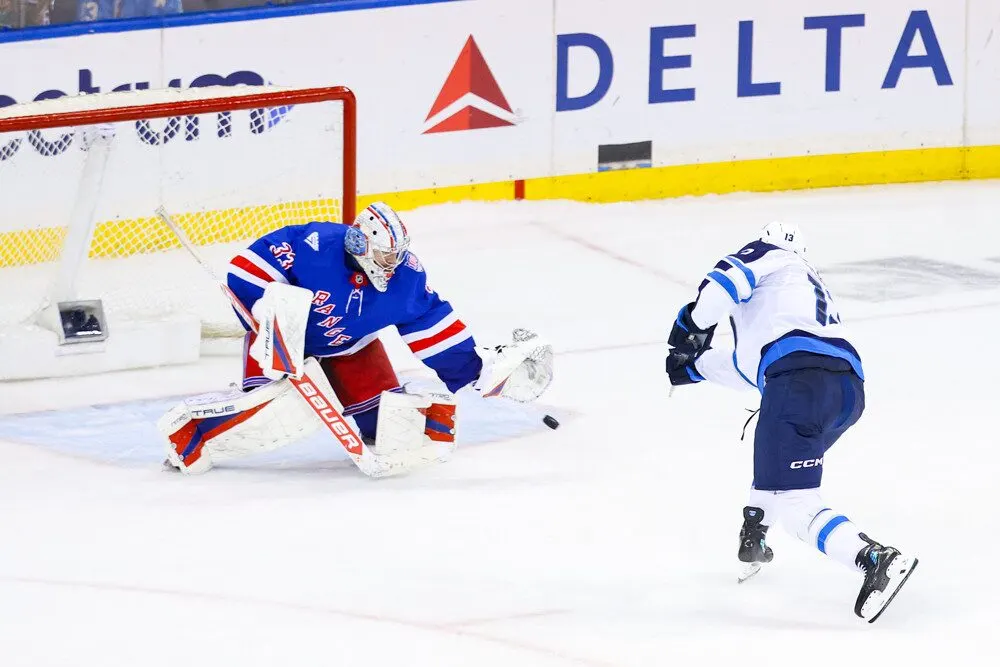

Every Jets conversation this summer has been a Connor Hellebuyck conversation. Will he be traded, should he be traded, can he recover, what is he worth. It is understandable after the largest collapse of the cap era and a goaltending season that went sideways in spectacular fashion. It is also, at this point, the least interesting question about this team, because the reason Winnipeg fell apart is visible in the skater numbers and the reason it might recover is sitting in the middle of its lineup.
| Player | Games | Goals | Points | On-ice xGF% |
|---|---|---|---|---|
| Mark Scheifele | 82 | 36 | 103 | 55% |
| Kyle Connor | 82 | 39 | 92 | 54% |
| Gabriel Vilardi | 82 | 30 | 69 | 56% |
| Josh Morrissey | 77 | 14 | 55 | 54% |
Look at that group and then at the team result. Winnipeg had a 103-point scorer, a 39-goal winger, a 30-goal centre and a quarterbacking defenceman, all of them driving positive shares, and still finished at 48 percent with 229 goals for and 256 against. That combination, excellent individual numbers and a poor team profile, is unusual and diagnostic. The top of this lineup was not the problem.
Vilardi is the piece that makes it work
Gabriel Vilardi played all 82 games, scored 30 goals and drove a 56 percent share, the highest of the three forwards carrying the load, against a team that ran 44 without him, a plus-12 swing. That matters more than the raw totals suggest because he is the connective piece: a centre who can play with Mark Scheifele or Kyle Connor or anchor his own line, which is what separates a top-heavy team from a deep one. Winnipeg's forward group has three players who tilt the ice. Most teams have one.
So what actually went wrong
The collapse was a combination the standings flattened into one number. Goaltending regressed severely from an elite baseline, the defensive structure behind an ageing blue line let more through, and the depth beyond the top six produced very little, leaving the stars to outscore problems they could not always outscore. Strip those apart and only one is a talent problem. The others are the kind of thing that partially self-corrects, which is why a 48 percent team with this much high-end forward production is a more plausible bounce-back candidate than its reputation allows.
The Hellebuyck question, briefly
None of this argues Hellebuyck is irrelevant; elite goaltending is the difference between a bubble team and a threat, and Winnipeg's ceiling genuinely does depend on which version shows up. But the trade chatter has crowded out the more useful analysis. Whether he stays or goes, the Jets still need their skater group to be better than 48 percent, and the pieces capable of delivering that are already on the roster. A team that fixes only its crease and nothing else has fixed half a problem.
What Winnipeg is actually short of
The honest gap is depth and defence, not stars. Behind Scheifele, Connor and Vilardi, the scoring falls away sharply, and Josh Morrissey is carrying a blue line that needs a genuine second option. Those are the areas where a 48 percent team becomes a 52 percent one, and they are addressable with mid-tier additions rather than blockbusters. The Jets do not need another star. They need four or five players who do not lose their minutes, which is a much cheaper shopping list.
The honest counter
The pessimistic reading is that the collapse revealed something structural rather than incidental, that this core has now had its chance and the underlying numbers were never as good as the individual point totals implied. There is something to that: 48 percent is a real number, an ageing defence does not spontaneously improve, and betting on both a goaltending rebound and a depth improvement is stacking two uncertain outcomes. Teams that lean on three forwards tend to keep leaning on them until the window closes.
What a Hellebuyck trade would actually mean
Since the question refuses to go away, it deserves a straight answer rather than avoidance. Trading an elite goaltender only makes sense for a team that has concluded its window is shut, and Winnipeg's forward numbers argue the opposite. A club with a 103-point centre, a 39-goal winger and a 30-goal driver in his prime is not positioned to sell its most valuable asset for futures it will need years to convert. The logic of a Hellebuyck trade is the logic of a rebuild, and the Jets do not have a rebuilding roster.
The counter-scenario is that Winnipeg trades him precisely because the return would be enormous and the money freed could rebuild the depth this team lacks. That is coherent, but it assumes the Jets could then find adequate goaltending, which is the hardest thing in hockey to source. Teams that trade elite netminders and expect to replace them internally almost always discover that the position was doing more work than the spreadsheet suggested, and a 48 percent team in front of average goaltending is a lottery team very quickly.
The likelier path, and the one the chatter keeps under-weighting, is simply that a bounce-back happens. Goaltending is the most volatile position in the sport, elite netminders have bad seasons and recover from them routinely, and one poor year from a proven starter is weak evidence of permanent decline. If Hellebuyck returns to anything near his established level while the forward group performs as it did, Winnipeg's collapse looks like an aberration rather than a trend, and the trade talk evaporates on its own.
Which brings the analysis back where it started. The Jets' season will be decided by whether their depth improves and their blue line holds up, because those are the areas where the team is genuinely deficient and where improvement is genuinely available. The goaltending is a variable they largely cannot control and should mostly stop discussing. The skater group is a problem they can actually solve, and Vilardi's season is the evidence that the raw material is better than the standings implied.
Where this lands
Winnipeg's summer has been spent litigating its goaltender while the more useful story sat one line down. Gabriel Vilardi's plus-12, 30-goal, 82-game season is the evidence that the Jets' forward group is genuinely deep at the top, and the collapse was a structural and goaltending failure layered on top of a functional core rather than a talent problem. Fix the depth, address the blue line, and the crease becomes an upside variable instead of the entire plan. The Hellebuyck question will get answered eventually. It was never the one that decided this season.