
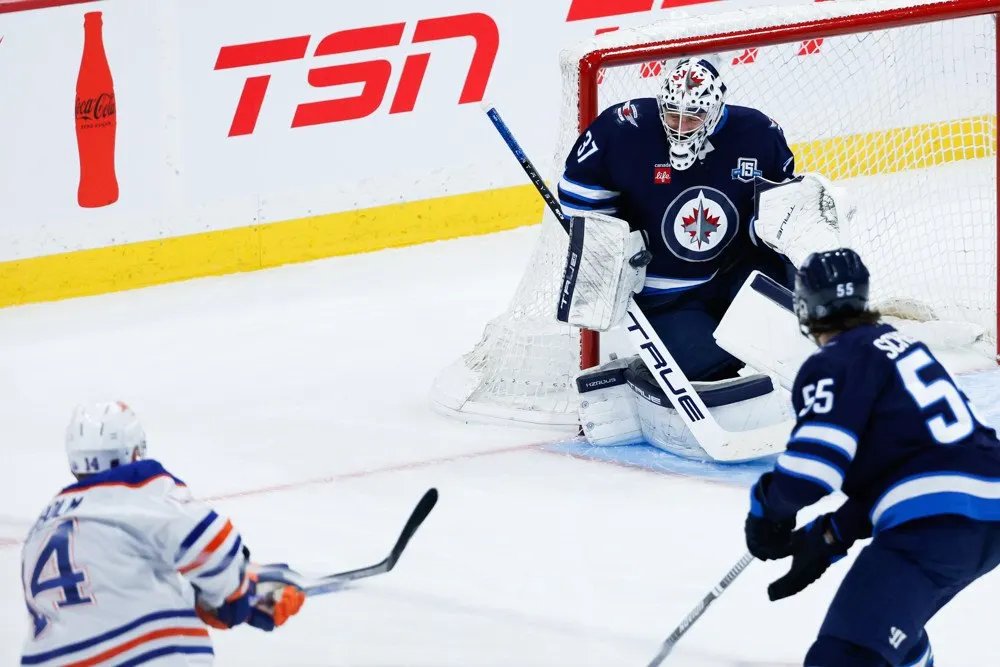

Twenty-five places. That is the gap between where the Winnipeg Jets finished in 2024-25 and where they finished last season: first in the NHL, then twenty-sixth. Sort every pair of consecutive seasons since the cap arrived in 2005-06 and nothing matches it. Toronto's fall from fourth to twenty-eighth, in the same season, is second at twenty-four places. After that the list drops to twenty-two and stays there. The 2023-24 Rangers are the only other Presidents' Trophy winner on the list, and they stopped at twenty-one.
Winnipeg's response has been to put its goaltender on the market. That is the wrong read of what happened, and the numbers are not close enough to call it a judgement call.
The goalie everyone wants to talk about
The offseason has settled on one explanation and Kevin Cheveldayoff has not worked hard to discourage it. The Jets are listening on Connor Hellebuyck. Five years left. The logic writes itself: a team does not fall that far unless the man who made it good stopped being good.
The numbers decline to cooperate.
By MoneyPuck's accounting, Hellebuyck faced 167.5 expected goals last season and allowed 162, saving 5.5 goals more than an average goaltender would have on the same shots. Among the fifty-two goalies with at least twenty-five hours of ice time, that ranks twenty-sixth. The precise middle of the league.
Look closer and the middle gets more literal. At five-on-five he faced 114.31 expected goals and allowed 114, a difference of a third of a goal across an entire season, which is another way of saying no difference anyone could measure. Nearly everything he did save came shorthanded, where he finished 3.4 goals to the good. For scale, Logan Thompson saved 29.3 and Jeremy Swayman 28.8.
We have already made the case that Hellebuyck was not the best goalie in the league even in the season everyone remembers fondly. Last year he was not the tenth best either. He was ordinary, and ordinary is not what breaks a Presidents' Trophy team.
Both ends went at once
| Metric | 2024-25 | 2025-26 |
|---|---|---|
| League finish | 1st of 32 | 26th of 32 |
| Points | 116 | 82 |
| Record | 56-22-4 | 35-35-12 |
| Goals for | 277 (3rd) | 231 (25th) |
| Goals against | 190 (1st) | 256 (21st) |
| Penalty kill | not recorded | 77.6% |
Read the bottom two rows again, because they are the story.
Winnipeg did not have a good defence and a shaky attack, or the reverse. In 2024-25 they allowed fewer goals than any team in hockey and scored the third most. Twelve months later they were twenty-first at one end and twenty-fifth at the other. Sixty-six more goals against, forty-six fewer for, in the same season, with much of the same roster.
That is not a goaltender regressing. A goalie can move the goals-against column. He cannot remove forty-six goals from his own team's attack. Whatever happened in Winnipeg happened to the whole roster at once, and the penalty kill, at 77.6 percent, was the one area where Hellebuyck was demonstrably above average.
Where the evidence stops, and what it still points at
One limit worth stating rather than writing around. The advanced numbers available here cover last season only, so whether the 190-goal season was a defensive achievement or a goaltending one cannot be settled from this data alone.
That does not leave the question open. It narrows it. A team that was third in scoring lost forty-six goals of offence in twelve months, and no goaltender in the history of the sport has ever been responsible for a team's shooting. Whatever went wrong in front of Hellebuyck was already going wrong somewhere he could not reach it. The most likely reading, and the one worth acting on, is that the 2024-25 defensive record was built on structure and personnel that no longer exists, and that Winnipeg has spent the summer looking at the one player who held up rather than the ones who did not. We saw the same shape in Boston last week, where the evidence ran far enough to prove it outright.
The verdict
Do not trade him.
The case for moving Hellebuyck depends on believing he was the reason for 2024-25, and if that is true then selling him now, at the lowest price his reputation will ever carry, is the worst possible timing. If it is not true, then he is the least broken thing on the roster and moving him solves nothing. There is no version of the argument that survives contact with the standings.
Winnipeg does not have a goaltending problem. It has a roster that surrendered sixty-six goals and stopped scoring, and a front office that has spent the summer entertaining offers on the one player whose season held up. A team that has just posted the largest collapse of the cap era should be asking how a top-three offence and a first-place defence disappeared together. Trading the goalie answers a question nobody has established was being asked, and it will feel like decisiveness right up until the moment it becomes the reason the rebuild takes five years instead of two.
The market will pay well for him, because the price is still set by 2024-25 rather than by last season. That gap is the strongest argument for keeping him, not for cashing him in.