
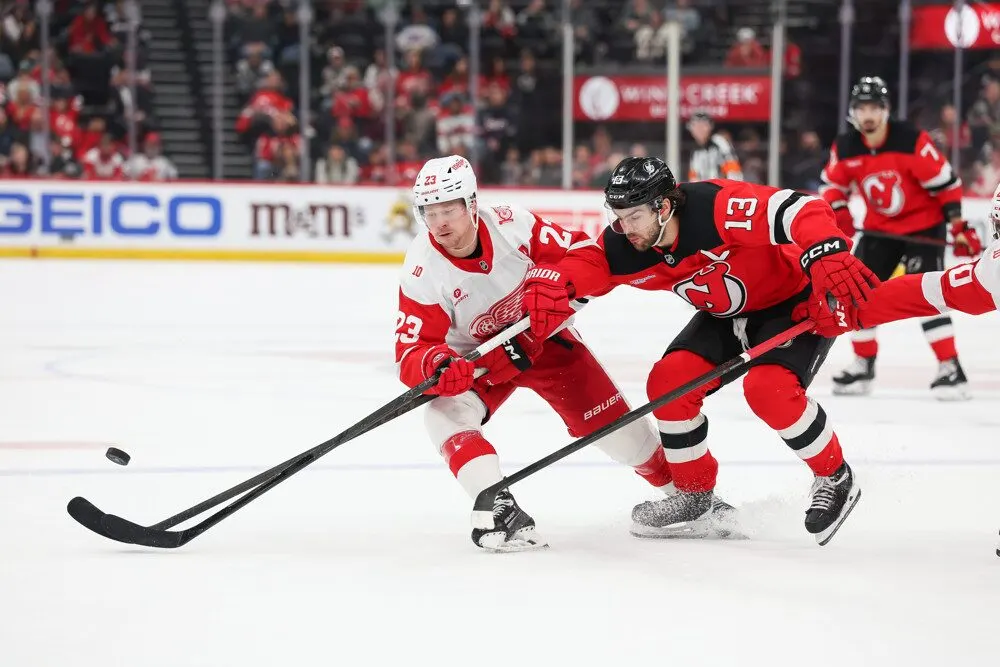

The Dylan Larkin trade saga has stalled again, and Detroit's offseason coverage has calcified into a single question asked on a loop: what happens to the captain? It is the wrong question, or at least the less important one. Whatever happens with Larkin, the player Detroit's next good team will actually be built around is already in the lineup, and he just quietly put together one of the best two-way winger seasons in hockey. The story of the Red Wings is not who might leave. It is Lucas Raymond, and almost nobody is telling it.
| Player | Goals | Points | On-ice xGF% |
|---|---|---|---|
| Alex DeBrincat | 41 | 85 | 63% |
| Lucas Raymond | 25 | 76 | 61% |
| Dylan Larkin | 34 | 67 | 56% |
Look at the table before the saga swallows the conversation again. Raymond scored 76 points and drove a 61 percent expected-goals share on a Detroit team that was 45 percent without him, a plus-16 swing that ranks with the elite play-drivers in the sport. Alex DeBrincat's 41 goals at a 63 percent share deserve their own appreciation. Larkin, good as he was, sits third in this hierarchy by impact, which is exactly why the months of trade coverage have been aimed at the wrong storyline.
What the swing number actually says
A plus-16 on-off swing is the statistical signature of a player who changes what his team is. With Raymond on the ice, Detroit played like a contender; without him, like a lottery team. That is not a stat you compile by riding shotgun. It is what shows up when a winger is the one carrying the puck through the neutral zone, driving the cycle and tilting the territorial battle shift after shift, at 24 years old. Detroit has spent a decade searching for the player its rebuild would eventually be about. The search ended, and the announcement got lost in the rumor cycle.
Why the saga matters less than it seems
None of this makes the Larkin situation trivial; a captain openly wanting a direction is real turbulence, and I wrote about his trade value when the saga began. But the stalled talks have clarified something useful: Detroit does not need to rush, because the outcome barely changes the foundation. Trade Larkin well, and the return accelerates a young core that already has its centerpiece. Keep him, and he is a very good 34-goal centre on a team that belongs to the kids anyway. The saga is a question about the supporting cast, not the star, and supporting-cast questions should never paralyze a franchise.
The core is more ready than the record
Detroit finished at 50 percent on expected goals with 239 scored against 254 allowed, the profile of a team a piece or two from genuine relevance, and the pieces are the young ones. Raymond driving play at an elite level, DeBrincat finishing at 40-goal pace, Moritz Seider anchoring the blue line, the succession problem I flagged in the spring notwithstanding. The gap between this team and a playoff spot is not talent at the top. It is depth and goaltending, the fixable kind of gap, and it is why the franchise's obsession with the Larkin question has been such a strange use of a summer.
The counterargument worth taking seriously
The fair pushback is that losing a first-line centre is never neutral, and wingers, however brilliant, do not replace what a centre does. If Larkin goes and Detroit's middle collapses, Raymond's driving numbers will sag under worse deployment and tougher matchups, and the plus-16 swing partly reflects playing meaningful minutes alongside good players. A version of next season exists where the trade is botched, the centre depth thins, and the kid's numbers take the hit for management's mess. Raymond being the franchise player does not make him immune to the franchise's decisions.
What Detroit should actually do
The plan follows from the hierarchy. Pay Raymond whatever his next contract requires, because cornerstone wingers entering their prime are the asset you never lose. Resolve Larkin on value rather than on deadline pressure, taking the best package whenever it appears, this month or in March. And spend the roster energy on the actual gaps, a second-line centre if Larkin goes, goaltending regardless. A franchise that knows who its best player is makes clean decisions around him. Detroit's problem all summer has been acting like that question is still open.
What history says about wingers like this
The skeptic's last line of defence is positional: franchises are built on centres and defencemen, the argument goes, and crowning a winger is how teams talk themselves into overpaying complementary talent. The counter-evidence is the modern league itself. The past decade's contenders have repeatedly organized around elite wingers who drive play, because the position matters less than the portability of the impact, and Raymond's impact is the portable kind. He does not need a play-driving centre to feed him; he is the one doing the feeding, carrying entries, running the cycle, creating for whoever shares his ice. That profile translates across linemates and coaching systems, which is exactly what the plus-16 swing measures.
The Detroit-specific version of the argument is even simpler: the franchise has spent its entire rebuild waiting for a player who makes everyone else's development easier, and Raymond is visibly doing that job already. Larkin's 34-goal season came largely on Raymond's wing. The young forwards arriving behind them will get their NHL minutes next to a winger who tilts the ice instead of a rookie learning alongside other rookies, and that compounding effect, the good young player making the next young player better, is the mechanism by which rebuilds actually end. Detroit's ended the day Raymond became this. The standings just have not caught up.
There is a warning in the history too, and Detroit should hear it: teams that under-rank their own franchise player pay for it at the negotiating table of everyone else. Every contract the Red Wings sign, every trade they weigh, should be priced against the fact that their best asset is a 24-year-old elite driver already in the room. Franchises that know what they have build coherently around it. Franchises that keep asking who the cornerstone is, while he posts plus-16 swings down the hall, end up making decisions like the one currently stalling in the rumor mill.
Where this lands
Dylan Larkin's stalled trade will keep generating headlines into camp, and most of them will miss the point. Detroit's rebuild stopped being about finding a franchise player the moment Lucas Raymond started dragging the team into contention every time he stepped over the boards. The saga is noise; the plus-16 swing is signal. Whenever the captain's future resolves, the Red Wings' actual future has been in the building for a while now, wearing 23, and it is time the conversation caught up to him.