
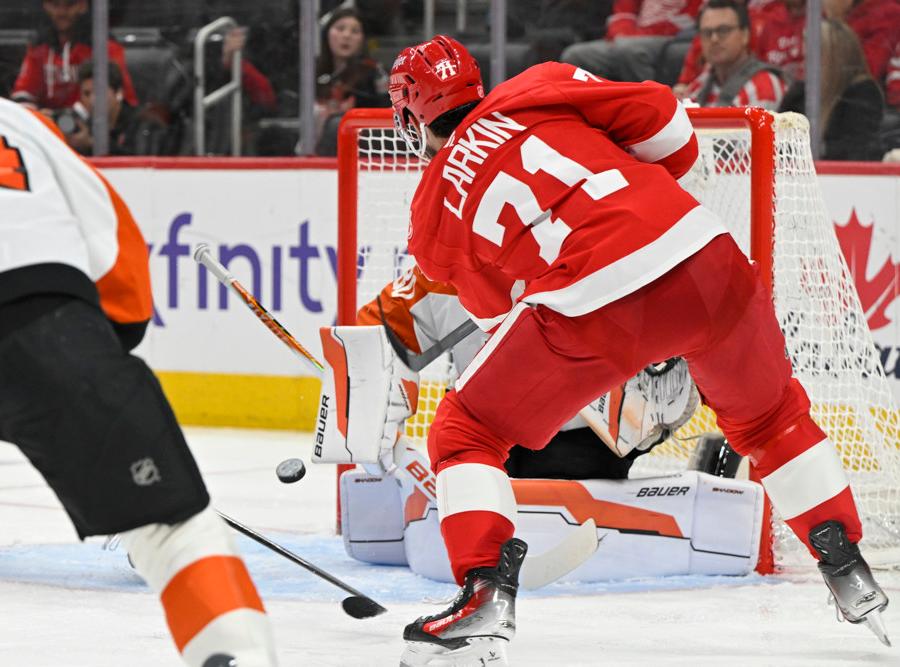

Detroit's rebuild has gone on long enough that its captain has become a story, and this summer the story is whether Dylan Larkin and the Red Wings still make sense together. It is the kind of situation that pulls opinion to the extremes. To one camp he is a franchise centre being wasted, the leader a contender should pry loose. To another he is an overpaid holdover on a team going nowhere. The numbers say both camps are wrong, and the truth is more useful than either.
| Situation | Goals | Points | On-ice xGF% |
|---|---|---|---|
| All situations | 34 | 67 | 56% |
| 5-on-5 | 9 | 25 | 47% |
Larkin scored 34 goals, and unlike a lot of contract-year scorers, he earned them. He posted 33.8 expected, which means his finishing was right in line with the quality of his chances, the sign of a sustainable goal-scorer rather than a percentage mirage. That part of his game is exactly what it looks like. He is a legitimate 30-goal centre, and 30-goal centres are hard to find.
The number that complicates the picture
Look at the two rows of that table again, because the gap between them is the whole evaluation. Across all situations, with the power play folded in, Detroit controlled 56 percent of the expected goals with Larkin on the ice, a strong number. At five-on-five, that figure falls to 47 percent, below break-even, and his on-ice share was actually a touch worse than the team's mark without him. In other words, a large share of Larkin's value is tied to the power play, and at even strength, where most of the game is played, he was a roughly neutral driver last season.
To his credit, the deployment was not soft. Larkin took a defensive-leaning share of his five-on-five starts, the hard assignments a coach hands a trusted veteran, and neutral results in tough minutes are more excusable than neutral results in sheltered ones. But excusable is not the same as elite, and a contender trading real assets for a number-one centre needs to be honest about which it is buying.
What a contender would actually get
A very good goal-scorer and power-play weapon, a respected leader, a centre who can handle difficult minutes without drowning, and an even-strength impact that is closer to average than to star. That is a genuinely useful player, and on the right team, slotted behind a true first-line driver rather than asked to be one, Larkin could be excellent. The mistake would be paying franchise-centre prices expecting franchise-centre play-driving, because the five-on-five evidence does not support it.
What Detroit should do
This is the more interesting question, and it turns on honesty about the timeline. If the Red Wings genuinely believe their young core is a year or two from contention, keeping a productive, respected captain to bridge that gap has real value, and letting him walk into free agency for nothing would be a waste. If they are further away than that, Larkin is exactly the kind of asset a rebuilding team should convert into futures while his goal-scoring keeps his value high, precisely because the underlying five-on-five game suggests his trade value may never be higher than his reputation makes it right now.
The honest counter
There is a real case that Larkin's even-strength number is a product of his surroundings rather than his play. Detroit was a bottom-ten team in five-on-five share overall, and it is hard to drive results when the roster around you cannot. A better team might lift his on-ice number the way it would lift anyone's. That is fair, and it is the argument a contender will make to itself. But it cuts both ways: if the environment is doing that much of the damage, then the player being acquired is more dependent on his supporting cast than the franchise-centre label implies.
The bottom line
Dylan Larkin is neither the wasted superstar nor the overpaid passenger the loudest voices make him out to be. He is a real 30-goal scorer and a fine leader whose even-strength impact last season was ordinary, and the right way to value him sits in that unglamorous middle. For Detroit, the decision is not about how good Larkin is. It is about how far away the Red Wings are, and whether the captain is the bridge to the next good team or an asset better spent building it.