

 Columbus Blue Jackets
Forget the trades for a second. The defining story of this offseason is the one that has not happened yet: two of the best young forwards in hockey are still unsigned with training camp closing in, and the standoff says more about where the sport is heading than any deal that got done. Cutter Gauthier and Adam Fantilli are the faces of a restricted free agent freeze that the market reset created, and neither side looks ready to blink.
| Player | Points | On-ice xGF% | Status |
|---|---|---|---|
| Macklin Celebrini | 115 | 58% | Signed the number that moved everything |
| Leo Carlsson | 67 | 57% | Locked in on a max-term deal |
| Connor Bedard | 73 | 52% | Signed long and early |
| Cutter Gauthier | 69 | 58% | Unsigned and holding |
| Adam Fantilli | 59 | 58% | Unsigned and far apart |
The trigger was the top of that table. When Macklin Celebrini and Leo Carlsson signed for the numbers they did, and Connor Bedard locked in long and early, they did not just set their own salaries. They set the comparables every other young star now points to, and they dragged the floor for a first-line talent up several million dollars in a single summer. Gauthier and Fantilli are simply the two players unlucky enough to be negotiating right after the reset, with agents who can now point to a much richer set of comps than existed a year ago.
Gauthier has the leverage of a great season
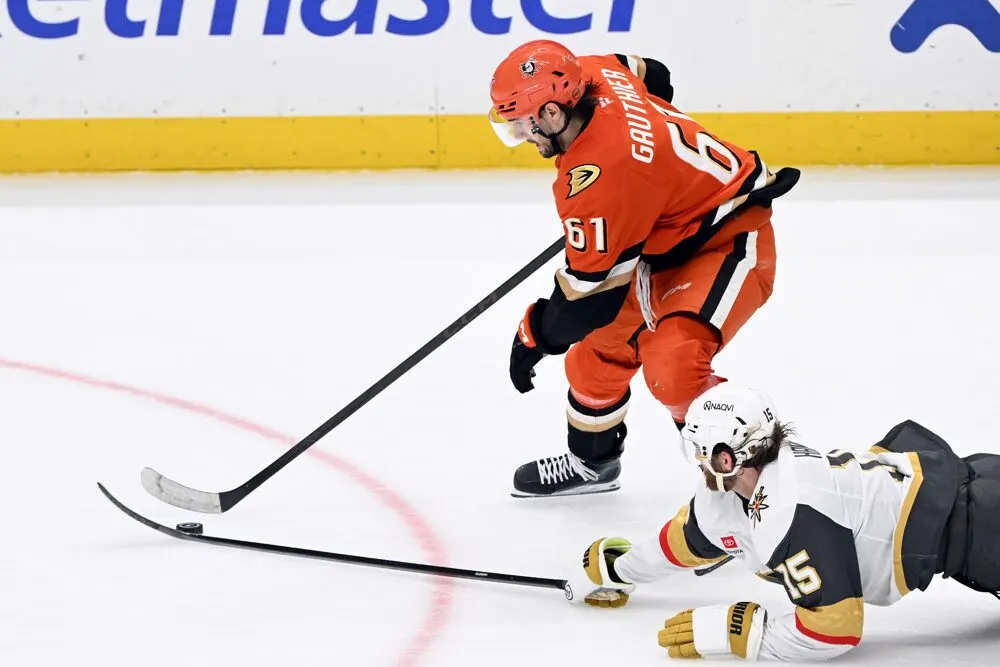
Start with Gauthier, because his case is the cleaner one. He scored 41 goals and 69 points and drove a 58 percent on-ice share, the kind of first-line production that, in this new market, commands a first-line price. When I wrote about Anaheim's next step, the point was that he is already a legitimate top-line winger, and a player like that coming off a 40-goal year holds real leverage. He can sit, he can miss the start of camp, and every week he does, the pressure lands on a Ducks front office that knows exactly how good he is.
Fantilli is the harder negotiation
Fantilli's standoff is thornier, because it is about term as much as money. He played all 82 games, scored 59 points and posted a 58 percent share with a plus-twelve on-off swing, the profile of a genuine number-one centre still ascending, and I made the case for his next step earlier this summer. Columbus wants the security of a long deal on its first-line centre. Fantilli, understandably, may prefer a shorter bridge that lets him cash in again in his prime, once the cap has risen further. That is not a gap you close by splitting the difference on dollars; it is a philosophical disagreement about who carries the risk.
Why the teams are holding firm
From the other side of the table, the clubs are not being unreasonable, and that is what makes this a freeze rather than a quick capitulation. A front office that hands out a max deal the day after the market jumps risks overpaying at the very top of the curve, and both Anaheim and Columbus are young enough that a bad long-term contract now would haunt them through the exact years they are trying to contend. Holding the line, even at the cost of a holdout, is a defensible bet that the player blinks first because he wants to play.
The offer-sheet shadow
Lurking behind all of this is the tool nobody quite wants to use but everyone now mentions: the offer sheet. An unsigned restricted free agent of this calibre is precisely the kind of player a rival can try to pry loose, and the reset compensation tiers mean a serious run at Fantilli or Gauthier is no longer unthinkable. Even the possibility changes the math, because it forces the incumbent team to weigh a rich extension against the nightmare of losing a franchise piece for picks. The freeze, in other words, is not stable. It is a standoff that something eventually breaks.
The honest counter
None of this guarantees a holdout that actually costs games. The likeliest outcome is still that one or both sides find a bridge or a compromise term in the final days before camp, because the incentives to play are enormous and neither player gains much by sitting into the season. Restricted free agents almost always sign eventually, and the drama tends to resolve less explosively than August makes it feel. The freeze is real, but it is not necessarily permanent, and predicting a lost month is the kind of confident call that ages badly.
The bigger shift underneath
Zoom out and the Gauthier and Fantilli standoffs are symptoms of a structural change, not isolated squabbles. An unusually strong draft class has hit its second contract all at once, and because the salary cap is finally rising after years of stagnation, the players and their agents can see the money coming and want their share of it now rather than at yesterday's suppressed rates. That combination, a bumper crop of talent and a cap that is expanding for the first time in a while, is what turned a normal summer of extensions into a leaguewide freeze.
The teams, for their part, are caught between two fears. Commit long and rich the moment the market jumps and you risk being the cautionary tale, the club that set the ceiling everyone else got to negotiate under. Wait too long and you risk a holdout, a poisoned relationship, or an offer sheet that forces your hand at a worse price. There is no clean answer, which is exactly why so many of these negotiations have stalled in the same place at once: both sides are rationally waiting for someone else to establish where the new line sits.
What makes this moment genuinely new is the willingness of young players to sit. For years the assumption was that restricted free agents had little leverage and always caved, because they could not play anywhere else and had every incentive to get on the ice. The reset changed the psychology. A player who just watched a peer sign for a number he considers his own floor is far more willing to miss camp to get it, and agents now have the comparables to justify the fight. The old power balance, tilted heavily toward the team, has shifted several degrees toward the talent.
That is why this is only getting started. Gauthier and Fantilli are simply first in line, but the same dynamic waits behind them for every ascending young star whose deal expires into a rising cap. The clubs that understand the shift will plan for it, extending their best young players early and eating a small premium for certainty. The ones that treat each negotiation as a one-off, and assume the player always blinks, are going to keep finding themselves exactly here, in late August, with a franchise piece unsigned and the leverage draining away.
What it means
The Gauthier and Fantilli standoffs are not isolated contract squabbles. They are the first tremors of a market that just reset itself, and they preview a new normal in which every ascending young star negotiates against a richer set of comps than the one before. Whoever blinks, the lesson for the rest of the league is already clear: the price of keeping the players you draft has jumped, the leverage has shifted toward talent, and the teams that plan for it will keep their cores together. The ones that assume the old numbers still apply will spend the next few Augusts exactly where Anaheim and Columbus are now.