
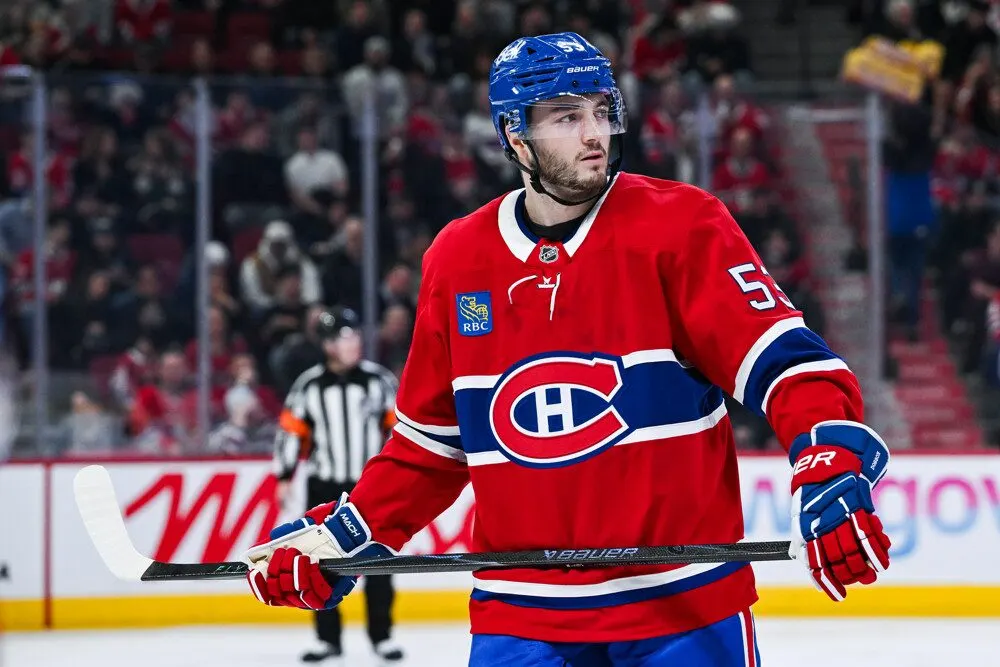

The Canadiens made their statement move to accelerate a rebuild that is genuinely ahead of schedule, committing a fortune in assets and dollars to a young, right-shot, puck-moving defenceman. On the surface it is exactly the kind of bet a rising team should make. Look one layer down, though, and Noah Dobson's first season in Montreal carries a warning the point total hides, and it is worth saying plainly before the narrative hardens.
| Defenceman | Points | On-ice xGF% | Off-ice xGF% |
|---|---|---|---|
| Lane Hutson | 78 | 60% | 43% |
| Noah Dobson | 47 | 48% | 51% |
Read those two rows side by side, because the contrast is the whole story. Dobson scored 47 points, a perfectly good raw total for a defenceman, and the kind of number that makes a signing look justified in a headline. But Montreal controlled just 48 percent of the expected goals with him on the ice and 51 percent without him, meaning the Canadiens were, if anything, slightly better when he sat. For a player paid to be a top-pairing driver, being underwater relative to your own team is a genuine red flag, not a rounding error.
The Hutson contrast is brutal
The reason the concern is so stark is sitting right above him on the table. Lane Hutson posted 78 points and drove a 60 percent share against a team that was 43 without him, a plus-seventeen swing that marks him as the genuine engine of Montreal's blue line at 21 years old. Hutson is doing exactly what Dobson was acquired to do, and doing it better, younger and cheaper. When your expensive addition is being outperformed this decisively by the kid already on the roster, the value of the addition deserves hard questions.
What Montreal actually bought
The optimistic framing is that Dobson is a 26-year-old with real offensive tools who could round into the player his contract assumes. The sobering framing is that Montreal paid top-pairing money and surrendered real assets for a defenceman whose two-way impact, so far, has been middling at best. A rebuild that is otherwise nailing its decisions, from Hutson to the forward core, made one bet that the underlying numbers do not yet support, and it happens to be one of the most expensive bets on the books.
The case for patience
In fairness to the Canadiens, one season of relative shot-share numbers is not a verdict, and usage matters. If Dobson was deployed against tough competition or in a sheltering role for Hutson, some of that gap is context rather than a flaw, and defencemen often take a year to settle into a new system before their impact stabilizes. He is young enough to improve, his offensive production is real, and writing him off after one year would be as premature as celebrating the signing was. The tools that made him worth the price have not vanished.
But the price raises the bar
The trouble is that the contract and the assets set the standard he has to meet, and that standard is high. A middling top-four season is a fine outcome for a cheap veteran; it is a disappointment for a franchise-priced acquisition meant to pair with Hutson and define the blue line for a decade. Montreal did not pay for a solid complementary defenceman. It paid for a driver, and the first year of evidence says it has not yet gotten one. The bar is the problem as much as the play.
Why it matters for the rebuild
Montreal's rebuild has been one of the best-run in the league, the 106-point season notwithstanding its own regression questions, and that is exactly why the Dobson bet stands out. A team getting almost everything right can afford one shaky wager, but a franchise-defining contract that underdelivers can quietly cap a ceiling, eating the cap space and blue-line minutes a genuine number-one should occupy. The Canadiens have the pieces to be very good. Whether Dobson becomes an asset or an anchor is one of the swings that decides how good.
The usage question, examined
The fairest defence of Dobson is that raw shot-share numbers can mislead without context, and usage is the biggest missing variable. If Montreal deployed him against the toughest competition, started him more often in the defensive zone, or leaned on him to shelter the young Hutson, some of the gap between his on-ice and off-ice numbers would be explained by circumstance rather than shortcoming. Defencemen asked to do the hard, thankless work often post worse surface numbers than teammates who get the easier minutes, and that is worth taking seriously before rendering a verdict.
But even granting the most generous read, the price is the problem. A defenceman signed and acquired to be a top-pairing driver is being paid to make his team better, not merely to survive difficult assignments, and the standard for that investment is high production and positive impact, not one or the other. If Dobson was sheltering Hutson, then Hutson is the driver and Dobson the support, which is a fine role but not a franchise-defenceman one, and the contract assumes the latter. The usage argument can explain the numbers without excusing the value.
The honest way to read a defenceman's first year is to hold both truths at once. Dobson has real offensive tools, he is young enough to improve, and one season of relative shot shares is not a career verdict, so writing him off would be premature. At the same time, the first year of evidence points to a middling two-way impact for a top-dollar commitment, which is exactly the kind of signal a smart front office flags early rather than rationalizing away. Both things can be true: promising player, worrying value.
What Montreal needs is for year two to answer the question year one raised. If Dobson's underlying numbers climb toward the level his contract assumes, the usage explanation will look prescient and the signing shrewd. If they stay underwater, the Canadiens will have confirmation that they paid a driver's price for a passenger's impact, and that the blue line already belongs to Hutson. The evidence so far is a caution, not a conclusion, but it is a caution worth heeding before the narrative decides the debate for everyone.
What it means
Noah Dobson is not a bad player, and this is not a declaration that the trade was a disaster. It is a caution, grounded in the numbers, that Montreal paid for a top-pairing driver and received, in year one, a defenceman its team was marginally better without. The contrast with Hutson is the tell, and the price is what turns a middling season into a real concern. The Canadiens bet big on the idea that Dobson rounds into the player his contract assumes. Buyer beware, because the first year of evidence says that outcome is a hope, not yet a fact.