
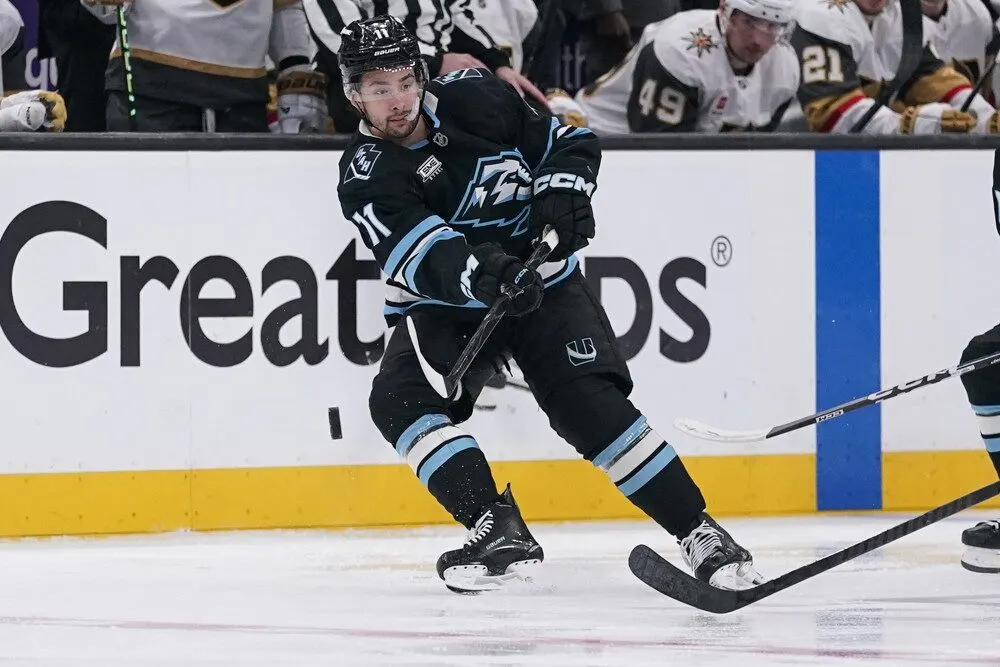

The trendy pick of the preseason is a young team in a new market, and for once the hype has real numbers behind it. Utah keeps showing up on most-improved lists, and the instinct is to roll your eyes at another sleeper that never wakes up. Then you look at the roster, and specifically at the 22-year-old winger who just scored 40 goals, and the case stops looking like hype and starts looking like arithmetic.
| Player | Goals | Points | On-ice xGF% |
|---|---|---|---|
| Clayton Keller | 26 | 88 | 60% |
| Nick Schmaltz | 33 | 74 | 55% |
| Dylan Guenther | 40 | 73 | 57% |
| Logan Cooley | 24 | 43 | 53% |
Guenther is the reason the arrow points up. He scored 40 goals and 73 points and drove a 57 percent on-ice share against a team that was 48 without him, a young sniper who already finishes like a star and tilts the ice while he does it. That combination, elite scoring plus real play-driving, is exactly the profile of a player about to take over games, and he is doing it at an age where most wingers are still fighting for top-six minutes. He is not the whole story, but he is the engine of it.
Utah is legitimately good underneath
The team behind him backs the hype. Utah controlled 51 percent of the expected goals and out-scored its opponents 268 to 240, the profile of a genuinely solid two-way club rather than a lucky one. This is not a team punching above its process; it is a team whose process is already good and whose best players are young enough to get better. When I flagged Clayton Keller as a sleeper, the point was that the pieces were arriving. A year later, the pieces have arrived, and the underlying numbers say the improvement is real.
The depth is the part people miss
Look past Guenther and the lineup keeps giving. Keller is a legitimate number-one at 88 points, Nick Schmaltz scored 33 goals, Logan Cooley is a rising centre coming off a 24-goal season with plenty of room to grow, and Mikhail Sergachev anchors the blue line at 59 points. That is a deep, young, ascending core, the rare group where nearly every important player is on the right side of the aging curve. Most-improved teams usually have one or two risers; Utah has a whole roster of them, which is why the ceiling is higher than the trendy label suggests.
What separates hype from reality
Here is the caveat that decides whether Utah actually leaps or just teases. Most-improved lists are littered with young, positive-possession teams that stalled because their goaltending could not hold up, and the difference between a nice story and a playoff team is almost always the crease. Utah's skaters are ready. The question is whether the goaltending is good enough to convert a 51 percent share into wins in the standings, because a young team that gets even average netminding from this group is dangerous, and one that does not will look like every other sleeper that fizzled.
The honest counter
Young teams are also the least predictable, and that cuts against the hype as much as for it. Development is not linear, a step back from one of the kids is always possible, and a roster this reliant on players in their early twenties can just as easily stall as surge. The 84-game schedule is a new test for a young group, and inexperience tends to show over a long season. The underlying numbers are genuinely encouraging, but betting on youth is betting on a range of outcomes, not a straight line up.
Why the bet is still worth making
Even with the caveats, Utah is the rare sleeper whose case rests on process rather than hope. A 51 percent team with a 40-goal 22-year-old, a point-per-game number one and a rising centre is not projecting improvement off a hot streak; it is projecting it off a solid foundation and a favorable age curve. That is the kind of bet worth making, because the downside is a team that treads water for a year and the upside is a genuine contender arriving ahead of schedule.
The leap in context
A 40-goal season at 22 is not just a nice number; it is a signal. Historically, wingers who reach that kind of scoring that young, while also driving positive shot shares, tend to keep climbing rather than plateau, because they have already demonstrated the two hardest things to project: elite finishing and the ability to tilt the ice. The players who post that profile in their early twenties are, more often than not, the ones who become perennial 40-goal men and occasional Rocket Richard threats. Guenther is squarely on that curve.
What makes the projection safer than the usual young-scorer bet is the play-driving underneath the goals. Plenty of young wingers ride a hot shooting percentage to one big year and then regress, but Guenther's 57 percent on-ice share says the production is built on process, not luck. He is not just finishing; he is helping to create the chances, which is the kind of underlying signal that tends to hold up year over year. A goal total can bounce around; a play-driving habit at his age usually points to a rising floor as much as a rising ceiling.
The context around him matters too, because scorers do not exist in a vacuum. Guenther gets to play alongside a genuine number-one in Clayton Keller, a 30-goal complement in Nick Schmaltz and a rising centre in Logan Cooley, which means defences cannot key on him the way they might on an isolated young star. That supporting cast both boosts his production and protects it, giving him the runway to keep developing without carrying an impossible load. Young stars leap fastest when they are surrounded, and Guenther is.
Put the pieces together and the case for Utah is really a case for its age curve. A team whose best players are this good and this young does not need everything to break right to improve; it just needs its core to follow the normal development path, and Guenther is the clearest evidence that path is steep. The most-improved label usually rests on hope. In Utah's case it rests on a 22-year-old who already scores and drives play, and on the reasonable bet that he, and the kids around him, have not finished getting better.
What it means
The most-improved label usually means very little, but Utah is the exception that earns it, and Dylan Guenther is why. A young winger scoring 40 and driving play is the kind of foundation that turns a solid team into a rising one, and the core around him is deep and young enough to grow together. The one thing standing between Utah and the leap everyone is predicting is goaltending, the same variable that decides most sleepers. Solve that, and the hype becomes a playoff team. Everything else is already in place.