
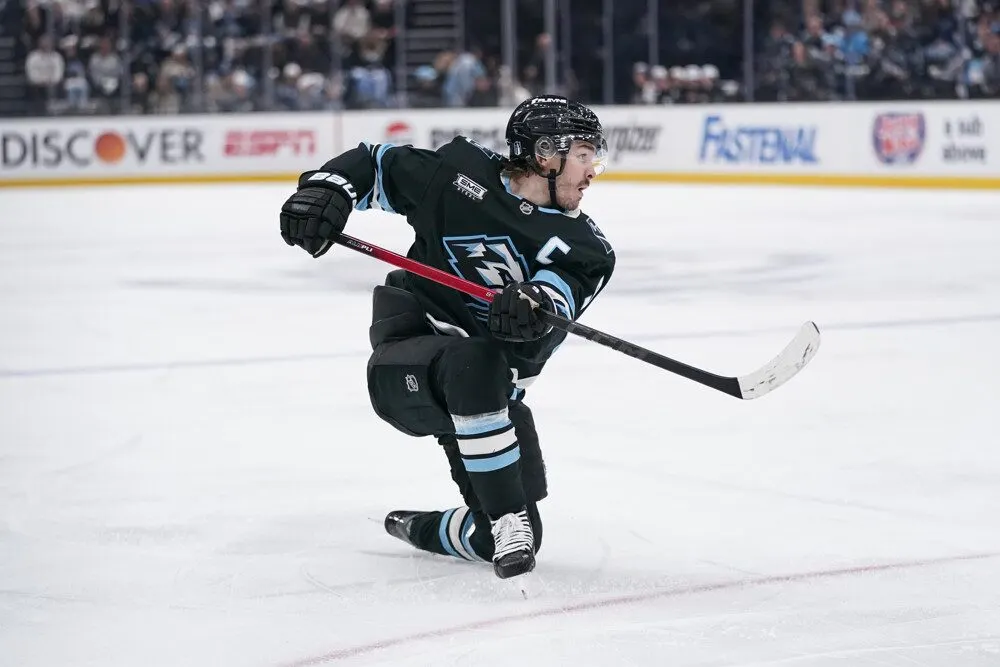

There is a very good young hockey team in Salt Lake City, and most of the league is still not paying attention. That is the market tax of being a relocated franchise in a new building, but it does not change what the numbers say. Utah controlled 51 percent of the expected goals last season, the profile of a real playoff team, and it did it with a young core that has not come close to its ceiling. The face of it is Clayton Keller, and he is a legitimate star whether or not the national broadcasts have noticed.
| Player | Points | Goals | On-ice xGF% |
|---|---|---|---|
| Clayton Keller | 88 | 26 | 60% |
| Nick Schmaltz | 74 | 33 | 55% |
| Dylan Guenther | 73 | 40 | 57% |
| Logan Cooley | 43 | 24 | 53% |
Keller is the real thing
Keller scored 88 points and drove a 60 percent on-ice share while Utah was a 45 percent team without him, a fifteen-point swing that puts him in the class of forwards who genuinely tilt a game. That is not a compiler padding numbers on a bad team; it is a driver making his club better every shift, and he is doing it as the centerpiece rather than a passenger. In a bigger market he would be a household name. In Utah he is the best-kept secret in the sport.
The core around him is young and climbing
What makes Utah dangerous is that Keller is not alone. Nick Schmaltz put up 74 points and 33 goals. Dylan Guenther, at 22, scored 40. Logan Cooley, still only scratching his potential, scored 24 in 54 games and profiles as a future number-one centre. JJ Peterka, added over the summer, chipped in 25 goals, and Barrett Hayton quietly posted a 65 percent on-ice share in a middle-six role. Mikhail Sergachev anchors the blue line. This is a lineup getting better by age curve alone, before you account for a single addition.
The honest gaps
It is not a finished product. The goaltending, with Karel Vejmelka a modest six goals above average, is competent rather than a difference-maker, and a young team chasing a playoff spot usually needs its crease to become a strength at some point. The bottom of the lineup has holes, with Kevin Stenlund (37 percent) and Ian Cole (44) both underwater. And a young team taking the next step is never guaranteed; sophomore lulls and uneven development are the normal texture of a rebuild arriving. But those are the ordinary caveats of a rising team, not the signs of a flawed one.
Why it matters now
Utah is exactly the kind of team that sneaks up on a league that is not looking, and the underlying numbers say the sneaking-up is already underway. Like Anaheim out in the Pacific, it is a young, plus-possession club the standings still underrate. A 51 percent team with a bona fide star in his prime, a 40-goal scorer at 22, and a future top-line centre still developing is not a curiosity. It is a playoff team waiting for the rest of the sport to catch on. Keller has been a star for a while now. This is the season Utah stops being a secret.