
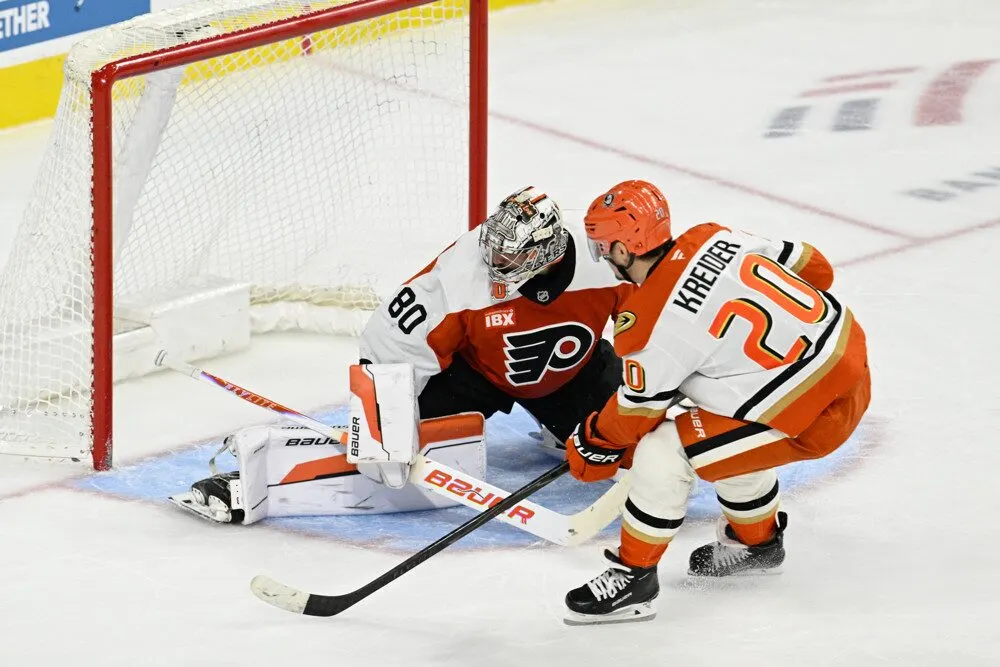

Anaheim ended a nine-year playoff drought, beat Edmonton in six, and took Vegas to six in the second round. That is a real season, and it should end the habit of describing this team as a rebuild. What it does not do is settle the question the Ducks have been avoiding for two years, because they did all of that while allowing 288 goals - the fourth-worst mark in the league, behind only Vancouver, Toronto and San Jose.
| Player | Goals | Points | On-ice xGF% |
|---|---|---|---|
| Cutter Gauthier | 41 | 69 | 58% |
| Leo Carlsson | 29 | 67 | 57% |
| Chris Kreider | 22 | 50 | 59% |
| Mason McTavish | 17 | 41 | 56% |
Chris Kreider is the player most often named when people argue Anaheim's forward group is crowded, so it is worth being precise about what he actually did. He played 75 games, scored 22 goals and 50 points, and drove a 59 percent on-ice expected-goals share - the best mark of any regular forward on the roster. He was sixth in team scoring, behind Gauthier, Carlsson, Beckett Sennecke, defenceman Jackson LaCombe and Troy Terry. That is a useful complementary forward doing exactly what a useful complementary forward should.
The crowding argument did not survive the season
The worry going into last year was that a veteran winger taking top-six minutes on a young roster would stall the players Anaheim actually needs to develop. It is a reasonable worry in the abstract. It simply did not happen.
Cutter Gauthier scored 41 goals. Leo Carlsson put up 67 points and a 57 percent share. Sennecke added 60 points. The young forwards Kreider was supposed to be blocking had the best seasons of their careers, and the Ducks won a playoff round on the back of them. Whatever minutes Kreider absorbed, they did not come out of anyone's development. That argument can be retired.
The problem is the same one it was a year ago
When I wrote about Cutter Gauthier and the blue line, the point was that the Ducks already control play up front, and that their young core had already made the leap. Both of those held up. Anaheim scored 273 goals and pushed play in the right direction with essentially every forward line.
Then it conceded 288. A team that wins a playoff round while surrendering the fourth-most goals in hockey has not solved its problem; it has outrun it for one spring. Vegas is the proof - the series turned on Anaheim's inability to defend a lead, not on any shortage of finishing.
Why another forward is the wrong answer
This is where the offseason matters. The forward group is not where the next win comes from. Anaheim has a 41-goal scorer, a 67-point centre entering his prime, a 60-point winger who is 20, and Kreider as a genuinely effective complementary piece. Adding to that group buys very little, because the group is already good enough to have beaten Edmonton.
The blue line is where the margin is. A defender who can take the hardest matchups does not just prevent goals - he shelters the young forwards, lets the coaching staff pick favourable spots for them, and takes the most punishing minutes off their plates. That is the addition that helps in every direction at once, and it is the one Anaheim has now passed on two summers running. LaCombe's 58 points show the blue line can move the puck. The 288 against is about everything that happens in the other direction.
Where Kreider fits from here
None of this is an argument against Kreider. His 59 percent share was the best on the team, and a net-front finisher on the power play is a specific role young rosters routinely lack. Used as a complementary scorer on a line that is not asked to carry the matchup, he is a clear positive, and last season is the evidence.
There is also a version of this where he becomes an asset rather than a fixture. A productive veteran is exactly what a contender wants in March. If Anaheim slips out of the race, Kreider returns a pick or a prospect and the Ducks are better for having had him. The move that would look bad is holding him out of a misplaced conviction that the roster is closer than it is - and after a second-round appearance, that conviction is easier to hold than it was.
What it means
Anaheim's forwards are not the problem, and Chris Kreider is not the problem. He was their most effective possession forward and their sixth-leading scorer on a team that won a playoff round for the first time since 2017. The problem is that the same roster allowed 288 goals, fourth-worst in the league, and the Ducks have now had two offseasons to address that and have spent neither of them on it.
The next step for this team is a top-pairing defenceman or a goaltender who can steal a series. Everything else is already in place. If next season looks like last season - good enough to make the playoffs, not good enough to survive a team that defends - the reason will not be hard to find, and it will not be at the wrong end of the forward group.