
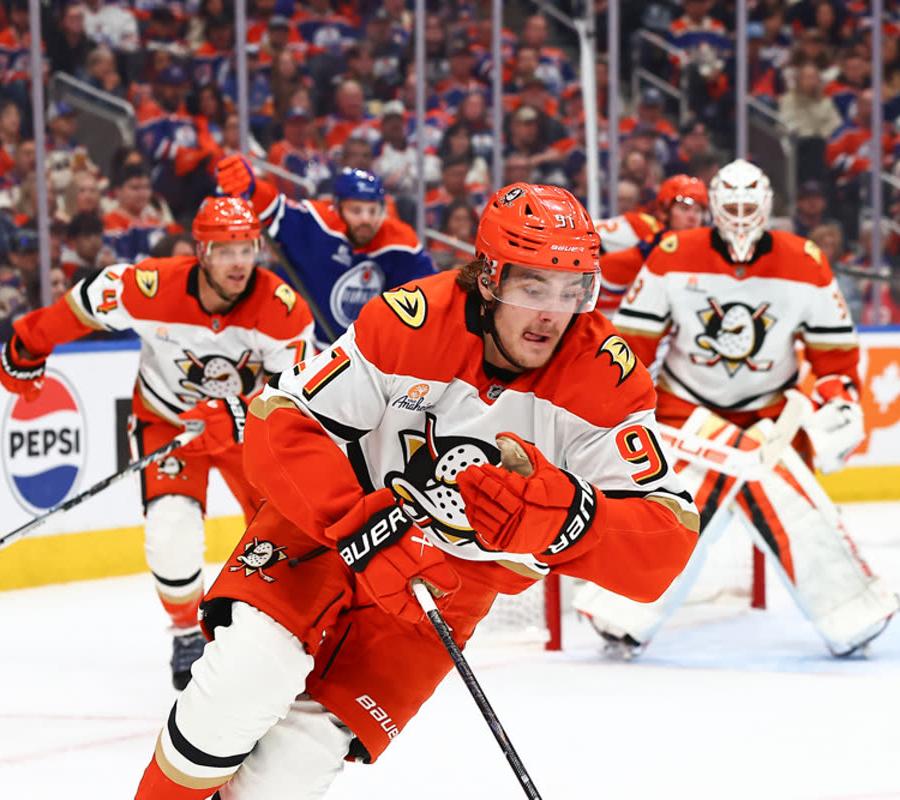

Rebuilds are supposed to announce themselves with a breakout season, a sudden jump in the standings that tells the league a young team has arrived. Anaheim had the quieter version last season: a playoff berth, a first-round upset of Edmonton, and a 92-point record that looked like a nice step and nothing more. The underlying numbers tell a louder story. The Ducks did not just take a step. They became a genuinely good possession team, and they did it while the puck actively refused to go in for them, which is the best problem a rising team can have.
| Player | Goals | Points | On-ice xGF% |
|---|---|---|---|
| Cutter Gauthier | 41 | 69 | 58% |
| Leo Carlsson | 29 | 67 | 57% |
| Mason McTavish | 17 | 41 | 56% |
Start with the team number. Anaheim controlled 51 percent of the expected goals last season, a plus-possession team, the side of the ledger that separates real teams from pretenders. Then look at what it did with those chances: the Ducks generated 286 expected goals and scored only 265, under-finishing by 21. That is not a talent problem; it is a luck problem, and luck of that kind reverses. A 51 percent team that shoots at a normal rate scores those 21 goals, and 21 goals is worth a fistful of standings points. The record undersold the team, and the gap is the kind that closes on its own.
The core already drives play
The reason to believe is in that table. Cutter Gauthier scored 41 goals and drove a 58 percent on-ice share. Leo Carlsson, the franchise centre the Ducks paid a fortune to keep, posted 67 points and a 57 percent share with a plus-ten on/off. Mason McTavish chipped in 41 points and, tellingly, under-finished his own chances by six, though Anaheim will not be the team that collects on that rebound: the Ducks traded him to St. Louis on June 26 for the No. 15 and No. 29 picks in the 2026 draft. Gauthier and Carlsson are not sheltered kids padding stats in soft minutes. They are young players who already tilt the ice against real competition, which is the hard part of development. The finishing is the easy part, and it is the part most likely to improve as they age.
Why this is different from a fluke playoff team
Plenty of teams sneak into the playoffs on a hot goalie or a lucky bounce and vanish the next year. Anaheim is the opposite case. It made the postseason despite its luck, not because of it, riding underlying play good enough to survive a 21-goal finishing shortfall and slightly below-average goaltending. Take a team that already controls the run of play, add a year of development for a core still in its early twenties, and let the finishing regress to normal, and you do not get a modest improvement. You get a team whose record finally matches how well it was already playing. The McTavish trade removes one of the three drivers, but the two who tilted the ice hardest are still in Anaheim, and the picks that came back are how the front office keeps the pipeline stocked.
The honest counter
The caution is the crease. Anaheim's goaltending was a touch below average last season, and a young team that wants to hold a playoff spot needs at least league-average netminding behind its improving skaters; if the goaltending slips further, it can eat some of the finishing gains. And young cores do not always progress in a straight line; a sophomore lull for one of the key pieces is always possible. But those are the ordinary risks of a rising team, not signs of a mirage. The foundation, a plus-possession team driven by a young, ascending core, is exactly what a front office hopes to build.
The bottom line
The Ducks spent years being the league's patient rebuild, and last season the project quietly matured. They out-chanced their opponents, beat a Cup contender in the spring, and did it all while scoring 21 fewer goals than they earned. The leap everyone is waiting for already happened in the underlying numbers; the standings just have not caught up. Give it one more year of development and a normal shooting percentage, and Anaheim will not be a feel-good story. It will be a team the West has to take seriously.
Correction, September 7, 2026: An earlier version of this article described Mason McTavish as a current member of Anaheim's young core and suggested his goal total was likely to climb with the Ducks. Anaheim traded McTavish to St. Louis on June 26, 2026 for the No. 15 and No. 29 picks in the 2026 draft, before this article was published. The relevant sentences have been revised to reflect the trade, and the table caption has been updated. The statistical analysis of the 2025-26 season is unchanged.