
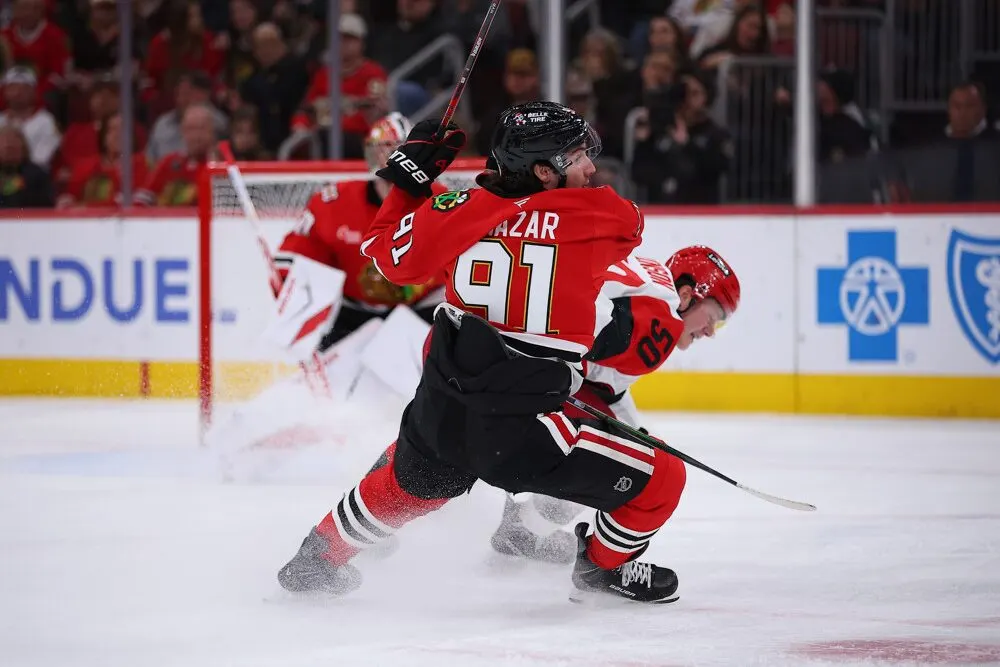

Chicago's rebuild has a face, and it is not the one everyone expected. Connor Bedard is the franchise, the generational draw, the reason the building fills. But the most encouraging development of the Blackhawks' season was the emergence of the player beside him, because a rebuild does not turn on one star. It turns on whether the second and third pieces arrive, and in Frank Nazar, Chicago finally has one climbing the curve.
| Player | Points | On-ice xGF% | Note |
|---|---|---|---|
| Connor Bedard | 75 | 52% | A plus-14 on-off and the franchise |
| Tyler Bertuzzi | 58 | 55% | 32 goals as the veteran finisher |
| Frank Nazar | 41 | 48% | Promising plus-7 sophomore |
| Ilya Mikheyev | 36 | 39% | The drop-off past the top line |
Start with the good, and be precise about it. Nazar posted 40 points as a sophomore and, more importantly, drove a positive on-ice share on a team that drives almost nothing. With Nazar out there, Chicago controlled 48 percent of the expected goals; without him, 41. A plus-seven swing does not sound thunderous until you set it against the backdrop, which is a 44 percent team that gets buried most nights. On this roster, a young player pushing the play toward even is doing something genuinely valuable, and Nazar did it with speed and detail rather than empty offence. He is a real NHL centre, ahead of schedule, and that matters more to Chicago's future than any single highlight.
Bedard is further along than the record shows
The franchise piece is progressing too, and the numbers are kinder to Bedard than the standings are. He put up 73 points and drove a plus-14 on-off, 52 percent with him and a dismal 38 without, which is the fingerprint of a young star already dragging a bad roster uphill by himself. The knock on Bedard has always been that his teams lose; the underlying game says he is not the reason. He is the reason they are ever in it. Add Tyler Bertuzzi's 32 goals as the veteran finisher, and Chicago has a top line that can genuinely play. The trouble is everything after it.
The rest of the roster is where the rebuild still lives
Here is the sobering half. Beyond the top line, Chicago is barren, and the numbers are brutal. Ilya Mikheyev was on the ice for 39 percent of the expected goals. On the blue line, Alex Vlasic sat at 35 percent and Louis Crevier at 39, the kind of marks that turn a promising young forward group into a 44 percent team that allows 270 goals. The Blackhawks are essentially a strong top line and a roster of replacement-level and developing pieces behind it, which is exactly what a rebuild looks like in the middle innings: the stars arrive first, and the supporting cast is the slow, unglamorous part that takes years to fill.
The prospects are the real timeline
The optimism, and it is real, lives in the pipeline. Chicago has one of the deepest prospect pools in hockey, and last season it started to trickle up, with young defencemen Artyom Levshunov and Sam Rinzel and forward Oliver Moore getting their first real looks. None of them fixed the possession problem yet, and none should have been expected to. But they are the reason the rebuild has a direction, and the reason Nazar's emergence matters: he is proof of concept, the first of the draft-and-develop wave to become a genuine NHL contributor. If two or three of the prospects follow the same curve, the barren supporting cast fills in around Bedard and Nazar over the next couple of seasons.
The honest risk
Rebuilds are not guaranteed, and this is where Chicago's could still stall. Prospect pools are probabilities, not promises, and a pipeline that looks loaded on paper can produce two useful players instead of five. The Blackhawks also cannot develop their way out of every hole; at some point they have to spend the cap space they have been hoarding on a real second-pair defenceman and middle-six help, because you cannot ask Bedard and Nazar to drag a replacement-level roster to respectability forever. Patience is the plan, but patience without eventually adding is just losing.
The season-preview reality
So temper the timeline honestly. Chicago is not a playoff team next season, and pretending otherwise does the rebuild a disservice. A 44 percent group does not leap to respectability in one summer, and the goaltending, with Spencer Knight a genuinely useful plus-11, is doing more to hold the fort than the skaters in front of him. What this season is about is not the standings. It is whether Bedard takes another step, whether Nazar builds on the sophomore breakout, and whether the next prospects arrive on schedule. Progress here is measured in development, not points.
Where Nazar fits, and how high he goes
The projection question is the fun one. Nazar profiles as a fast, detailed, two-way centre, which means his ceiling is not just points; it is the kind of complete middle-of-the-ice player who lets a team roll a real one-two punch down the middle behind Bedard. If he becomes a genuine second-line centre, Chicago suddenly has the spine that took Colorado and Dallas years to assemble. If he tops out as a very good third-liner, he is still a useful piece, just not a needle-mover. Last season's plus-seven on a bad team argues for the higher outcome, because driving play at all in that environment is hard and doing it as a sophomore is rarer still. The tell to watch this season is deployment: if the Blackhawks trust Nazar with tougher minutes and his share holds, the arrow points at a legitimate top-six centre. If it sags when the competition stiffens, he is still developing. Either way, he is the first real answer to the question every rebuild eventually has to face, which is whether the machine produces NHL players beyond the lottery pick at the top.
What it means
Frank Nazar will not win a scoring title this season, and the Blackhawks will not make noise in the standings. But the question that actually decides Chicago's future is whether the rebuild is producing NHL players beyond Bedard, and the answer, for the first time in a while, is yes. Nazar is the next piece. The pieces after him are in the system. The waiting is the hard part, and Chicago is finally far enough along that the waiting has a point.