
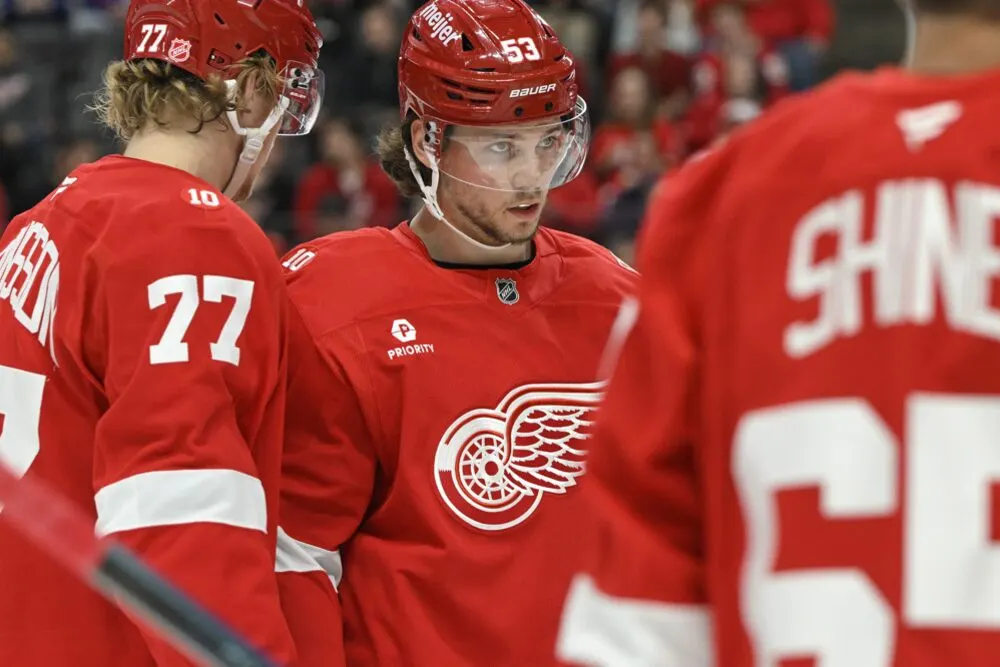

The rebuild in Detroit was supposed to end with a moment like this: a core of drafted-and-developed stars, a respectable team by the underlying numbers, a return to the spring after a long absence. The Red Wings have the first two. They keep failing to get the third, and the reason is not the part of the roster the Yzerplan built. It is everything around it.
| Player | Points | On-ice xGF% | Note |
|---|---|---|---|
| Alex DeBrincat | 85 | 63% | 41 goals and a plus-20 swing |
| Lucas Raymond | 76 | 61% | Plus-16 driver |
| Moritz Seider | 60 | 59% | Carries the blue line |
| Dylan Larkin | 67 | 56% | 34 goals |
The top of this roster is genuinely good
Start with the talent, because it is real. Alex DeBrincat scored 41 goals and drove a 20-point on-ice swing, one of the widest on any team in the league. Lucas Raymond added 76 points at a plus-16. Dylan Larkin scored 34 goals as the captain. Patrick Kane, in his veteran years, still tilted the ice at 62 percent. And holding the blue line together is Moritz Seider, who put up 60 points and a 59 percent on-ice share while playing the hardest minutes on the team. That is a legitimate top five, the kind most rebuilds trade years of losing to assemble.
Seider is doing the work of two players
Seider is the fulcrum, and the numbers show how much he carries. He plays every situation, against the other team's best, and Detroit controlled 59 percent of the expected goals with him on the ice and 44 without him, a fifteen-point swing that is enormous for a defenceman logging that many minutes. Volume at that quality is the whole job of a number-one defenceman, and Seider does it while quarterbacking the power play, killing penalties, and defending the last two minutes of one-goal games. He belongs in the same Norris conversation the sport reserves for the Makars and the Hughes brothers, and he is having it while dragging a flawed roster rather than riding a great one. The trouble is what happens the moment he steps off the ice.
The bottom of the roster gives it all back
Here is where the season leaks away. Detroit's depth and second pair are a sieve. Ben Chiarot was on the ice for just 42 percent of the expected goals against a team that was 55 without him, one of the worst regular drags in the league. J.T. Compher (42 percent), Mason Appleton (40) and Michael Rasmussen (42) tell the same story, and even Justin Faulk, a top-four defenceman, sat at 43. A 50 percent team overall is the average of a starry top five that drags the ice one way and a bottom half that drags it right back. Seider and DeBrincat pull Detroit to even. The depth pulls it back under, shift after shift, until a promising season settles into the same familiar place just outside the picture.
| Piece | Number | The read |
|---|---|---|
| John Gibson goals saved above expected | +11.7 | Good when he played |
| Cam Talbot goals saved above expected | -13.1 | A disaster the other half of the time |
| Bottom-six and second pair | Underwater | Chiarot Compher and Appleton all near 42 percent |
The crease split it in half
The goaltending did not help, and it failed in the most maddening way. John Gibson saved almost 12 goals above expected, a genuinely good season. Cam Talbot gave back more than 13. Whenever Talbot played, an already-shaky Detroit defence had no safety net at all, and the roughly 25-goal gap between the two goalies is the difference between a team that sneaks in and one that watches. A club this thin in front of its goalies cannot afford to run out the one who finishes 13 in the wrong direction, and the fact that it kept doing so is the kind of decision that quietly costs a fringe team its season.
The fix is unglamorous, and that is the point
None of Detroit's problems require another star. They require the parts of a roster that do not make highlight reels: a third pair that can hold its own, a checking line that does not surrender the middle of the ice, a stable second goaltender. Steve Yzerman spent the rebuild hoarding cap space and draft capital precisely so he could buy those pieces when the core arrived, and the core has arrived. The question is whether the front office treats last season as the near-miss it was and finally spends on the boring, necessary depth, or keeps waiting for internal development to solve a problem that is really about roster construction. Young players like Marco Kasper and Simon Edvinsson will help at the margins, but margins are not the issue. The issue is that four of the bottom-six regulars and half the crease are actively costing the team games.
The Larkin and Kane question
The urgency is sharpened by the shape of the forward group. Patrick Kane is playing out the final act of a great career, a brilliant complementary piece rather than a foundation. And the captain's own future has been a summer-long storyline; I broke down Dylan Larkin's situation earlier, and the short version is that Detroit's veteran core and its young core are on slightly different clocks. That tension is exactly why the depth problem cannot be deferred. If the Red Wings believe this group's window is now, they have to spend to support it now, while Kane can still contribute and before the next contract crunch. If they are further away than that, they owe themselves honesty about it. What they cannot keep doing is icing a roster good enough to tease and too shallow to deliver.
What it means
Detroit does not need more stars. It has them, and Seider is quietly one of the best defencemen in the league. What it needs is a bottom six that can tread water, a second pair that does not hemorrhage chances, and a goaltending tandem without a minus-13 half. The Yzerplan built the hard part, the high-end talent that takes years and losing to acquire. The easy part, the depth and the crease, is what keeps ending the season, and until the front office fixes it, Seider and DeBrincat will keep dragging the Red Wings to the cut line while everyone behind them drags the team right back off it. The stars have done their job. The roster around them has not, and that is a solvable problem the Red Wings can no longer afford to defer.