
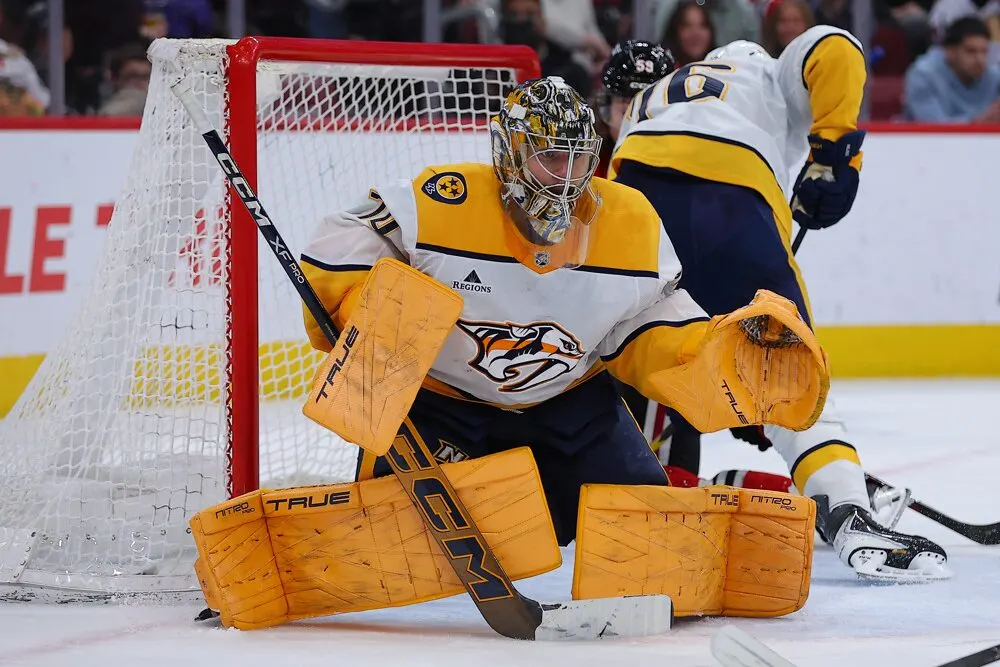

Nashville built last season's roster like a team in a hurry. It spent on veterans, leaned on its established stars, and asked a proven core to drag it back into the race. The stars did their part. Nashville still missed, and the reason is not complicated once you look past the standings: the goaltending, and the blue line in front of it, gave away what the forwards earned.
Start with the production, because it undercuts the easy story that this group is too old to score. Filip Forsberg scored 40 goals. Steven Stamkos, supposedly finished, scored 42. Ryan O'Reilly added 74 points, Luke Evangelista broke out for 56, and Roman Josi, when healthy, still ran the show from the back end. That is a top of the lineup that produced at a playoff level.
| Piece | Number | The read |
|---|---|---|
| Forsberg and Stamkos goals | 82 | The veterans scored plenty |
| Juuse Saros goals saved above expected | -9.3 | The starter cost the team |
| Justus Annunen goals saved above expected | +8.3 | The backup was far better |
| Team 5-on-5 share | 48% | Out-chanced and the crease made it worse |
The crease sank it
Here is where the season turned. Juuse Saros, the franchise goaltender and one of the highest-paid at his position, finished nine goals below what an average netminder would have allowed across 59 games. In a league where the gap between a playoff team and a lottery team is a couple of dozen goals, a starter running nine in the wrong direction is close to disqualifying on its own. The cruelest part is that Nashville had a better option on its own bench: Justus Annunen saved eight above average in 28 games. The distance between those two crease profiles, over a full season of starts, is the difference between watching the playoffs and playing in them.
The back end did not help
The goaltending did not fail in a vacuum. Nashville's defence beyond Josi is where the chances leaked. Brady Skjei, a big-money signing, was on the ice for just 43 percent of the expected goals against a team that was 52 without him. Nick Perbix (38 percent) was worse. A goalie can only do so much behind a blue line that surrenders the middle of the ice, and the Predators asked Saros to rescue a group that kept handing opponents the exact chances goalies are least likely to stop.
The uncomfortable parallel
This is the same lesson that keeps recurring around the league, most recently in St. Louis with Jordan Binnington: reputation at the goaltending position lags reality, and teams that keep feeding starts to a struggling name over a better-performing alternative pay for it in the standings. Nashville is not obligated to bench a franchise icon. It is obligated to be honest that last season the icon was the problem and the backup was the solution.
Going into the season
The bones are better than the record. Forsberg and Stamkos can still score, O'Reilly is a genuine two-way centre, and a 48 percent possession team is closer to the cut line than a bad one. But the fix is specific and it is not on the top line. Nashville needs Saros to climb back toward his career norm, or it needs to give Annunen the net and mean it, and it needs a top-four defenceman who does not bleed chances. Do that, and the same core is a playoff team. Run it back and hope, and the Predators learn the same lesson twice.