

 Vancouver Canucks
 Colorado Avalanche
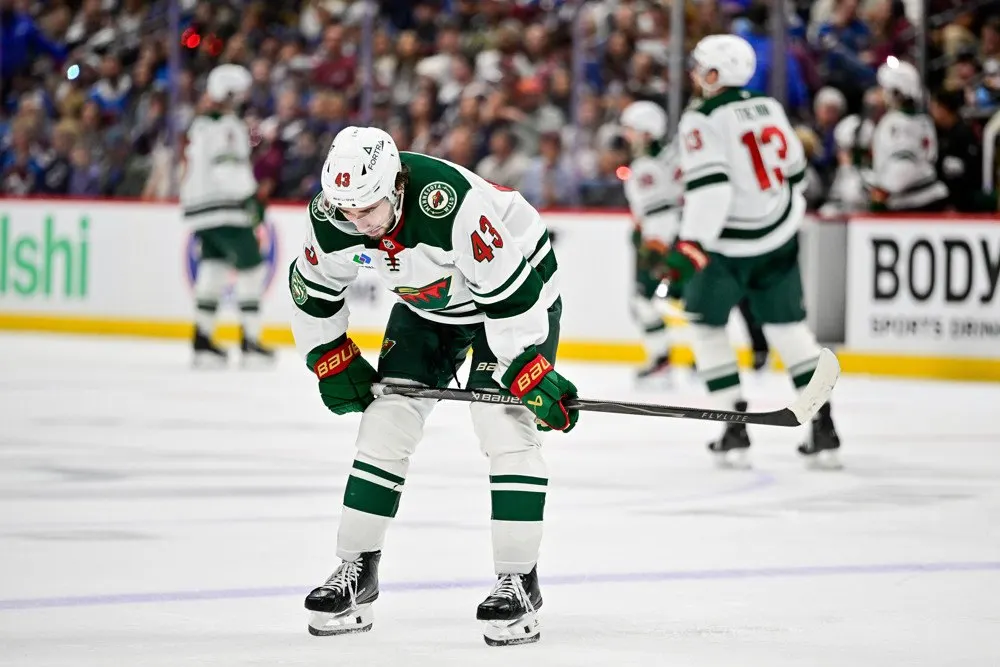
Brock Faber took a shot near the left ear hole in a preseason game against Dallas on 25 September, finished the period, and had surgery four days later on a fractured skull. He is out indefinitely. His coach's description of how close it came was that a quarter of an inch higher and the puck hits the helmet.
That is the first thing to say, and the only part of it that matters to the player. The second thing is what it does to a team that had just rebuilt itself around a blue line, and had spent December acquiring the most heavily used defenceman in hockey to sit on top of it.
The leap was defensive, and it was recent
Minnesota's 104-point season was the best the franchise has had in years, and the shape of it is worth being precise about. The scoring went up, from 229 goals to 272, per the 2025-26 standings. But the thing that actually moved was at the other end.
The important detail, and the one that complicates every easy reading of this injury, is that Minnesota did not have its best defenceman for most of that season.
Quinn Hughes began 2025-26 in Vancouver. He played 26 games there, then 48 for the Wild after the trade. Across the full season he averaged 27.7 minutes a night, more than any defenceman in the NHL, and finished with 76 points. Faber played 80 games for Minnesota at 24.7 minutes, with 51 points and 148 blocked shots.
So the fourth-best goals-against figure in the league was produced by a team that had Faber all year and Hughes for a little over half of it. The pair people imagine anchoring that season only existed for 48 games.
The cliff behind them
Whatever the split, the usage pattern is the thing. Minnesota concentrates defensive minutes in very few players, and there is a sharp drop to everybody else.
Jonas Brodin at 20.3 minutes is the obvious candidate to step up. He is a good defensive player, but he managed 62 games last season and has not carried a 24-minute workload for some time. Jared Spurgeon played 79 games at 19.6. Both are being asked to do more at the point in their careers when teams usually ask them to do less.
The swap nobody framed this way
Here is the honest accounting, and it is not the disaster the headlines imply.
Minnesota is losing Faber for an unknown period. It is also gaining roughly 34 more games of Quinn Hughes than it had last season, because he arrived in the middle of it. In pure minutes, those two things are closer to cancelling out than anyone has said.
What does not cancel out is the shape. Two 24-plus-minute defencemen let a coach split the hardest assignments, run two penalty-killing looks and protect the bottom pair. One 27-minute defenceman and a 20-minute second option does not. Everything gets harder downstream: Hughes draws more of the opposition's best, the second pair plays minutes it was not built for, and the third pair plays at all.
The penalty kill is where this should show up first, and it was already the soft spot. Minnesota's power play was third in the league at 25.2 percent. Its penalty kill was 16th, at 79.8 percent, a long way behind Colorado's league-leading 84.6. Faber's 148 blocked shots were not decorative.
The warning sign hiding in Hughes's season
There is a reason to doubt that simply giving Hughes more is the answer.
He led every defenceman in the league in ice time and finished at minus-4. Among the six highest-scoring defencemen in hockey he was the only one in the red. Cale Makar was plus-32 on 24.8 minutes a night. Lane Hutson was plus-36 on 23.8. Evan Bouchard, who led all defencemen with 95 points, was plus-25 on 24.7.
Plus-minus is a blunt instrument and Hughes split his season between a 32nd-placed team and a contender, which flatters nobody. But the direction is still worth noting: the player being asked to absorb Faber's minutes was already playing more than anyone in the sport, and the on-ice results were not following the ice time.
The part the league should be uncomfortable about
Faber was struck below the shell of the helmet and played the rest of the period before anyone understood what had happened.
In the same fortnight, the NHL circulated an enforcement video to all 32 clubs covering jersey tucks, visor height, warmup helmets and mandatory cut-resistant neck protection. The neck guard requirement applies only to players who have never played an NHL game. Trevor Zegras was given the first jersey-tuck penalty in 13 years, and most of the Philadelphia roster skated warmups tucked in protest.
Those are not equivalent problems, and nobody is claiming a neck guard would have helped here. But it was a strange fortnight, in which the league's visible equipment energy went into where a jersey sits and where a visor sits, while a 24-year-old finished a period with a fractured skull through a gap no rule covers.
The case for Minnesota, stated fairly
Where this lands
They finished fourth in the league in goals against and scored 272 goals, their most in years, and the offence is intact: Kirill Kaprizov had 89 points in 78 games and the power play was third in the NHL. Crucially, they did all that with Hughes for only 48 games. A full season of the most-used defenceman in hockey is a real addition, and it lands in the same year they lose Faber rather than a year later. Brodin and Spurgeon have played big minutes before. Faber is 24 and this is an injury he returns from.
A top-four that works because two men play 24-plus minutes does not survive losing one of them, and the drop to the third option is 4.4 minutes a night. The penalty kill was already 16th at 79.8 percent, and Faber blocked 148 shots. Hughes was at minus-4 while leading the league in ice time, which is not the profile of a player with obvious headroom. And "indefinite" after skull surgery is not a timeline you build a season around.
What it means
Watch Hughes's ice time through October. If it climbs past 28 minutes a night, Minnesota has chosen to solve this by asking one man to do more, which works for a month and rarely works for a season. If John Hynes can hold him near 27 and lift Brodin to 23, the Wild have spread the load instead, which is the version that lasts.
Then watch the goals against rather than the record, which Pucky's standings carry side by side. Minnesota conceded 235 last season and that number, not the scoring, is why they were a 104-point team. If it drifts back toward the 263 they allowed in 2023-24, this becomes a different season entirely, and the penalty kill will be the first place it shows.