

 Colorado Avalanche
 Anaheim Ducks
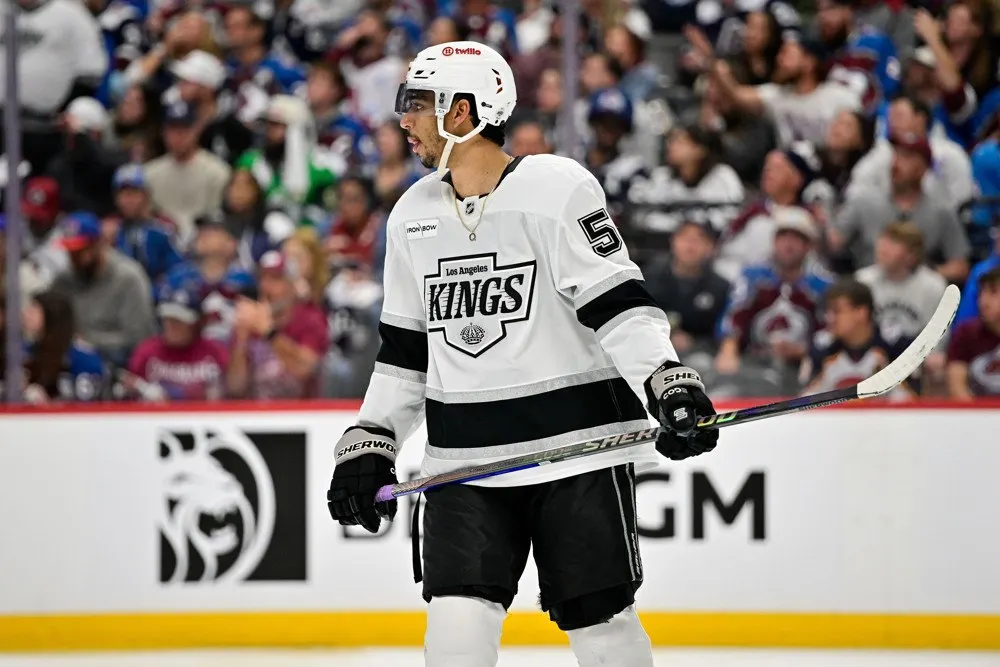
Los Angeles opened the season by losing 8-4 in Denver, in Peter Laviolette's first game as head coach, and the question arrived before the handshakes: is that what this season is going to be?
Two answers are circulating. The first is that it was one night in the hardest building in the conference and nobody should read anything into it. The second, which has been gathering pace all summer, is that it does not matter either way, because the Kings are quietly running this season down to clear the books for the summer of 2028, when Connor McDavid and Auston Matthews both reach free agency on the same day.
One of those answers is wrong and the other one is not reported. The honest reading is less flattering than either: the warning was in last season's table, and almost nobody read it.
What 90 points was actually worth
Los Angeles finished 2025-26 on 90 points and took the final playoff place in the Western Conference. On the face of it, a sixth straight postseason. Underneath, it was the worst season the club has had in half a decade, and the standings hid it.
The Kings lost 20 games in overtime, more than any team in the league. Each of those is a point in the table for a game they did not win. Strip them out and Los Angeles won 35 of 82 games. Only 77.8 percent of their points came from actual wins, against roughly 89 to 91 percent in each of the four seasons before it.
The goal differential tells the same story without the arithmetic. They were minus-13.
A 60-goal swing is not noise. It is the difference between a good team and a bad one, and it happened in a single season while the record moved from 48-25-9 to 35-27-20.
They were not even the worst case in their own conference. The Western playoff field last season contained two clubs that were outscored across 82 games: Anaheim at minus-15 in sixth, and the Kings at minus-13 in eighth. Four teams that missed the playoffs altogether had a better goal differential than Los Angeles, as the 2025-26 standings show.
So the answer to whether the 8-4 means anything is: on its own, no, and it does not need to. A team that was outscored across a full season, then lost its franchise centre to retirement, is not being slandered by one bad night in Denver. It is being described.
What changed, and what did not
Anze Kopitar has retired. He played 67 games last season for 38 points, well down from his peak, but he was still the centre the structure was built around for the better part of two decades, and there is no replacement on the roster. Quinton Byfield moves up to take the job on the back of a 49-point season.
The club's leading scorer last season was Adrian Kempe with 73 points. Artemi Panarin arrived from the Rangers in February on a two-year extension at $11 million a season and added 27 points in 26 games as a King, 84 in all across both clubs. After that it drops away quickly: Kevin Fiala managed 40 points in 56 games, Drew Doughty 23 in 72 at $11 million against the cap, and Darcy Kuemper played 50 games in a crease that has not been settled since Jonathan Quick left.
That is a top-heavy, expensive, ageing roster that was outscored last season and has lost its centre. Laviolette is the third man behind the bench in eight months, after Jim Hiller was sacked on 1 March and D.J. Smith finished the year on an interim basis.
The 2028 maths is real
Here is where the speculation starts, and the first part of it checks out.
McDavid signed a two-year extension in October 2025 worth $25 million, carrying him through 2027-28 at a $12.5 million cap hit. Matthews is in year three of a four-year, $53 million deal at $13.25 million. Both contracts expire at the same moment. Both men become unrestricted free agents on 1 July 2028, McDavid at 31 and Matthews at 30, and both are represented by the same agent, Judd Moldaver.
Los Angeles, meanwhile, has roughly $1.8 million of space this season against a $104 million cap, about $37 million for 2027-28, and roughly $82.6 million for 2028-29. Panarin and Doughty come off the books in 2027 at $11 million each, along with Kuemper, Mats Zuccarello, Corey Perry, Anton Forsberg and Erik Gustafsson. That is around $32.5 million expiring in one summer, a year before the two best players of their generation hit the market together.
Nobody has to invent a conspiracy to find that interesting. The cap structure is a matter of record and the expiry dates are a matter of record.
Nobody actually reported the plan
What is not a matter of record is the intent, and this is the part worth being careful about, because the story has been laundered.
The original source is Elliotte Friedman, who said on his podcast that the Kings were keeping "maximum flexibility" for an "LA-type move", and described them as a dollar-in, dollar-out cap team. That is the entire reported basis. Friedman did not name McDavid. He did not name Matthews. He did not say 2028.
From there, The Hockey News ran a headline saying an NHL insider believed the Kings could be positioning for McDavid or Matthews, while the body of the piece quoted only Friedman's two phrases and then noted that they had "sparked speculation". Aggregators picked up the headline and reported it as the Kings "reportedly lining up" a blockbuster. A fan site then published the full version, complete with a described "plan" and the line that the two contracts expiring together is "the quiet engine" of it. One fan blog, to its credit, pointed out that Friedman had never mentioned anybody by name.
So a reporter's two words about flexibility became a named, dated, two-player strategy in about four steps, and none of the steps added any sourcing.
Against that, the things the Kings have actually said and done point the other way. General manager Ken Holland, at his end-of-season press conference in May, was explicit: "When you head into rebuild modes, it's eight to 10 years till you come out on the other side, with no guarantees." He said his job was to "build a better team" and to "push and grind" to make it deeper. He did not mention cap space or free agency at all. And in February, the Kings traded a first-round-calibre prospect and two conditional picks for a 34-year-old winger and immediately extended him for two years at $11 million. That is not what banking 2028 cap space looks like.
The case for the patient read, stated fairly
Where this lands
The 8-4 was one night, in Denver, against the team that won the Presidents' Trophy, with a coach running his first game and a roster missing the centre it was built around for twenty years. Holland's point that only six clubs have made the playoffs five years running, and that a teardown costs eight to ten years with no guarantees, is a fair defence of not blowing it up. The cap flexibility is genuine and it arrives at a genuinely useful moment, whether or not anyone has said so out loud. Byfield at 24 taking the top-line job, with Panarin and Kempe on his flanks, is a reasonable bet rather than a surrender.
The 90-point season was fiction. Twenty overtime losses, the most in the league, dressed a minus-13 goal differential up as a playoff team, and the honest version of last season is a club that was outscored and finished 35-27-20. The 60-goal collapse from plus-47 happened before Kopitar retired, not after. Doughty is 36 and costs $11 million. The crease is unresolved. And the consolation story being told about 2028 is not a story anybody has reported: it is one podcast phrase about "flexibility" that four outlets turned into a plan.
What it means
Watch the goal differential, not the points, and Pucky's standings carry both. Los Angeles will bank overtime points again, because they have done it every year and did it more than anyone last season, and those points will keep the record looking respectable long after the hockey stops justifying it. If they are still negative at American Thanksgiving, the record is lying again.
The second thing to watch is Byfield. He is the one player on this roster whose ceiling can still move the franchise, and he has been handed the job that decides whether this is a retool or a decline. If he takes a real step at centre, Holland's refusal to tear it down looks like judgement. If he does not, the Kings spend two more seasons in the same place they have been for five, which is good enough to make the playoffs and not good enough to survive a week of them.
And when somebody tells you in February that Los Angeles is clearing the decks for McDavid, ask them who reported it. The cap sheet is real. The plan is a rumour with a four-step paper trail, and the Kings' own general manager has already said the opposite.