
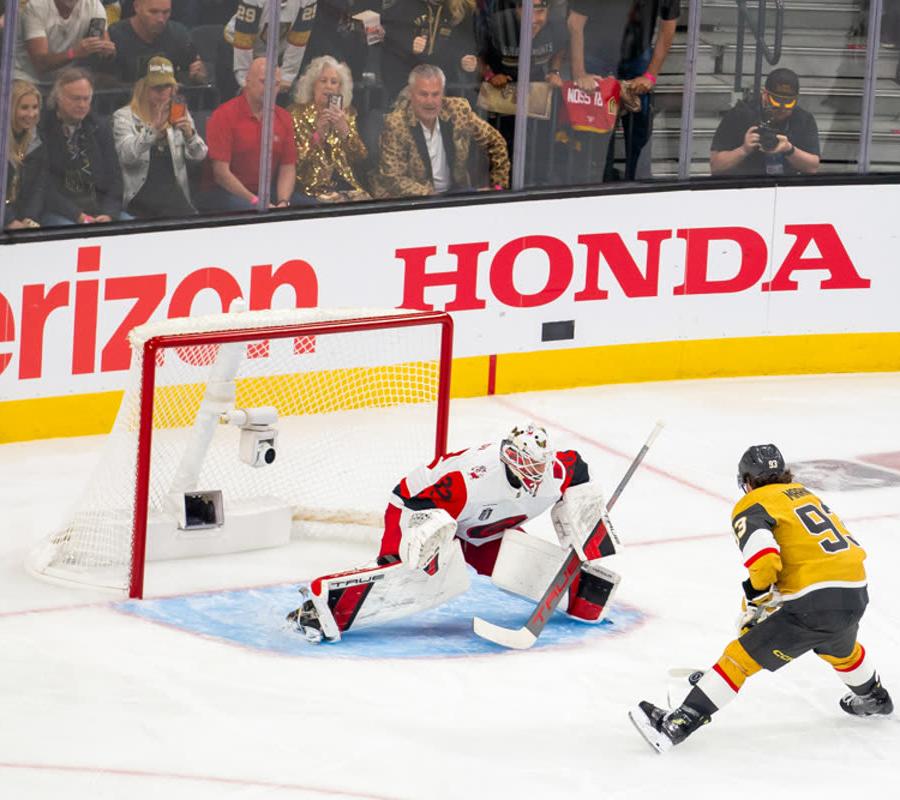


The Stanley Cup that Rod Brind'Amour lifted in Las Vegas was not built in Raleigh. It was assembled, piece by piece, out of players other teams talked themselves out of. The winning goal came off the stick of a winger imported to play twelve minutes a night. The clinching empty-netter belonged to a Winnipeg lifer who walked in free agency. And the loudest performer in the entire tournament was a scorer Toronto let leave in a different uniform.
Trades don't get graded on the day they happen. They get graded in June. The season is over, the bracket is settled, and every deal below has a result attached to it now - not a projection. So here is the ledger, with the receipts.
The Rubric
Three inputs, weighted by what matters most in July. On-ice production with the new team, measured in points per game against the player's pre-trade rate. Role and fit - did the team get the piece it actually needed. And, decisively, the playoff payoff, because a deadline is a bet on the spring and the spring has now happened. Draft picks and prospects who haven't debuted are noted but not fully scored, so a few grades lean incomplete. Letter grades are editorial judgments, not a model.
1. Carolina Wins the Trade of the Year Without Winning the Player
Sixteen months ago the Carolina Hurricanes had Mikko Rantanen - a genuine superstar, a rental they'd acquired weeks earlier and could not sign - and a choice to make. They flipped him to the Dallas Stars for Logan Stankoven, a 21-year-old they could keep, plus draft capital. The framing wrote itself: the Canes rented a franchise winger, got cold feet, and settled. That is the story you tell in March.
Then the players played, and the playoffs graded it. Stankoven scored ten goals across 82 regular-season games - a useful, unremarkable middle-six line. And then the tournament started and he became someone else: eleven goals and fifteen points in eighteen playoff games, three of them game-winners, on the way to a Cup. He scored more goals in eighteen playoff games than in his entire regular season. Rantanen did what a star does in the regular season - 74 points - and then produced a single goal in a three-game first-round exit. The better player, comfortably, delivered three playoff points for the team that paid full price.
You do not win this trade on talent. You win it on timeline, cost and June. Carolina turned a winger it was going to lose for nothing into a cost-controlled 24-year-old champion.
2. Toronto Was Right About Marner. It Cost Them Anyway.
When the Toronto Maple Leafs moved Mitch Marner to the Vegas Golden Knights in a July sign-and-trade, they were closing the book on a player who had just posted 102 points - and who had spent a decade producing in the regular season and disappearing in the spring. In year one, the regular-season read looked correct and brutal: Marner's scoring fell from 102 points to 51, a clean halving, in a lower-usage role.
And then the playoffs arrived and he was the best forward in the tournament. Twenty-nine points in twenty-one games. A plus-14. He tied a Cup Final scoring record that had stood for over a century and dragged Vegas to within two wins of the title. The player Toronto begged to show up in the playoffs for ten years showed up - in someone else's sweater, the same summer they let him walk.
3. Minnesota Bought the Present, Vancouver Bought the Future
The Minnesota Wild traded for a Norris-calibre No. 1 defenceman in Quinn Hughes and immediately ended an eleven-year first-round drought, pushing Colorado to a Game 5 in the second round. The Vancouver Canucks took back a young, real return - Marco Rossi produced at a 0.76 clip, Zeev Buium flashed top-four upside - plus draft capital, and finished last in the Pacific in the first year of a reset.
This is the rare blockbuster both sides can defend. Minnesota won the present decisively. Vancouver's grade is written in pencil until the kids and the picks resolve.
4. Vegas Found Its Top Four
Vegas needed a right-shot defenceman for a Cup push and got one in Rasmus Andersson, whose plus-minus swung from minus-38 in Calgary to plus-4 in the desert on eighteen minutes a night - and reached the Final. Calgary, mid-teardown, took back Zach Whitecloud and a pick. Fair business for a seller; Vegas got the June out of it.
5. The Deal Both Sides Can Frame
MacKenzie Weegar anchored a blue line that carried the first-year Utah Mammoth to their first playoff series - precisely the veteran spine an expansion-era roster needed. Olli Määttä, going the other way to Calgary, posted the single biggest per-game jump of any deadline defenceman (0.05 to 0.67). Nobody lost this one.
6. Good Process, Cruel Result in Colorado
The Colorado Avalanche reunion made sense: Nazem Kadri gave the Presidents' Trophy winners a bona fide second-line centre (0.59 with Colorado) as they piled up 121 points. The asterisk is April - Colorado was swept in Round 2 with Makar and MacKinnon hurt, so the payoff never arrived. You grade the process an A and the result a C, and land in the middle.
7. A Swap of Problems in Net
Both goalies in the Pittsburgh Penguins-Edmonton Oilers exchange got worse after the move. But Brett Kulak stabilised a Pittsburgh third pair that made the playoffs, while Edmonton's return became one of four goalies they cycled through in a 93-point season that ended in Round 1 and cost the coach his job. Nobody won this. Someone lost it less.
8. Two Moves That Didn't Move the Needle
Brayden Schenn gave the New York Islanders a centre bump (up to 0.58 a game); Jonathan Drouin faded with the St. Louis Blues. Grade it on the standings, though, and it's moot: both teams missed the playoffs, St. Louis by four agonising points. A deadline move that doesn't get you in is, in the end, a move that didn't matter.
9. The Steepest Fall on the Board
Yegor Chinakhov collapsed from 0.73 to 0.21 points per game after landing in Columbus - the largest drop of any traded player this season - and the Blue Jackets missed the playoffs for a sixth straight year. Danton Heinen, going back to Pittsburgh, didn't light it up either, but he did it on a team that made the dance. Low bar, cleared.
10. Buffalo Bought Depth, and the Drought Ended
The Buffalo Sabres did quiet, sensible business with the Winnipeg Jets at the deadline - adding scoring depth in Isak Rosen and bottom-six bodies in Tanner Pearson and Logan Stanley, sending back Jacob Bryson and futures. None of it was a headline. All of it was part of a season that finally ended a fourteen-year playoff drought and delivered an Atlantic Division banner. Depth doesn't trend. Depth decides March.

The Rest of the 77
Most deadline moves are role changes dressed up as blockbusters. For the record, the biggest per-game risers and fallers among the players who changed teams and weren't graded above:
| Player | POS | Trade | GP | PPG Before → After | Swing |
|---|---|---|---|---|---|
| Lukas Reichel | LW | VAN → CHI | 5 | 0.07 → 0.80 | +0.73 |
| Tye Kartye | LW | SEA → NYR | 24 | 0.20 → 0.58 | +0.38 |
| Isak Rosen | RW | WPG → BUF | 16 | 0.14 → 0.44 | +0.29 |
| Bobby McMann | C | TOR → SEA | 18 | 0.53 → 0.78 | +0.24 |
| Conor Garland | RW | VAN → CBJ | 20 | 0.52 → 0.35 | -0.17 |
| Mason Marchment | LW | CBJ → SEA | 29 | 0.82 → 0.45 | -0.37 |
| Yegor Chinakhov | RW | PIT → CBJ | 29 | 0.73 → 0.21 | -0.53 |
Small samples cut both ways - Reichel's leap came on five games - but the pattern is the point: the deadline is where contenders overpay for certainty and rebuilders sell it, and a season later almost none of it touches a ring.
GM of the Trade Season · Carolina
Two pieces the market treated as consolation prizes - Stankoven and, in free agency, Ehlers - turned into a banner. The blueprint for winning by buying what everyone else undervalues.
The Deal They'd Take Back · Edmonton
The goaltending answer that helped turn 93 points into a first-round exit and cost the coach his job. The one move on this page that changed a franchise's summer.
Best Kept Secret · Utah
Weegar gave a first-year franchise a playoff-calibre spine. The least-discussed win of the deadline.
Still Unwritten · Vancouver
Rossi, Buium and the picks could make the Hughes trade respectable in hindsight - or not. Ask again in 2027.
What the 2026 Ledger Actually Says
The players who decided the playoffs were, at the moment they were acquired, considered the lesser end of their deals. Stankoven was the consolation for losing Rantanen. Marner was a bet on a reputation the market had soured on. Both were dismissed in the moment and vindicated in June.
For a league heading into another summer of overpaying at the deadline, that's the number to remember: the two trades that built and nearly-built champions this year were the two that looked, on the day they were signed, like someone settling. Carolina and Vegas didn't win by acquiring the best player in the room. They won by correctly guessing which player would still be standing in June.
The rest of the league spent the deadline buying names. The champions bought the spring.