
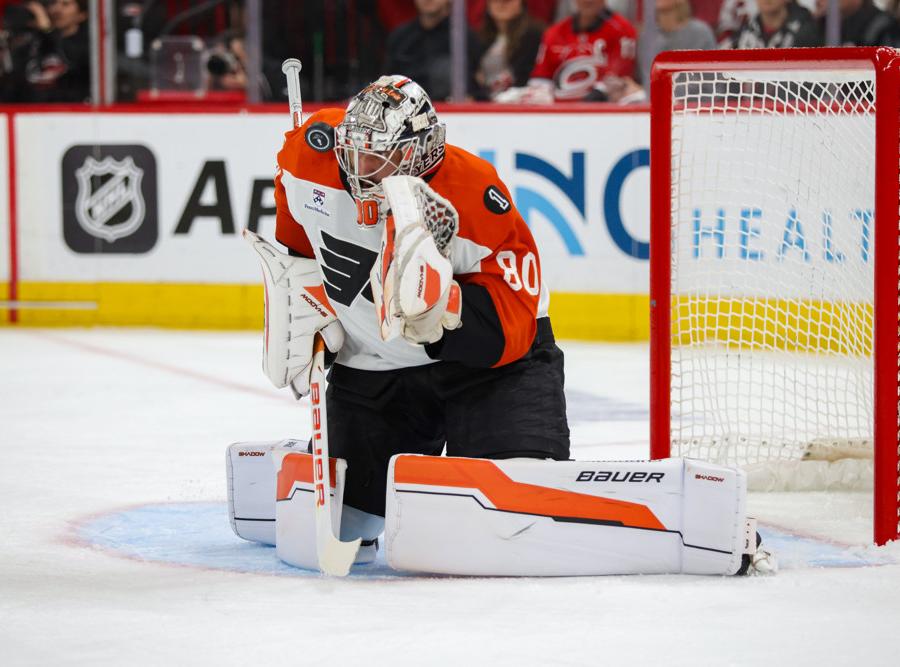

The preseason over-under was 84.5 points. They finished with 98. They beat Pittsburgh as 3.8% favourites. They were swept by the eventual Stanley Cup champion Carolina Hurricanes in Round 2. Thirteen players made their playoff debut, five of them rookies, nine of them 24 or younger. The summer brings the question that could change everything: what do they do with Matvei Michkov?
By Mike Holloway · June 2026 · 2025–26 Season Review Series · #8 of 32 · Playoff Teams · Best Turnaround in the East
Phase 1 · Oct–Nov: Belief From Day One
"All the doubters all year, we believed right from training camp." Owen Tippett's words and the team's October hockey told the same story. The 84.5-point over-under and the 150-to-1 Cup odds were ignored from the first puck drop by a group that had decided in September it was not the team the market had priced.
Phase 2 · Dec–Feb: Vladar Carrying
Michkov was inconsistent. Zegras was still finding his role. Daniel Vladar was the team's most important player from December through February, the goaltender keeping a young, structurally sound team in games it had no business being in on talent alone. He was the bridge that held the season together until the offence caught up.
Phase 3 · Mar–Apr: Martone Arrives
A 19-year-old walked in from Michigan State on March 31. Four goals and six assists in nine regular-season games. A 3.67 goals-per-game average with him in the lineup - more than a full goal per game above the team's season average. The pipeline turned into present-tense production in three weeks.
Phase 4 · Apr 13: Foerster Clinches
Tyson Foerster had surgery on December 15 and was not expected back this season. He returned April 2. On April 13 he scored the shootout winner against Carolina that clinched the Flyers' playoff spot. It is one of the season's most improbable individual stories and the moment the franchise knew it was different now.
The Philadelphia Flyers entered the 2025-26 season with a preseason over-under of 84.5 points, Cup odds of 150-to-1, and the recent memory of finishing last in the Eastern Conference with 76 points. John Tortorella had been fired. Rick Tocchet, who had won the Jack Adams Award coaching Vancouver the year before, was hired on a five-year contract as one of the NHL's highest-paid bench bosses. The roster featured an inconsistent 20-year-old in Matvei Michkov, a newly acquired Trevor Zegras still finding his way, and a goaltender in Daniel Vladar who had been quietly excellent and loudly underappreciated. They finished with 98 points. They beat the Pittsburgh Penguins in the first round, entering that series as 3.8% favourites by playoff odds. They were swept by the Carolina Hurricanes in the second round, losing all four games to the team that went on to win the Stanley Cup with a 16-3 postseason record. It was the furthest the franchise had gone in the playoffs since 2012. Thirteen players made their playoff debuts. The summer brings one question that could define the next decade.
From 150-to-1 Cup Longshots, Last in the East, and Tortorella Fired to 98 Points, Second Round, and the Most Exciting Young Roster in the Metropolitan Division.
The Low Point - 2024-25. 76 points. 16th in the East. 286 goals against. Tortorella fired on March 27. No postseason. A coaching staff out of road and a roster that had stopped believing it could be coached.
The Turnaround - 2025-26. 98 points. 8th in the East as the second wild card. 243 goals against - a 43-goal defensive improvement on the same core. Tocchet hired May 14, 2025 on a five-year contract. Second round of the playoffs, the franchise's deepest postseason run since 2012.
The 22-point improvement is the second largest single-season swing in the Eastern Conference this year. The 43-goal defensive correction is the directly attributable evidence of a coaching change that worked. The same players, the same building, the same fanbase that had given up by April of the prior year - structured into a team that finished the year four wins from the conference final.
The single most important individual contribution to the 2025-26 Philadelphia Flyers season is Rick Tocchet's system. The 43-goal defensive improvement from last season is not a coincidence of personnel, it is the direct result of a coaching structure that made the same players play defensively coherent hockey. The 22-point turnaround, from 76 to 98, is the evidence. The second-round appearance is the result. His first year in Philadelphia produced exactly what the franchise hired him to produce: a competitive, structured team that believed in itself from October through May.
Tocchet's Vancouver work, the Jack Adams season that produced a Pacific Division title and a Game 7 second-round series, was the résumé that got him the job. The Philadelphia version of it was a more difficult assignment with a younger roster and a worse starting point, and he produced a comparable result one season faster than anyone in the market priced in. The B-plus on his coaching grade acknowledges the achievement and notes only that Year Two has a harder expectation to meet.
“"All the doubters all year, we believed right from the start, right from training camp. It's going to be a blast, and we're going to soak it all in. But the job's not done."=Owen Tippett, on clinching the playoff spot - the attitude that defined the entire season from September through May.”
Daniel Vladar was the season's most important individual in orange and black. 29 wins. 2.42 goals-against average and a .906 save percentage across the regular season, the best numbers from a Philadelphia starting goaltender in years. In the playoffs the numbers got better: 2.18 GAA and .922 SV% against opposition that included the eventual Stanley Cup champions, with a 37-save Game 4 overtime loss in the second round that was the postseason's finest individual goaltending performance from a losing side.
He was not the reason the Flyers were swept. Five goals in four games from the team in front of him is the reason they were swept. He was superb. He is, as a direct consequence of how well he played, a trade target this summer for teams that need a starter and were paying attention. Both things are true at once, and both are signs of a successful individual season from a player who maximised everything his situation offered.
Porter Martone, the sixth overall pick in the 2025 Draft, finished his college season at Michigan State and arrived in Philadelphia on March 31. Four goals and six assists in nine regular-season games. A 3.67 goals-per-game average when he was in the lineup. At 19 years old, in his first NHL action. His playoff-clinching assist on Foerster's shootout winner on April 13 was the moment Philadelphia understood what it had. He is not the finished article. He is the clearest evidence that the franchise's pipeline is producing something real and ahead of schedule.
Tyson Foerster had right-arm surgery on December 15. He was not expected back this season. He returned on April 2 with 11 games remaining and scored three goals in eight regular-season games. On April 13 he scored the shootout winner against Carolina that clinched the Flyers' playoff spot. It is the most improbable individual story of the entire Philadelphia season, a player who was not supposed to be there, who was there, who scored when it mattered most, and who embodied the team's collective character of refusing to accept the outcome others expected.


[game-card:Apr 13 · Philadelphia 4-3 SO=PHI=CAR=W=The Foerster shootout winner that clinched the playoff spot. A player who wasn't supposed to be back this season scoring the goal that clinched a postseason berth a year after the team finished last in the East. Martone with the playoff-clinching assist in his eighth NHL game.||R1 Gm 6 OT · Philadelphia 1-0 OT=PHI=PIT=W=The series-clinching overtime win in Pittsburgh. Vladar's biggest game of the regular postseason. Crosby's Penguins out of the playoffs to a Philadelphia team they were favoured to beat at every stage of the series.||R2 Gm 4 OT · Carolina 3-2 OT=PHI=CAR=L=Vladar stops 37. Michkov scratched. Philadelphia outshoots Carolina at five-on-five. The series ends as a sweep but the final game ends in overtime - which is its own evidence of how close the second round was, despite the scoreline.]
Beating Pittsburgh as a 3.8% playoff-odds team is one of the genuine upsets of the first round. Pittsburgh was the higher seed, had Sidney Crosby, came back from 0-3 to 2-3, and still couldn't close it out. Five goals in four games against a Carolina team that went 16-3 through the postseason is not competitive collapse, it is the correct result of a young team without the scoring depth to exploit any opponent's defensive structure, against the best defensive team in the conference playing its best hockey. The sweep is honest. The season that produced it is something else entirely.
22 Points in 26 Post-Olympics Games. Team-Leading Pace in the Final Quarter. Scratched in Game 4 of the Second Round. The Most Important Personnel Decision in Hockey This Summer.
Matvei Michkov was 21 years old and led the Flyers with 22 points in the 26 games after the Winter Olympics, a pace that suggested his best hockey was arriving exactly as the season reached its most meaningful stretch. He was scratched for Game 4 of the second round against Carolina. The combination of those two facts, franchise-best pace in the final quarter of the season, not in the lineup for an elimination game, is the defining tension of Philadelphia's summer.
Michkov's regular-season production and late-season form suggest a player on the trajectory the franchise drafted him to produce. His playoff scratch in a must-win game suggests something else, a coaching or personnel decision that reflects either a tactical fit problem, a team discipline issue, or both. Daniel Briere must determine which it is. If it is tactical fit, the solution is roster construction and player deployment. If it is something deeper, the franchise faces the hardest possible individual decision about a player it selected specifically to build around.
"Next season we want to go more than the second round," Michkov said through an interpreter, with evident determination. He said it in public. The summer will determine whether he says it as a Flyer.
| Player | Pos | Line | Grade | Note |
|---|---|---|---|---|
| Daniel Vladar | G | 29W · 2.42 GAA · .906 SV% (RS) · 2.18 GAA · .922 SV% (playoffs) · 37 saves in G4 OT | A | The season's most important individual in orange and black. Best Philadelphia goaltending in years. Playoff numbers were elite. Not the reason for the sweep. He was superb - and as a direct consequence, a trade target this summer. |
| Rick Tocchet | HC | Last in East → second round · 43-goal defensive improvement · 22-point turnaround | B+ | The single most important individual contribution to the season. The system change is the directly attributable cause of the turnaround. Year Two has the harder expectation to meet. |
| Travis Konecny | W | 68 pts (team leader) · alternate captain · competitive engine all season | B | 68 points on a 98-point team is exactly the kind of individual contribution that makes a group work. The voice in the room alongside Couturier that kept the group aligned. Reliable, professional, and exactly what this team needs him to be. |
| Trevor Zegras | C/W | 26G · 67pts (career bests) · first PHI season · 8A on Tippett goals | B | Acquired from [Anaheim](/teams/anaheim-ducks) on June 23 to be developed into a No. 1 centre. Career bests in goals and points. His chemistry with Tippett was the offensive engine that the team needed beyond Konecny. |
| Matvei Michkov | W | 22 pts in 26 post-Olympics games · team-leading pace · scratched G4 R2 | B- | The post-Olympics pace is the most encouraging sustained stretch of his young NHL career. The Game 4 scratch is the deduction. A 21-year-old playing the best hockey of his season left out of an elimination game is a significant individual moment regardless of the reason. |
| Porter Martone | F | 4G-6A in 9 RS games · 3.67 GF/game with him in lineup · playoff-clinching SO assist | B | Nine regular-season games. Ten points. 3.67 goals-per-game average when he was in the lineup. At 19, in his first NHL action after leaving Michigan State. The clearest evidence the pipeline is producing something real and ahead of schedule. |
| Tyson Foerster | RW | Surgery Dec 15 · returned April 2 · 3G in 8 games · scored playoff-clinching SO winner | B | The most improbable individual story of the season. Not supposed to be back. Was back. Scored when it mattered most. The grade is B because 8 games is a limited sample. The moment is something else. |
“"Next season we want to go more than the second round. This season we tasted playoffs. Next season we need to go even further so the progress will show, and every player has to work harder to make that happen."=Matvei Michkov, through an interpreter, on break-up day - said after being scratched in Game 4. The determination is real. The summer will determine if he says it as a Flyer.”
The Michkov decision is the summer. Everything else, Vladar's trade value, Zegras's contract situation, whether Martone opens next season in the NHL, is secondary to what happens with the player Philadelphia selected to build around. The 22-point post-Olympics pace is the case for keeping him, continuing to develop him, and building the patience that elite young talent requires. The Game 4 scratch in a playoff elimination game is the case for asking whether the fit is genuinely working and whether a different environment might unlock what Philadelphia cannot. Daniel Briere must answer that question. The answer will define the franchise for a decade.
Vladar's trade market is real and the return would help every part of the roster that still needs help. Zegras has another year on his deal and a coach who has figured out how to use him. Martone may or may not start next season in the NHL, that is a development decision, not a roster one. Foerster is the kind of culture player you build around regardless of the line he plays on. Konecny remains the competitive engine. Tocchet has a five-year contract and the Year One result that justifies it. The roster is younger, faster, more structured, and more believable than it has been at any point since the 2010-12 window. The summer's hardest decision is also its most important one.
B+=98 Points. Second Round. The Biggest Single-Season Turnaround in the Eastern Conference. Swept by the Stanley Cup Champions. Michkov Scratched in Game 4. The Summer That Defines the Decade Begins Now.=The B-plus is the highest grade any second-round loser in this series has earned, and this one earned it more directly than any team ranked above it. Going from last in the East to the second round in one year is the most impressive single-season improvement of the entire 2025-26 NHL campaign.
Season statistics sourced from NHL.com, MoneyPuck, and Hockey-Reference.