
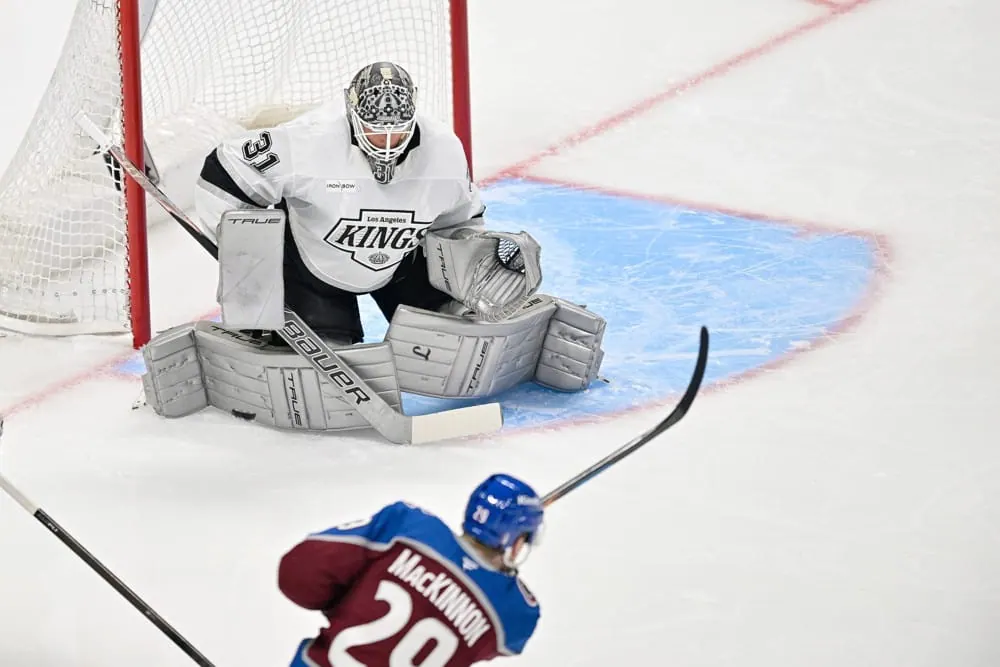
There is a moment, somewhere around the midpoint of every Nathan MacKinnon shift now, when the rink seems to tilt. The puck finds him in the neutral zone, his crossover gathers, and three Kings defenders make the same calculation at the same time: back off, or get burned. They back off. He skates into the space they've conceded, ten feet of clean ice on a playoff power play, and a tape-to-tape feed lands on Cale Makar's stick at the top of the circle. The goal that follows is almost incidental. The damage was done in the read.
This was the spring MacKinnon stopped being elite and started being inarguable.
The Colorado Avalanche finished the 2025-26 regular season with 121 points, breaking the franchise record of 119 set by the 2000-01 Stanley Cup champions. They won 55 games, surpassing the 2021-22 team's mark, and entered the playoffs as the Western Conference's top seed. None of those numbers exist without MacKinnon's December. None of them exist without the goal-scoring leap that turned a perennial 35-goal passer into a 53-goal threat who shoots first and second-guesses never.
For a decade he has been one of the league's best players, sometimes the best, almost always close. He has a Cup. He has a Hart. He has a résumé that, were he to retire tomorrow, would walk him into the Hall of Fame on the first ballot. And yet there has remained, until now, a faint and unfair caveat attached to his name. Connor McDavid existed. Auston Matthews scored 69 in a season. Nikita Kucherov kept stacking 140-point years like cordwood. MacKinnon was great. He just wasn't, in the strictest sense, the guy.
He is now.
The number to fix on is 53.
MacKinnon has always been a passer first. Look at the shape of his career: the 97-point Hart season in 2019-20 came on 35 goals; the 140-point monster in 2023-24 came on 51. He has scored. He has scored a lot. But for years the defining act of a MacKinnon shift was the moment he found a teammate, not the moment he beat a goaltender. He was the engine of the offense, not its terminus.
In 2025-26, that changed.
Fifty-three goals in 82 games, a career high, and the league scoring lead by year's end. He ran a 15.4 shooting percentage, which is not a fluky number for a player who lives in the high-danger areas of the offensive zone. He scored 11 on the power play and seven game-winners. He went on a tear from October through December that produced 34 goals in 39 games, including a 14-goal, plus-21 December that effectively ended the Central Division race before Christmas.
What's striking is not the volume. It's the choice. MacKinnon decided, somewhere between last summer and this October, to shoot more and second-guess less. The patient half-second he used to spend hunting for Makar or Mikko Rantanen in his peripheral vision became a release. The same elite skating that opened lanes for his linemates was now opening lanes for himself. He started arriving at the net front like a power forward. He started ripping one-timers from the off-wing on the power play with the conviction of a player who fully expects them to go in.
They did. Constantly.
“The Avalanche finished the regular season with 121 points, breaking the franchise record of 119 set by the 2000-01 Stanley Cup champions.”
— The best season in Colorado history
You cannot talk about MacKinnon at 30 without talking about how he lives.
The training stories have circulated for years, and most of them are true. The summer skates in Halifax with Sidney Crosby. The diet that makes professional nutritionists sound conservative. The conditioning sessions that his teammates describe with a mixture of admiration and mild psychological alarm. He has built his body, and more importantly his recovery, into something that does not slow down in March the way most stars do.
The numbers bear this out. His best month last season was December (26 points, plus-21). His second-best was November (26 points, plus-20). He played 82 of 82 regular season games. When the playoffs began, he was not arriving worn down. He was arriving honed.
This is the part of the MacKinnon story that gets lost in the highlight reels. The skating, yes. The shot, yes. But the reason he has now had four straight seasons north of 110 points, the reason he has not dipped, the reason he has actually improved as a goal-scorer at an age when most elite forwards begin a slow plateau, is that he has built a body that can deliver his game three nights a week for eight months. That is not luck. That is decision-making compounded over a decade.
How MacKinnon Weaponized the Off-Wing
For most of his career, MacKinnon's primary power-play role was to play the bumper or distribute from the half-wall. His shot was a threat, but not the first option. In 2025-26, Jared Bednar moved him more aggressively to the right-side flank on the top unit, in part to free Makar to roam and in part to give MacKinnon a runway for the cross-ice one-timer.
The result: 11 power-play goals and a 17.1 percent power play that finished among the league's most efficient. The geometry of the unit changed. Defenders could no longer falter on Makar at the point without surrendering a clean look to MacKinnon, and they could not pressure MacKinnon without leaving Makar in space. There is no good answer. The Kings spent four games failing to find one.


A first-round sweep is the cleanest possible verdict a playoff series can deliver, and it is also the easiest to dismiss. The Kings are a good team. They were not a good matchup. Los Angeles plays a heavy, structured, mid-pace game built to grind opponents into mistakes; Colorado plays a track meet built to make mistakes irrelevant. The series was, in some ways, decided before the puck dropped.
But that framing underrates what MacKinnon did. The Kings did not roll over. They are coached too deliberately for that under interim coach D.J. Smith. What happened, instead, is that they ran into a player operating at a level that rendered their structure beside the point. You can defend a system. You cannot, on most nights, defend a forward this fast, this strong on the puck, this committed to shooting, who also happens to be flanked by the best offensive defenseman in hockey.
Colorado's regular season was 55-16-11, 121 points, first in the Central, and the top seed in the West. None of those numbers exist without MacKinnon's December. None of them exist without the goal-scoring leap. The sweep was not a surprise. It was the regular season, distilled and accelerated.
The 121-point finish puts this Avalanche team in rarified franchise territory. The 2000-01 team that set the previous record with 119 points won 52 games, claimed the Presidents' Trophy, and lifted the Stanley Cup behind Joe Sakic, Peter Forsberg, and Patrick Roy. The 2021-22 team that matched that mark with 119 points won the franchise's third championship. This is the best regular season in Colorado/Quebec Nordiques history, and both teams ahead of it won titles.
MacKinnon now sits second in franchise history with 949 points, trailing only Sakic's 1,378. He ranks second in goals with 419, 206 behind Sakic's 625. He is second in game-winning goals with 76, ten behind Sakic's 86. He has four 100-point seasons; Sakic had six. The gap is closing. The argument over the greatest player in franchise history, once settled, is now open.
The parallel to 2000-01 is deliberate. That team won the division, set a franchise record for wins, and steamrolled through the playoffs with the kind of offensive depth and blue-line dominance that made defensive structures irrelevant. This team scored 302 goals in 82 games. It allowed 197. It ran a 17.1 percent power play and an 84.5 percent penalty kill. The defense allowed the third-fewest goals in the West. The offense scored the most.
The question is not whether this team is good enough. The question is whether the goaltending will hold.
You cannot write about MacKinnon without writing about Makar, and the inverse is also true. They have become the league's defining duo, the way Crosby and Malkin were, the way Gretzky and Kurri were before that. They share a power-play unit, a five-on-five shift structure on most nights, and a telepathy that takes years to build and cannot be coached.
What Makar gives MacKinnon is the one thing a center of his caliber most needs and most rarely has: a defenseman who can join the rush as a fourth forward without surrendering the back end. What MacKinnon gives Makar is the gravitational pull that creates Makar's open ice in the first place. Defenders cannot falter on the defenseman walking the line because the center is already burning past them. Defenders cannot stay tight to the center because the defenseman is winding up for a shot.
It is a closed loop, and the league has not solved it.
“Defenders cannot falter on Makar at the point without surrendering a clean look to MacKinnon, and they cannot pressure MacKinnon without leaving Makar in space.”
— The geometry that defines the Avalanche offense
He is 30. He has a Cup, a Hart, the goal-scoring leap, and now a franchise-record regular season defended in dominant fashion through round one. The honest question, the one that follows every player who reaches this altitude, is what is left.
The answer is: a great deal.
A second Cup would change the conversation about him historically more than any other single accomplishment. One ring is the price of admission for the all-time tier; two rings, with a Hart and a scoring title in between, puts him on a shelf with a very small number of names. He is in the window. The roster is built. The goaltending is the question every Colorado spring asks, and it is the question this spring will ask too.
An Art Ross has eluded him to this point, mostly because McDavid has existed in the same era. If he finishes 2025-26 atop the scoring list, that gap on his résumé closes.
And then there is the larger conversation, the one that this season has, finally, opened. For years the question of the best player in the world has had a default answer in Edmonton. MacKinnon's 2023-24 Hart suggested the answer was contestable. His 2025-26, with the goal-scoring breakthrough and the team success layered on top, suggests it is no longer a question with a default answer at all.
The Two-Way Engine
He is a plus-56 forward who scored 53 goals. There is no version of modern hockey in which that combination is not the most valuable thing a player can be.
The Crease
Colorado's Cup ceiling will, as it always does, come down to goaltending in May and June. MacKinnon cannot solve that from the top of the circle.
The Art Ross
A scoring title would close the last meaningful gap on his individual résumé and reframe the McDavid-MacKinnon conversation for the rest of the decade.
The Second Cup
He has the team, the partner, and the prime. The window is open. Windows close faster than anyone expects.
There is a temptation, when a player has been great for this long, to flatten his seasons into a single shape. MacKinnon has been a 100-point player for years. He has been an MVP. He has lifted the Cup. The 2025-26 season, viewed casually, looks like more of the same.
It isn't. The shift this year was real, and it was specific. He became a goal-scorer of the first rank without giving up any of the playmaking that defined him. He delivered the best regular season of his career at 30 years old, on a team that finished first in its division with a franchise-record 121 points and entered the playoffs as the West's top seed. He then opened the postseason by sweeping a well-coached, well-built opponent in four games.
The argument that he is the best player in the world is no longer a contrarian argument. It is, at minimum, the consensus second answer, and on a growing number of nights it is the first. That is the move he made this year. From elite to inarguable. From "one of the best" to "you have to make a case against him, not for him."
The rest of the spring will write itself. There are three rounds left, and each of them will ask different questions of him. He has answered every question the regular season asked. He answered the first one the playoffs asked in four games.
The puck finds him in the neutral zone. The crossover gathers. The rink tilts. We have seen this movie before, but it plays differently now. The shooter has become as dangerous as the passer. The 30-year-old skates faster than the 25-year-old did. The team is built around him, and the team is winning.
This is what a peak looks like when a great player decides he is not done getting better.