
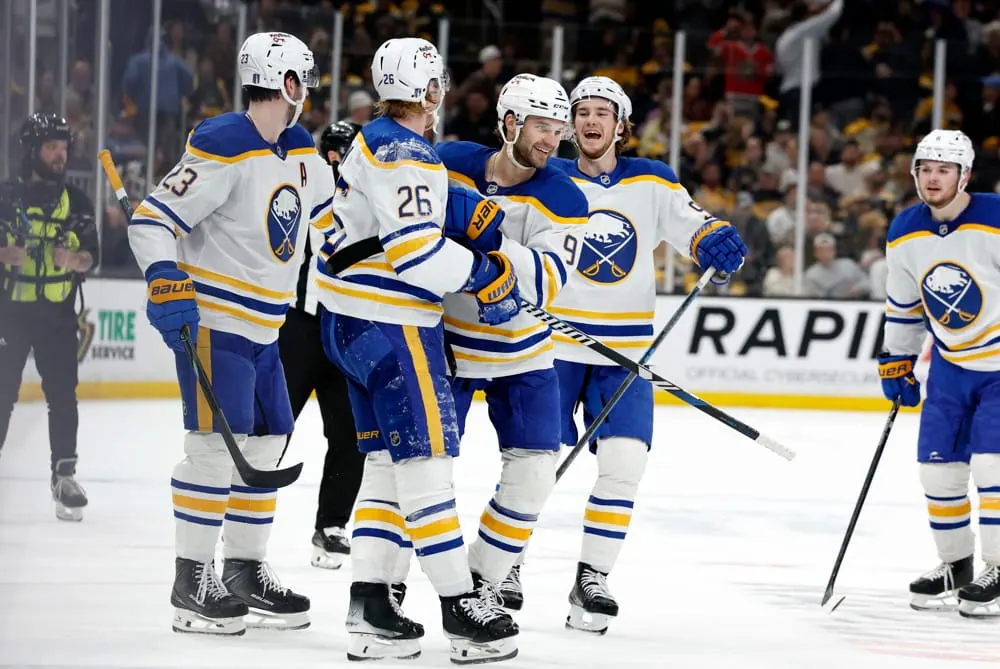
A backup goaltender nobody saw coming. A 20-year-old getting under every Bruin's skin. A franchise that last won a playoff series when the iPhone didn't exist. Friday night in Boston, all of it finally arrived.
Zach Benson was laughing. Charlie McAvoy had just delivered a two-handed slash across his arm with 1:31 remaining in a game the Bruins were already losing, a 10-minute game misconduct to cap the final elimination game of a season that had promised so much more for Boston. Benson, 20 years old, bleeding just slightly where the stick had connected, stood in the scrum and grinned. The Sabres bench was already over the boards. The celebration was already beginning. He had just scored the goal that put Buffalo up 3-1 and effectively finished the series. McAvoy's frustration was the punctuation mark on everything Benson had done across six games: got under the Bruins' skin, delivered in the moments that mattered, and smiled through all of it.
The thesis of Buffalo's six-game series win is simple: depth beats stars when the stars can't find their supporting cast, and goaltending beats everything when it arrives at 1.14 GAA. Boston finished the regular season 45-27-10 (100 points), tied Carolina for most home wins in the NHL at 29. The Sabres, Atlantic Division champions at 50-23-9 (109 points), brought a balanced attack - six different players scored in Game 4 alone - and a 32-year-old journeyman backup who posted a .955 save percentage across five playoff appearances. David Pastrnak had 100 points in the regular season and three goals in this series. It wasn't enough. Buffalo's youth movement, anchored by a goaltender nobody planned on and a 20-year-old agitator, proved too much for a Bruins team that couldn't solve their home ice problem.
That image, Benson laughing while McAvoy was being walked off, is the image of this series. Not because it was the most important moment - the most important moment was Alex Lyon stepping in during Game 2's third period and proceeding to deliver one of the more astonishing backup goaltender performances in recent playoff memory. But Benson laughing through a slash is the spirit of it. Irreverent, fearless, irritating in all the right ways. It is exactly what a Buffalo Sabres team that last won a playoff series in 2006-07, when Benson was one year old, needed to be in order to change what everyone assumed the end of this story would look like.
The Sabres advance to the second round for the first time since 2007. They did it with a backup goalie who started four games and allowed five goals total. They did it with the Atlantic Division's top seed playing like it belonged there. And they did it against a Boston Bruins team that went 0-3 in playoff home games, extending their home playoff losing streak to six consecutive games.
The template for the series was established in the first game. Boston looked sharper early, scored first through Morgan Geekie at 10:52 of the first with Pastrnak collecting the primary assist. Elias Lindholm extended it to 2-0 just over a minute into the third period. The Sabres were two goals down with 19 minutes left in Game 1. The crowd at KeyBank was uneasy. Fourteen years of not making the playoffs. This is how it always seems to begin.
Tage Thompson had other ideas. He pulled one back at 12:01 of the third, then tied it at 14:19, two goals in two minutes and eighteen seconds, the kind of individual response that a franchise player delivers when his team needs him to change the game rather than wait for it to change on its own. Then Thompson set up the winner at 16:34 for Mattias Samuelsson. 4-2. Thompson assisted on another. Final: 4-3 Buffalo. The Sabres dominated the physicality all night, 52 hits, season-high, Alex Tuch leading with 10, Samuelsson with nine. Ukko-Pekka Luukkonen made 17 saves in his playoff debut including two breakaway stops on Pastrnak that proved pivotal.
“Thompson's two goals in 2:18 of the third period. A team that has gone 14 years without making the playoffs could easily fold when going down 2-0 late in Game 1. Instead their captain answered personally. That response told you exactly what kind of team this was going to be across six games.”
— Key Moment - Game 1
The game that changed the series, not because Buffalo lost it, but because of what happened 16 seconds into the third period. Viktor Arvidsson scored twice for Boston, and Luukkonen allowed four goals on 20 shots across his portion of the night, a 4.19 GAA in his two career playoff games that made Lindy Ruff's decision unavoidable. With the score at 4-2 and 19:44 remaining in the third period, the Sabres pulled Luukkonen and inserted Lyon.
Lyon stopped all 10 shots he faced in his 19-minute cameo. The game was already lost. The door he walked through, though, was not closing behind him. Ruff's post-game comments were carefully chosen, telling the world Lyon was going to start Game 3 and telling his team the same thing. "I can tell you this: We've used three goalies all year," Ruff said afterward. "Some people thought it was a little unusual that we alternated. The cool thing about our team is that we haven't relied on one guy."
Lyon knew. He would not look back.
“Luukkonen's pull 16 seconds into the third. The in-game decision to end a starter's series in real time, not at the next intermission, not after a loss, but during a game, is the kind of coaching call that either validates itself immediately or becomes a crisis. Lyon's four subsequent starts with a 1.14 GAA made it the defining decision of the series.”
— Key Moment - Game 2
Lyon's first start. Boston, a team that had gone 29-11-1 at home during the regular season and tied Carolina for the most home wins in the league, was expecting a TD Garden crowd to assert itself in the way it had done all season. Lyon's game plan was simple, as he explained it: bring his best for 60 minutes, do the right things, and not overthink it.
He made 24 saves. Boston scored once, their lone goal, and spent the rest of the night watching the Sabres execute with the kind of controlled, structured efficiency that the Atlantic Division's top seed had built across 82 games. Noah Ostlund, a 22-year-old rookie making his postseason debut in place of the injured Josh Norris, played with no trace of the occasion's weight on him. The Sabres led the series 2-1 and owned a road win at a building that had felt like a fortress all season.
The first period was the key. The crowd was loudest at puck drop, expecting the building to do its work against a nervous visitor. Lyon was not nervous. His composure in the opening 20 minutes deflated whatever atmosphere the home crowd had generated and set the tone for a game Buffalo controlled from the second period forward.
If Game 3 was controlled, Game 4 was a statement. The Sabres scored three times in the first nine minutes and thirteen seconds: Peyton Krebs at 3:58, Josh Doan at 7:10 on a redirection in front, Benson at 9:15 after Doan forced a turnover on the Bruins' breakout and Benson read his linemate's aggression perfectly to score five-hole. Three goals. Nine minutes. Boston's home crowd went from hopeful to silent to something quieter than silent.
Pastrnak addressed it directly afterward. "Buffalo, there's a reason they won the division," he said. "A lot of skill and speed over there. Their defense is very active. So, yeah, they were better."
Six different Buffalo players scored. Lyon was immovable despite the game being long decided before the second period ended. The Sabres went up 3-1 in the series and needed just one win in three remaining games to advance for the first time since 2007.
“Benson's goal at 9:15 of the first - the third Sabres goal in under ten minutes. The Bruins had 29 regular-season home wins and were supposed to play better in this building than anywhere else. Three goals in nine minutes while the crowd watched in confusion is the game's defining image.”
— Key Moment - Game 4
Pastrnak's overtime heroics are the reason this series required a sixth game. He scored on a 2-on-1 with Pavel Zacha, Zacha feeding him on the left side of the circle, Pastrnak firing it in from the faceoff dot. Jeremy Swayman made 22 saves and was, in this particular game, the better goaltender. Lyon still played well, the nature of overtime losses being what they are, a single goal can be a product of circumstance as much as execution, but this was a Boston performance that finally looked like a team playing for its life.
The Bruins went 25-0 in the regular season when scoring first. They scored first here. They protected that lead with a defensive discipline that had been absent in Games 3 and 4. Marco Sturm had found something in the way his team responded to elimination that he hadn't been able to manufacture in the earlier games. It would not be enough to change the series, but it extended it by two days and gave Pastrnak the overtime goal his season deserved.
“Pastrnak's overtime winner on the 2-on-1 with Zacha. The best player on the Bruins, who had been quiet across the series after a 100-point regular season, delivered in the moment his team needed it most. The series result reflects the gap between his individual excellence and his team's collective delivery.”
— Key Moment - Game 5
The Sabres scored 3:25 into the first period. Rasmus Dahlin found a rushing Tuch alone in front, a touch pass at the edge of the crease, Tuch guiding it in, and the building went quiet in the way it had done in Games 3 and 4. Samuelsson made it 2-0 from above the left circle, his wrist shot threading inside the near post through a screen. Pastrnak pulled one back 1:54 into the second, a turnover in the neutral zone, his own hit on Ryan McLeod, then a 2-on-1 with Zacha that he converted from the left circle. 2-1. Boston had twenty-three minutes to force overtime or find an equaliser in regulation.
Lyon had other plans. He faced wave after wave of sustained Boston pressure, including a nine-minute stretch in the second period where the whistle barely sounded, and denied everything. Then Doan outraced both Pastrnak and McAvoy, two of the most accomplished players in the building, to a loose puck in the left corner, absorbed a McAvoy elbow to the head in the process, and backhanded a pass across to Benson standing alone between the circles. Benson scored glove-side. 3-1. McAvoy then slashed Benson. Benson was laughing. Norris added an empty-netter. It was over.
McAvoy's frustration afterward was telling. "It's not acceptable," he said. "I don't know exactly what it is. We can talk a big game in here about how excited we are, but for whatever reason we were awesome at home this year and we didn't do it when it mattered the most."
“Doan beating Pastrnak and McAvoy to the puck in the corner with under fifteen minutes left in the third. Two of the best players on the Bruins, both chasing him, neither catching him. His backhand pass to a wide-open Benson in the slot was the hustle play that defined what separates this Buffalo team from the ones that came before.”
— Key Moment - Game 6
The Backup Who Stole the Series
Lyon is 32 years old. He has bounced around professional hockey for most of his adult life: Carolina, Florida, Columbus, Philadelphia, back to Florida, and now Buffalo on a two-year contract that was never supposed to make him a playoff starter. Ruff used three goaltenders across the regular season as a deliberate philosophy of depth and competition. Lyon was part of that rotation. He was not supposed to be the goalie who carried the Sabres to the second round.
Three starts, three wins: Games 3, 4, and 6. He also started Game 5 and lost 2-1 in overtime on a single Pastrnak goal. His goals-against average of 1.14 across five appearances is the best by any goaltender in the 2026 Eastern Conference playoffs so far. His .955 save percentage places him in the top tier of single-series goaltending performances in the modern era.
MoneyPuck credited Lyon with 4.6 goals saved above expected, fifth best among all goaltenders across the entire 2026 first round. For context: he played four games. Goaltenders who played full six-or-seven game series are ranked below him. In every meaningful advanced metric, Lyon in this series was operating at Vezina Trophy-calibre level. He held a Boston team with Pastrnak coming off a 100-point regular season to 5 goals across his five appearances: one, one, two, and one in his four wins and one overtime loss.
"He bailed us out, I don't know how many times," Thompson said after Game 6. "In big games like that, there's a lot of momentum swings, and a couple huge saves at key moments. He likes the big moments, and he's not afraid of them."
Zach Benson and the Art of Controlled Chaos
Doan put it most precisely: the little dog that everyone's scared of, that for some reason thinks he's really tough. Thompson went further: there's a reason guys do stuff like that to him. He gets under the best players' skin, and he came through in big moments.
Benson was 20 years old during this series. He scored in Game 4, the third goal of a nine-minute first-period barrage that effectively ended Boston's evening, and delivered the series-sealing goal in Game 6 off Doan's hustle play, beating Swayman to the glove side from the slot. He also irritated, agitated, and generally made life unpleasant for anyone in a Bruins jersey who had to defend against him, check him, or watch him on the ice. He drew penalties. He created turnovers. He scored when it mattered. McAvoy's slash at the end was the confirmation that Benson had gotten so far under the Bruins' captain's skin that even a 10-minute game misconduct, in a game that was already lost, became the reaction his presence provoked.
What Both Teams Revealed
Tuch led with four goals. Thompson and Krebs each had seven and six points respectively. Bowen Byram added three goals from defence. Six different players scored in Game 4. This is not a team reliant on one line or one player. The depth that won the Atlantic Division title showed up when the games mattered most.
Buffalo's regular season numbers tell the story of how they got here: 50-23-9, 109 points, 288 goals for (seventh in the NHL), 240 goals against (eighth), and an 81.9% penalty kill that ranked fourth league-wide. The power play at 19.5% was unremarkable, but it didn't need to be. This team won by playing sound defensively, controlling tempo, and getting contributions from all four lines.
Pulling a starter mid-game in the second game of a playoff series is a decision that ends coaching careers if it goes wrong. Ruff's trust in Lyon and his reading of what Luukkonen was going through was completely vindicated. The coaching call was the series. Without it, the outcome is genuinely uncertain.
Boston went 29-11-1 at TD Garden during the regular season. Tied for the most home wins in the league. Zero playoff wins at home. Lost their last six consecutive home playoff games. The inability to perform at home in the postseason, across multiple seasons and coaching staffs, is a structural problem, not a fluke. Pastrnak with 100 regular-season points was the only Boston player consistently playing to his level. The depth around him - Lindholm, Geekie, Zacha - never found its footing in the way the regular season promised they would.
Boston finished 45-27-10, 100 points, with 272 goals for and 247 against. Their 23.6% power play was elite. Their 76.6% penalty kill was middling. In the playoffs, those weaknesses were magnified. The Bruins couldn't generate enough at 5-on-5 when their power play went cold, and Lyon gave them nothing on special teams when they did get chances.
Lyon's Series Was Historically Good
Alex Lyon finished 3-1 with a 1.14 GAA and .955 save percentage, five goals against on roughly 110 shots across four starts and one relief appearance. MoneyPuck rated him at +4.6 goals saved above expected, fifth-best among all goaltenders in the first round despite only playing four games. He held a Pastrnak-led Boston attack to one, one, two, and one goals in his four starts and surrendered nothing in his Game 2 cameo.
Buffalo's depth was the structural advantage. Tuch (4G, 3A), Thompson (2G, 5A), Krebs (2G, 4A), and Byram (3G, 2A) all finished with five-or-more points. Six different players scored in Game 4. Boston, by contrast, had Pastrnak (3G, 3A) and almost no one else above three points. The series was won by a roster operating as a whole against a roster operating as a star and a supporting cast.
Buffalo's Second-Round Opponent
The Montreal Canadiens and Tampa Bay Lightning were locked in a Game 7 in Tampa after the Lightning forced the decider with a 1-0 overtime win in Game 6 Friday night. Buffalo will have home-ice advantage in the second round against either opponent as the No. 1 Atlantic seed. The rest advantage, following a six-game first round, is meaningful, particularly for a goaltender who started four games in 13 days.
Buffalo's trajectory mirrors other young teams making noise this postseason. The Anaheim Ducks and Canadiens, both emerging from rebuilds, are thriving - Anaheim leads Edmonton 3-1, while Montreal holds a 3-2 edge over Tampa. These teams share Buffalo's blueprint: internal development, youth energy, and avoiding the pitfalls of veteran teams like Tampa, who despite Brandon Hagel's six goals in five games this round, are teetering on elimination in the post-Stamkos era.
If Montreal Wins
The Canadiens split the regular-season series 2-2 with Buffalo. Nick Suzuki led Montreal with eight points in four regular-season games against the Sabres. Cole Caufield scored four goals in those four games. Buffalo and Montreal have met in the playoffs seven times, Montreal winning four. Lyon's save percentage against Caufield will be an immediate storyline.
If Tampa Bay Wins
The more dangerous draw. Nikita Kucherov had four goals and four assists against the Sabres this season, eight points in four games. Andrei Vasilevskiy, despite a rough series against Montreal, is a Vezina Trophy finalist with championship pedigree. A Lightning team that survived to Game 7 will be dangerous and desperate. Tampa's struggles this round - down 3-2 despite Hagel's heroics - suggest leadership gaps, but experience matters.
Lyon's Form
A 1.14 GAA and .955 SV% across four starts. Whoever Buffalo draws will see the same goaltender who shut down a 100-point Pastrnak.
Does Luukkonen Return?
Ruff trusted three goalies all year. The second round will test whether that philosophy still applies, or whether Lyon has earned the entire net.
Key Quotes
“It's one step in the right direction. That's it.”
— Alex Tuch, Buffalo Forward, after Game 6
“Buffalo, there's a reason they won the division. A lot of skill and speed over there. Their defense is very active. So, yeah, they were better.”
— David Pastrnak, after Game 6
“It's not acceptable. I don't know exactly what it is. We can talk a big game in here about how excited we are, but for whatever reason we were awesome at home this year and we didn't do it when it mattered the most.”
— Charlie McAvoy, on losing all three home games
“I can tell you this: We've used three goalies all year. Some people thought it was a little unusual that we alternated. The cool thing about our team is that we haven't relied on one guy.”
— Lindy Ruff, after pulling Luukkonen in Game 2
“He bailed us out, I don't know how many times. In big games like that, there's a lot of momentum swings, and a couple huge saves at key moments. He likes the big moments, and he's not afraid of them.”
— Tage Thompson, on Alex Lyon
Buffalo Were the Better Team. The Question Is Whether the Lyon Story Has Another Chapter.
Nineteen years. A backup nobody planned on. A 20-year-old getting slashed for laughing. A franchise that is finally, genuinely different. Thompson answered when it was 2-0 down in Game 1. Lyon answered when the starter couldn't. Doan outran Pastrnak and McAvoy to a loose puck in the corner of a must-win game. Benson got under everyone's skin and scored when it was sealing time. Ruff made the goaltending call of his career in the middle of Game 2's third period.
Boston had 29 home wins during the regular season and lost every playoff game in that building. They had Pastrnak at 100 points and couldn't convert it into a series. The franchise deserves answers this summer about what keeps going wrong in April.
Buffalo doesn't need to think about any of that right now. One step at a time. That's what Tuch said. They meant it.

