
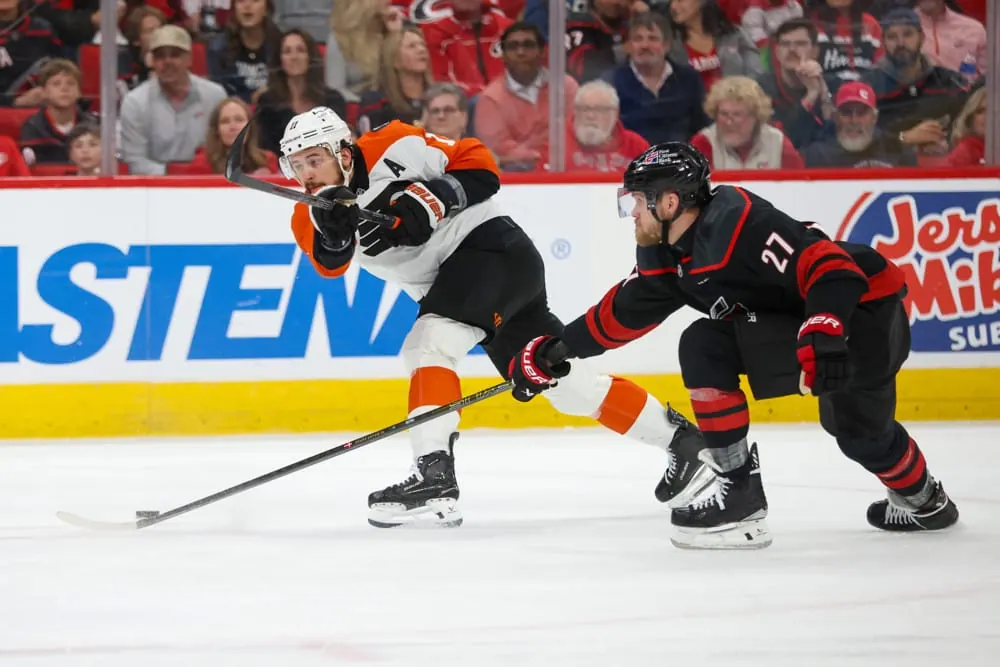
A few months ago, when the Philadelphia Flyers were clinging to the outer edges of the Eastern Conference playoff picture, someone inside the organisation pulled the number. It was 3.8 percent - Philadelphia's estimated probability of making the playoffs at that point in the season. The Flyers printed it on their T-shirts. They wore it to morning skates. They looked at it every day and decided to use it as fuel rather than conclusion.
On Wednesday night at Xfinity Mobile Arena, with Cam York's shot deflecting off the post and into the net 2:28 into overtime, the Flyers completed the most improbable postseason journey in the Metropolitan Division in years. They eliminated the Pittsburgh Penguins 4-2, claimed their first playoff series win in front of a live Philadelphia crowd in fourteen years, and punched a second-round ticket to face the Carolina Hurricanes. Dan Vladař stopped 42 shots. For the second time in six games, he kept Pittsburgh off the scoresheet entirely.


The series told multiple stories simultaneously. It was the story of Vladař - a journeyman Czech goaltender who had never recorded a shutout in a regular-season start with the Flyers - delivering the kind of postseason that gets talked about for decades in a market starved of hockey in April. It was the story of Porter Martone, a 19-year-old rookie in his tenth NHL game ever, scoring in each of his first two playoff games. It was the story of Philadelphia winning two games on the road first - in Pittsburgh, where PPG Paints Arena was supposed to be impenetrable - before holding on at home when it mattered most.
And it was, unavoidably, the story of Sidney Crosby not scoring a single goal in a playoff series for the first time in a career defined by producing in April. Zero goals. A team that went from near-certain elimination to a 3-0 series hole, clawed back to 3-2, and then fell in a Game 6 that felt, at the final buzzer, like the closing of a particular chapter in Pittsburgh hockey.
PHIPPG Paints was raucous for Pittsburgh's first playoff appearance since 2022. The Penguins were the No. 2 Metropolitan seed at home against an opponent whose preseason playoff odds had been 3.8%. The crowd expected a statement. The Flyers had other ideas.
Jamie Drysdale scored first for Philadelphia, slotting a five-hole goal past Stuart Skinner. Evgeni Malkin tied it - his 68th career playoff goal - but Philadelphia kept pushing physically, finishing with 52 hits. Travis Sanheim gave the Flyers the lead midway through the third, splitting a pair of Penguins and firing past Skinner. Then Martone - 19 years old, in the 10th NHL game of his life - scored with 2:37 to play for the insurance. Bryan Rust pulled one back in the dying minute but Vladař held.
Martone's first career playoff goal with 2:37 left in the third. A teenager in his tenth NHL game converting an insurance goal in Pittsburgh in Game 1 - the kind of moment that tells a franchise something about what it has.
PHIPittsburgh managed two shots on goal in the first period. By the time Martone scored in the second - a backhand from the left circle - the building had gone very quiet. Garnet Hathaway added a shorthanded goal, the first for Philadelphia in the playoffs since Valtteri Filppula in 2018. Luke Glendening's empty-netter sealed it.
What made this game was Vladař. He stopped all 27 shots he faced for his first career playoff shutout - and the first shutout of his season in any context. A glove save on Malkin's redirection with seven minutes remaining announced itself as the save of the series. Martone became the first Flyer ever to score in each of his first two postseason games. Skinner's series numbers slid to a 3.08 GAA and .873 save percentage.
Vladař's glove save on Malkin in the third. The signature stop of a goaltender who would go on to define everything that followed.
PHIThe first playoff game in Philadelphia in eight years. The building, by every account inside it, was the loudest Xfinity Mobile Arena had ever been. Eleven players combined sat in the penalty box across the night, with two early bench-clearing scrums setting a tone that suited the home side perfectly.
Travis Konecny scored on the power play. Trevor Zegras added another. Martone fed Sanheim for the third. The Penguins pushed in the third but never got closer than two. The Flyers led the series 3-0 against a Pittsburgh team that had not lost three straight playoff games in a single series in over a decade.
Eleven players in the penalty box and a building that had waited eight years to make noise. The structural Pittsburgh game disappeared inside the chaos - and Philadelphia thrived in it.
PITDan Muse made his move. Skinner - .873 across three games - was replaced by Arturs Silovs, the backup with two prior postseason appearances. Silovs made 28 saves and was excellent. Pittsburgh, with their backs to the wall, played fast and direct, making the Flyers defend rather than allowing Philadelphia to impose structure.
Crosby scored on the power play - breaking his scoreless run in the series. Rickard Rakell stripped Vladař behind the net and scored on an open cage for a 2-0 lead. Denver Barkey cut it to 2-1 with his first career playoff goal. Kris Letang restored the two-goal margin. Konecny made it 3-2. Connor Dewar's empty-netter sealed it.
Rakell stealing the puck off Vladař behind the net - an extraordinary piece of opportunism against a goaltender who had been nearly untouchable. The play that gave Pittsburgh permission to believe again.
PITOne of the stranger goals in recent playoff memory, a Crosby health scare, and a rookie playoff debut. Elmer Soderblom opened it for Pittsburgh at 2:45. Dewar doubled it. Twelve seconds later, 22-year-old Alex Bump, in his first career playoff game, drove past a defender and slid one through Silovs' five-hole. Sanheim tied it from the left point late in the second.
Crosby was struck by a Ryan Shea shot and hobbled off, returning within minutes to collect his 33rd multi-assist postseason game - fourth-most in NHL history behind Gretzky, Messier and McDavid. Then Letang won it in the most improbable fashion possible: a point shot that rattled off the back wall, took a wild bounce, hit both of Vladař's legs, and slid in. Series 3-2.
Letang's winner at 17:12 of the second. There is no defending that goal and no coaching decision that prevents it. The Flyers had to file it away and win one more at home.
PHISixty minutes of regulation. Zero goals. Forty-two saves by Vladař - including a stop on Anthony Mantha at the doorstep in overtime and a denial of Rust with four minutes left in regulation when the entire building understood the stakes. Silovs on the other end was equally exceptional, 31 saves on the night.
Matvei Michkov, back in the lineup after a healthy scratch in Game 5, was twice denied by Silovs in the second. Pittsburgh's Andrei Chinakhov hit the post 6:49 into overtime. Then, at 17:32, Michkov moved across the blue line and fed York on the left point. Noah Cates was net-front, screening Silovs. York's shot threaded through the screen, struck the right post, and deflected in. He threw his stick into the crowd before realising he probably shouldn't have done that.
“It just felt like nothing was going to get past Vladdy. I think we all felt that, and we knew we just needed one good, decent look and we were able to capitalise. He was unbelievable for us tonight.”
— Cam York, after the Game 6 OT winner
Dan Vladař is 28 years old. He has played for the Boston Bruins (one game), the Calgary Flames (three seasons), and now the Philadelphia Flyers. He had not recorded a shutout in 51 regular-season starts this year - not one - before this series. Rick Tocchet had voted him the Bobby Clarke team MVP for the regular season, recognising what Vladař had given the team across 82 games. Nothing about the regular season prepared anyone for what the playoffs produced.
A .937 Series Save Percentage - And What It Meant
Two shutouts in six games. Ten goals allowed total. A .937 save percentage across the series. Game 6: 42 saves, zero goals, a stop on Mantha in overtime that may have been the save of the entire 2026 playoffs across all conferences.
His performance is the reason Philadelphia won. Not a small part of the reason - the reason. The Flyers scored just five goals in the final three games - twelve in six games. With any other goaltender at that offensive output, this series is a Pittsburgh win in five or six. With Vladař, Philadelphia held on because he kept making it 0-0 or 1-0 or 2-1 long enough for the team to find a way.
He becomes the second Flyers goaltender to record a playoff shutout against the Penguins, following Martin Biron in Game 5 of the 2009 conference quarterfinals. Stuart Skinner - who had backstopped consecutive Stanley Cup Final appearances with Edmonton before being traded - finished his three games with a 3.08 GAA and .873 save percentage. That gap, maintained across six games, is the complete explanation for the series result.
| Goalie | GP | W-L | GAA | SV% | SO |
|---|---|---|---|---|---|
| Dan Vladař (PHI) | 6 | 4-2 | 1.63 | .937 | 2 |
| Stuart Skinner (PIT) | 3 | 0-3 | 3.08 | .873 | 0 |
| Arturs Silovs (PIT) | 3 | 2-1 | 2.06 | .939 | 0 |
The Silovs data point deserves a separate sentence: he was exceptional. His .939 save percentage across three games was marginally better than Vladař's across six. He gave Pittsburgh everything a backup could give an elimination-facing team. It wasn't enough because the Flyers only needed one goal in Game 6, and Vladař only needed to stop everything on the other side.
Porter Martone was 19 years old, 176 days old to be precise, when he scored in Game 1. He was the No. 6 pick in the 2025 NHL Draft. He was playing in the 10th NHL game of his professional life. He scored in Game 1. He scored in Game 2. He became the 12th teenager in NHL history to score in each of his first two postseason games - and the sixth-youngest to do so behind Don Gallinger, Jordan Staal, Rod Brind'Amour, Tyler Seguin, and Wendel Clark.
“There's not a lot of guys that can come in and make the impact that Martone has. Especially in the games leading up to making the playoffs - how important those were - and for him to be able to jump in. It just speaks to his character.”
— Travis Konecny, Philadelphia Flyers
He was the first Flyer in franchise history to score in consecutive playoff debuts. He wore the team's early-season playoff improbability with the same composure as the veterans beside him - probably because, at 19, he did not yet have a library of postseason failures to reference. His rookie presence was not accidental to Philadelphia's success. It was structural.
Vladař Was the Series
Two shutouts, a .937 save percentage, 42 saves in a series-clinching overtime game. The goaltending gap that opened after Pittsburgh replaced Skinner with Silovs showed how much of the series was defined by net play. Vladař won three of those four games before Silovs levelled the individual goaltending battle in Games 4-6.
The 3-0 Foundation, Built on the Road
Winning the first three games - two of them in Pittsburgh, where the Penguins were 29-11-1 at home during the regular season - gave Philadelphia a margin that survived the subsequent 3-2 comeback and still held. Games 1 and 2 away from home are the foundation on which everything else was built.
Crosby Goalless For the First Time
Zero goals in a playoff series. 202 career playoff points, passing Jagr for fifth all-time, on assists alone. Sidney Crosby was held off the scoresheet by a defence and a goaltender that simply refused to give him the clean looks his career is built upon. That has never happened to him before. It needs context, not dismissal.
Skinner's Collapse Was the Series-Defining Failure
A .873 save percentage through three games for a goaltender with Stanley Cup Final experience is the reason Pittsburgh went 0-3 before the switch. The Silovs numbers after the change - .939 - confirm that the problem was not the system. It was the goaltending decision Muse made at the start that proved costly.
Pittsburgh's Future Without a Rebuild Answer
Crosby is 38. Malkin is 39. Letang is 39. Pittsburgh's ageing core produced a competitive regular season under Muse but fell short when Vladař refused to let them back in. The franchise needs answers about what comes after this generation that losing in six games in the first round does not delay.
First Real Playoff Win Since 2012
The last time the Flyers won a playoff series in front of a live Philadelphia crowd was 2012 - when they eliminated the Penguins in the first round. Fourteen years. Xfinity Mobile Arena roaring for playoff hockey again, with a team the city actually believes in, is the real result.
| Player | Team | G | A | PTS | GP |
|---|---|---|---|---|---|
| Travis Sanheim | PHI | 2 | 1 | 3 | 6 |
| Sean Couturier | PHI | 0 | 3 | 3 | 6 |
| Trevor Zegras | PHI | 1 | 2 | 3 | 6 |
| Porter Martone | PHI | 2 | 1 | 3 | 5 |
| Jamie Drysdale | PHI | 1 | 2 | 3 | 6 |
| Sidney Crosby | PIT | 0 | 4 | 4 | 6 |
| Kris Letang | PIT | 2 | 2 | 4 | 6 |
| Evgeni Malkin | PIT | 1 | 2 | 3 | 6 |
| Rickard Rakell | PIT | 1 | 1 | 2 | 6 |
| Category | Philadelphia | Pittsburgh |
|---|---|---|
| Goals For | 12 | 10 |
| Power Play Goals | 2 | 3 |
| PP Conversion | 11.8% | 21.4% |
| Shutouts | 2 | 0 |
| Road Wins | 2 | 2 |
| Overtime Wins | 1 | 0 |
Philadelphia faces the Carolina Hurricanes - who swept the Ottawa Senators in four games without surrendering the lead for a single second of the entire series. Logan Stankoven scored in every game. Frederik Andersen posted a .955 save percentage. The team that never trailed, never panicked, and never gave Ottawa an inch is now the Flyers' second-round opponent.
This is a different proposition from Pittsburgh. Carolina's penalty kill went 1-for-21 against Ottawa. That will absorb a Philadelphia man-advantage that went 2-for-17 against Pittsburgh. Rod Brind'Amour's defensive structure - built around relentless forechecking and positional discipline - is the kind of system that takes away the scrappiness and physicality that overwhelmed Pittsburgh in Games 1, 2 and 3. Carolina has home-ice advantage throughout.
The Flyers have Vladař on a run that has no obvious ceiling. They have Martone, who has yet to look like any moment is too big. They have a defence that contributed six goals across the series including the overtime winner. And they have a locker room that printed "3.8%" on their T-shirts and meant it.
The two teams have never met in the Stanley Cup Playoffs. Their two regular-season meetings split: Carolina won 3-2 in overtime on December 14, Philadelphia won 3-2 in a shootout on April 13. Two one-goal games with the season on the line. If that is the template, Vladař and Andersen are about to write one of the most compelling goaltending narratives of the year.
“I hope everyone's OK in the stands, definitely don't want a lawsuit. I honestly blacked out. I didn't even know what to do, I was so excited.”
“I was just trying to give the guys in front of me a chance. I had the belief they were going to capitalise. So obviously, glad that they did - and even better that it was Yorkie who scored.”
“We believe in our group. We've believed in our group all year long. A lot of people counted us out all year. We stuck to the way we want to play. It's just the belief in that room - we play for one another.”
“We're a young group, we're learning. Going up 3-0 and then being able to lose those two and kind of learn from that, get into an overtime game - it's all great for this group heading into the next series.”
“That was the craziest building I've ever played in. The fans were fantastic.”
“He gave us a chance to win every time he was in. He was outstanding.”
“The first three games we got into the same slow game. Obviously, the playoffs are a different energy, but Games 4 and 5, we're playing with pace - and that's what we did all year.”
They Printed 3.8% On Their T-Shirts
Philadelphia Flyers · Round 1, 2026
Vladař stopped 42 shots in overtime on a Tuesday night and nobody who watched it was surprised. That is how thoroughly he had convinced his teammates - and eventually everyone watching - that nothing was getting past him. They wore 3.8% on their shirts. It is now irrelevant.