

 Minnesota Wild
The kid from Sorel-Tracy stepped onto the ice at PPG Paints Arena one last time on April 15, 2025, thirty-seven years old and somehow still smiling. The Minnesota Wild didn't have a game that night. Marc-Andre Fleury did. Pittsburgh arranged a ceremonial one-shift appearance before their regular-season finale, a gift to the man who'd given the franchise three Stanley Cups and nearly two decades of memories. He took the crease wearing number 29 in white and gold. The building shook. Grown men in Crosby jerseys wept openly. Fleury dropped into his familiar crouch, glove high, blocker loose, that elastic flexibility still evident even as his knees creaked. The puck dropped. Fifteen seconds of game action. One shot from the point, gloved casually. The whistle. Standing ovation. Exit.
It was theater, sure. But theater earned by 21 seasons, 1,051 games, and a career that bent the architecture of what a goaltender could be, not just in skill, but in spirit.
The question hanging over Fleury's retirement wasn't whether he belonged in the Hall of Fame. It was whether we'd properly catalogued what made him different. The numbers say legend. The film says artist. The locker rooms say something else entirely: beloved. Not in the cliché sense of "good teammate," but in the structural sense, that his presence altered the chemistry of a franchise, that goalies aren't supposed to make people smile that much, that winning three Cups across two eras while maintaining genuine joy in the work is rarer than any save percentage.
What the Wild showed in 2024-25 underscored the point. Minnesota finished 46-24-12 with 104 points in the Central Division, playoff-bound despite a defensively inconsistent roster. Fleury posted a .907 save percentage across 70 regular-season games, numbers that looked ordinary until you asked Kirill Kaprizov and Matt Boldy what they learned. The veteran's final season became a master class in how elite goaltending transcends statistics, how a 37-year-old with creaking knees could still anchor a contender through sheer preparation and refusal to let pressure kill joy.
The Teenager Who Wasn't Ready (But Was)
The Penguins took Fleury first overall in the 2003 draft knowing full well they were gambling. Eighteen-year-old goalies don't succeed in the NHL. The position demands maturity, repetition, and the neurological wiring to process chaos at NHL speed. Fleury had just finished a dominant year with Cape Breton in the QMJHL, 48 wins, a 2.17 GAA, the Memorial Cup. Pittsburgh was rebuilding, desperate, and convinced that the athletic French-Canadian kid with the lightning reflexes could accelerate the timeline.
He played 21 games in his rookie season, went 4-14-2, posted a .893 save percentage, and looked exactly like what he was: a teenager fighting grown men with release points he'd never seen. The Penguins were dreadful. Fleury was overmatched. But two things showed through the statistical wreckage. First, the athleticism, sprawling, paddle-down desperation saves that had no business working but did. Second, the disposition. He never sulked. Never blamed defensemen. Took his beatings and came back grinning.
By 2005, after the lockout, the Penguins had Sidney Crosby. By 2006, they had Evgeni Malkin. Fleury had company. The franchise flipped from punchline to contender in 24 months, and suddenly the kid in net wasn't learning on a last-place team, he was anchoring a juggernaut.
The 2008 Heartbreak
Detroit defeated them. Not brutally, the 2008 Final went six games, but thoroughly. Chris Osgood outplayed Fleury. The Red Wings, older and sharper, controlled tempo and exploited every coverage mistake. Fleury wasn't terrible. He was 23 and facing a dynasty. The lasting image: Henrik Zetterberg lifting the Cup at Mellon Arena while Fleury sat in the crease, mask off, staring at nothing.
The narrative hardened fast: Fleury was the weak link. Too athletic, not technical enough. A flopper. Commentators dissected his lateral movement, his five-hole, his rebound control. Fair criticisms, mostly. But the discourse missed the context, Pittsburgh's defense in 2008 was porous, and Fleury had dragged them through a seven-game Eastern Conference Final against Philadelphia just to get there.
What happened next defined him.
June 12, 2009
The Penguins and Red Wings met again, same Final, same stakes. This time it went seven. Game 7 in Detroit. Fleury had been better all series, calmer, more efficient, technically cleaner. Pittsburgh led 2-1 with under a minute left. Faceoff in the Penguins' zone. Pavel Datsyuk won the draw. Puck cycled to Nicklas Lidstrom at the right point. Fleury was square. Lidstrom's shot came through traffic, hard, low, glove side. Fleury's glove snapped out, parallel to the ice, fully extended. He caught it. Puck disappeared into leather. 34.3 seconds left. Game over. Cup won.
The Save Heard 'Round Pittsburgh
Fleury faced 23 shots in Game 7, allowing one goal, a Jonathan Ericsson point shot in the first period. He stopped all six third-period shots with the Penguins clinging to a one-goal lead. The Lidstrom save came on Detroit's 23rd shot, with 34 seconds remaining and the Red Wings' net empty for an extra attacker.
The sequence redeemed an entire year of doubt. Fleury finished the 2009 playoffs with a .908 save percentage across 24 games, middle-of-the-pack by raw numbers but clinch-perfect when it mattered. He was 24 years old.
The difference between 2008 and 2009 wasn't just maturity. It was technical refinement. Fleury spent the summer of 2008 overhauling his positioning with goalie coach Gilles Meloche, tightening his angles, cutting down the sprawl-first impulses. The athleticism remained, he could still make saves that violated geometry, but it became a weapon of last resort instead of first instinct.
That save on Lidstrom became his signature. Not because it was his best, he made better ones, flashier ones, more acrobatic ones, but because it arrived at the exact moment a franchise needed proof that he was the guy.
“The save didn't just win a Cup. It answered every question Pittsburgh had spent two years asking.”
The Dynasty Years
The Penguins didn't win another Cup for seven years. They came close, lost to Boston in 2013, to the Rangers in 2014, but couldn't break through until 2016. By then, Fleury was 31, sharing the crease with Matt Murray, a rookie who'd seized playoff starts and refused to give them back. The narrative got messy. Fleury was beloved, a franchise icon. Murray was younger, hotter, cheaper. The Penguins rode Murray to the 2016 Cup. Fleury played two games.
In 2017, same story. Murray started the playoffs. Fleury backed up. Except Murray got hurt in the second round. Fleury took over. Played every game from the Conference Final onward. Went 9-4 with a .924 save percentage. The Penguins won back-to-back Cups, and Fleury had done it again, anchored a championship run while navigating the impossible politics of a tandem.
That summer, the expansion draft arrived. Pittsburgh couldn't protect both goalies. Murray was 23. Fleury was 32. The choice was obvious and brutal. On June 21, 2017, the Vegas Golden Knights selected Marc-Andre Fleury, ending his 14-year tenure in Pittsburgh.
Year One in the Desert
The Golden Knights weren't supposed to compete. Expansion teams don't make the playoffs, let alone win divisions. Vegas did both. Fleury went 29-13-4 with a .927 save percentage. He dragged a roster of castoffs and prospects to the Pacific Division title, then through the playoffs, swept Los Angeles, beat San Jose in six, dispatched Winnipeg in five. The Cup Final. Again. Against Alex Ovechkin and the Washington Capitals.
Washington won in five. Fleury was good, not great. The Capitals were inevitable that spring. But the Vegas story, the inaugural-season miracle, was Fleury's story. He'd proven that 33-year-old goalies discarded by their franchise could not only survive but dominate.


The next three years in Vegas were uneven. Injuries. Playoff disappointments. A rotating cast of backup goalies. But in 2020-21, at age 36, Fleury authored the best statistical season of his career: 26-10-0, 1.98 GAA, .928 save percentage. He won the Vezina Trophy, his first major individual award in a career spanning 18 seasons. The Jennings Trophy came with it.
| Category | *Fleury | Brodeur | Roy | Luongo |
|---|---|---|---|---|
| Career Wins | 575 | 691 | 551 | 489 |
| Stanley Cups | 3 | 3 | 4 | 0 |
| Vezina Trophies | 1 | 4 | 3 | 1 |
| Games Played | 1051 | 1266 | 1029 | 1044 |
| Shutouts | 76 | 125 | 66 | 77 |
The Vezina felt like vindication on two fronts. First, it proved Fleury could still play at an elite level past the theoretical goalie expiration date. Second, it certified what Pittsburgh fans had always believed: that Fleury's prime had been underrated, overshadowed by Cup wins but never properly honored with hardware.
Vegas traded him to Chicago in July 2021, a cap-space move that blindsided Fleury and enraged the fanbase. The Golden Knights, who finished 39-26-17 with 95 points in 2024-25 and clinched a playoff spot, had moved on from their inaugural hero. The organizational chaos that marked Vegas's late-season coaching change stood in sharp contrast to Fleury's steady professionalism during his four years in the desert.
The Chicago Interlude and Minnesota Farewell
He played 36 games for a dismal Blackhawks team, went 19-21-5, and requested a trade. Minnesota acquired him in March 2022. He stabilized their crease immediately, went 9-2 down the stretch, carried them into the playoffs.
The Wild became his final home. Two-plus seasons, 70 regular-season games in his final campaign alone, a .907 save percentage on a defensively inconsistent team that still managed to finish third in the Central Division with 104 points. The numbers dipped, age and mileage caught up, but the intangibles didn't. Kaprizov credited Fleury with teaching him how to approach pressure. Boldy called him the best teammate he'd ever had. The Wild marketed his 2024-25 season as a farewell tour. Fans in opposing arenas gave him standing ovations.
On April 10, 2025, Fleury recorded his 161st overtime win, breaking his own NHL record, in an 8-7 victory over San Jose at Xcel Energy Center. It was likely his final home game. He skated a lap afterward, mask off, waving to all four corners. The Wild entered the postseason as the third seed in the Central Division.
The Pittsburgh cameo five days later was pure ceremony. No competitive stakes. Just closure.
What Made Him Different
Fleury's athleticism was elite but not unprecedented. Dominik Hasek was more acrobatic. Patrick Roy was more technically sound. Martin Brodeur played more games and won more often. What separated Fleury was the fusion of skill and humanity. He smiled. He pranked teammates. He celebrated saves with full-body fist pumps. He never pretended the job was joyless.
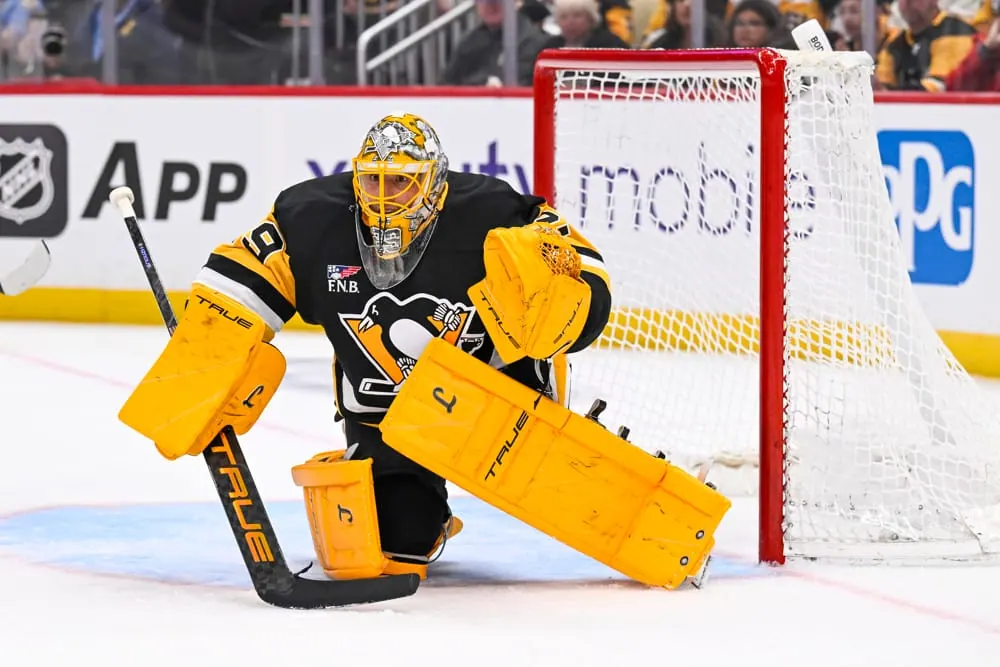
Goalies are supposed to be stoic, inscrutable, faintly psychotic. Fleury was none of that. He played with visible emotion, flopped on desperation saves, buried his head after goals against, pumped his glove after big stops. The mask changes alone told the story: bright yellow in Pittsburgh, gold knight's helmet in Vegas, wilderness-themed in Minnesota. He leaned into the theater of the position instead of hiding behind it.
Critics called him a choker after 2008 and during various playoff exits. The label never stuck because the evidence didn't support it. Three Cups. A .908 career playoff save percentage across 167 games. Multiple instances of stepping into a tandem mid-run and delivering. The "clutch gene" discourse is mostly noise, but if it means anything, Fleury had it.
“He was the rare superstar who made the sport feel lighter without diminishing its stakes.”
The Hall of Fame Case
Second all-time in wins. Three Stanley Cups across two franchises. A Vezina at 36. Olympic gold in 2010. World Cup gold in 2016. Seventy-six shutouts. Over 1,000 games played. The résumé is airtight.
The only complication: Fleury was never the best goalie in the league for more than one season. Brodeur, Roy, and Hasek dominated eras. Henrik Lundqvist (no Cup but eight top-five Vezina finishes) was more consistently elite. Fleury's excellence was durable, not transcendent. He was rarely the best but almost always very good, and very good for 21 years gets you to 575 wins.
The Hall will induct him. First ballot, likely. Not because of peak dominance but because of cumulative value and cultural imprint. He changed how people thought about goalies, made the position seem less lonely, less grim. That matters.
Best French-Canadian Goalie Since Roy?
The question is worth asking. Roy retired in 2003 with four Cups, three Vezinas, and 551 wins. Fleury surpassed him in wins, matched him in Olympic gold, and played in a harder era (tighter defensive systems, better shooters). Roy's peak was higher, his 1993 playoff run is the gold standard, but Fleury's longevity is staggering.
Roberto Luongo played 1,044 games and won 489. Jose Theodore won a Hart Trophy but flamed out. Martin Brodeur was French-Canadian by birth but American-raised, a technicality that complicates the lineage. The title probably belongs to Fleury by default. Not the most dominant, but the most accomplished since Roy hung up the pads.
What He Meant to Pittsburgh, Vegas, and the Position
Pittsburgh got three Cups and a franchise icon. Vegas got credibility and a Final run in Year One. Minnesota got a mentor and a bridge to the next generation. The broader hockey world got 21 years of proof that elite goaltending doesn't require misery.
Fleury's legacy isn't one signature save or one dominant season. It's the accumulation: 575 wins, each one earned through preparation, athleticism, and a relentless refusal to let the job's brutality kill the joy. He was never the best. He was one of the best, for longer than almost anyone. That's enough.
Marc-Andre Fleury
2003 - 2025
He came into the league as a teenager with a smile too big for the moment and left two decades later with the smile intact. Three Cups, 575 wins, and a generation of teammates who loved playing in front of him. The Hall of Fame will enshrine the numbers. The sport will remember the spirit. Sorel-Tracy's gift to hockey, now and always.