
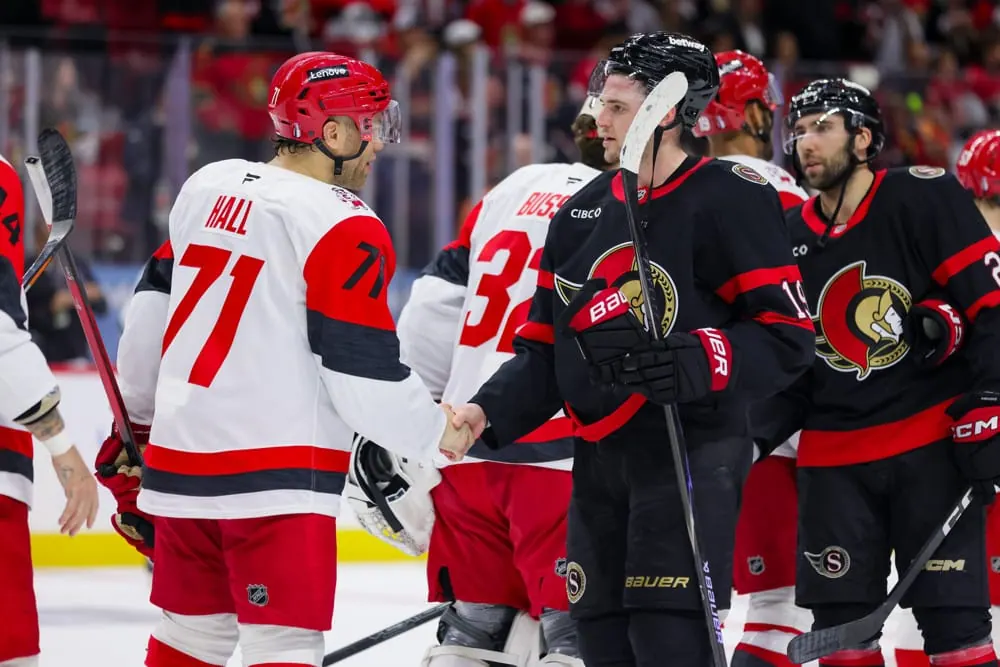
The Carolina Hurricanes swept the Ottawa Senators in four games. They outscored the Senators ten-to-five across the series and - most remarkably - never trailed for a single second across all four contests. Not for a period. Not for a shift. Carolina scored first in every game. Ottawa spent the entire series chasing a deficit they could never fully close and never once overturn.
It is one of the most controlled four-game performances by an Eastern Conference favourite in years. Frederik Andersen, 36 years old and coming off a regular season in which he split starts with Brandon Bussi, played the best playoff hockey of his Hurricanes tenure. Logan Stankoven scored in all four games to set a franchise record. Carolina's penalty kill, the best in the league all season, held an Ottawa power play that finished the regular season ranked inside the top ten to one goal in twenty-one opportunities.
The sweep flatters Carolina somewhat. Games 2 and 3 were genuinely close. Ottawa's offensive restraint was partly the product of a defence corps that was collapsing under injuries before the series was even finished. Jake Sanderson - 23 years old, arguably the best two-way defender on either side - was concussed in the second period of Game 3 on a Taylor Hall hit and never returned. Artem Zub lasted one shift in Game 1. Nick Jensen missed the series entirely. Ottawa coach Travis Green said it directly: "Having Sandy and Zub would have been a world of difference."
But the result stands. The Hurricanes are through. The Senators are out. And Rod Brind'Amour has now coached Carolina to at least one playoff series win in each of his eight seasons behind the bench - making them only the third franchise in NHL history to do that, after the Montreal Canadiens and Philadelphia Flyers.
The Eastern Conference has been put on notice.
How the Series Unfolded
It started with the fight. Three seconds after the puck dropped, Brady Tkachuk challenged Jordan Staal at centre ice - captain to captain, the younger man trying to impose Ottawa's physical identity on a building that had heard it all before. Staal won the bout. The tone was set. What followed was a first period defined by physicality, scrums, and exactly zero goals.
Stankoven broke the deadlock early in the second period, sneaking a shot through Linus Ullmark after Jackson Blake set it up. It was the first goal of the series - scored by a 23-year-old who was, by the time this series was done, going to own several franchise records. Hall added a second midway through, deflecting Stankoven's attempt past Ullmark to make it 2-0.
Ottawa pressed late. Drake Batherson appeared to pull one back midway through the third period. It was ruled a goal on the ice. Video review overturned it - Andersen had stopped the puck with his glove before it crossed the line. He finished with a 22-save shutout, his sixth in the playoffs.
“Andersen's glove save on Batherson's apparent tying goal in the third period - reviewed, overturned - was the defining moment of Game 1. Had that stood at 2-1, the narrative of the series may have been entirely different. Instead Ottawa were shut out and Andersen was untouchable.”
— Key Moment - Game 1
This was the game that could have turned the series. Ottawa played their best hockey of the four nights, came back from 2-0 down to force double overtime, saw a would-be game-winner for Carolina overturned on review, and then lost it on a penalty shot. If you plotted Game 2 as a narrative arc, it would read like fiction.
Stankoven opened the scoring on the power play - a one-timer through Ullmark's five-hole. Sebastian Aho made it 2-0 with a shorthanded goal early in the second, intercepting in the defensive zone and springing a two-on-one with Staal. Ottawa needed a response and got two in the second period to level it - Batherson cutting short-side through a Jaccob Slavin deflection, then Dylan Cozens burying a sharp-angled wrist shot through Andersen's five-hole at 16:40. 2-2. Overtime was coming.
Andersen then made the save of the series. At 11:21 of the second overtime, Michael Amadio got behind the defence alone and made a move inside to his forehand. Andersen got a piece of it with his glove. The puck struck the crossbar. In between those events, Mark Jankowski appeared to score the series winner for Carolina in the first overtime - the horn went, the crowd erupted, players celebrated - before video review revealed the puck had hit the inside of the side netting and never crossed the line. Then Warren Foegele took a hooking penalty. Jordan Martinook drew a penalty shot. He scored. 3-2 Carolina, double overtime.
“Hockey's crazy, sports are crazy. Being able to score after that - I'll tell my grandkids about that one, that's for sure.”
— Jordan Martinook, on his double-overtime penalty shot winner
The series came to Ottawa with the Senators already in a desperate position. They needed two home wins to extend it. They got neither. Game 3 added an extra layer of difficulty when Ottawa lost their most important defenceman - Sanderson, who had logged 43:06 of ice time in Game 2 - to a concussion in the second period after a Hall hit to the head that drew a minor but not a major.
Before that, Stankoven had already opened the scoring for the third consecutive game - a one-timer from the left faceoff circle off a Hall feed, bar-down over Ullmark's blocker at 5:13. He became only the second player in NHL history to score the opening goal in each of his team's first three playoff games, joining George Armstrong of the 1956 Toronto Maple Leafs. Batherson tied it in the second on a forehand-to-backhand over Andersen's pads.
Ottawa then squandered a 5-on-3 power play in the second period, generating almost nothing against a Carolina penalty kill that played it perfectly. Blake answered immediately after Batherson's goal - K'Andre Miller faking a shot from the circle before feeding Blake across for a wrist shot that beat a sprawling Ullmark. 2-1. The Senators could not convert on five power plays across the night, including the two-man advantage. Carolina ground it out.
“The squandered 5-on-3 in the second period. Ottawa ran 1:28 of two-man advantage and registered almost nothing against Carolina's penalty kill. Had they converted to make it 2-2, the momentum in that building - and the series - could have shifted completely. Instead Blake's answer pushed it to 2-1, and it ended there.”
— Key Moment - Game 3
Game 4 was the most physical, most volatile, and most emotionally charged of the series - which is saying something given the captain fight in Game 1 and everything that happened in the double overtime of Game 2. It was played without Sanderson and Zub, meaning Ottawa were operating with the skeleton of a defence corps trying to hold off elimination. The crowd was towel-waving. The building was hostile. It was the kind of atmosphere where anything could happen.
Hall gave Carolina the lead in the second with a snap shot from the left hash marks - Jankowski's backhand cross-ice feed finding him perfectly - and the Senators responded through Batherson, who tipped a Tim Stützle one-timer past Andersen to finally break Ottawa's drought on the power play. 1-1 heading into the third. For a brief moment, the building believed.
Stankoven took that belief and buried it. On a Carolina power play, Miller's shot from the right point caromed off the end boards directly to Stankoven on the left side - fourth goal, fourth game, fourth time he had delivered when his team needed him most. The Senators threw their ninth power play of the night at the kill and got nothing. Aho added an empty-netter. Cozens pulled one back. Aho sealed it with another into the empty cage. Final: 4-2. Series: done.
The Game 4 middle section became a gutter war - 36 combined penalty minutes, Alexander Nikishin knocked from the game by a Tyler Kleven hit, Andrei Svechnikov landing punches on Kleven in retribution, Miller and Ridly Greig trading blows. Carolina handled all of it without crossing the line into self-destruction. That, Brind'Amour said afterwards, is what this team has learned from eight straight playoff seasons.
“Stankoven's power-play rebound at 9:10 of the third. Ottawa had tied it and had the building. Carolina's fourth line was getting abused physically. Stankoven's goal removed every piece of momentum Ottawa had built across the second period and the first half of the third. That was the series, right there.”
— Key Moment - Game 4
Where Was the Series Actually Won?
The power play discrepancy is the clearest single answer. Ottawa's man-advantage entered this series ranked inside the top ten in the league. It finished 1-for-21 in four games - a catastrophic collapse of what should have been their primary equaliser against a team with superior goaltending and more playoff experience. That one goal came in the second period of Game 4, Ottawa's eighteenth power-play attempt of the series. It arrived 16 minutes too late to change anything.
“I think special teams was the difference. The whole series we did a really great job on the penalty kill. And then today, the power play stepped up when we needed a goal.”
— Sean Walker, Carolina Hurricanes Defenceman
Carolina's penalty kill was the best in the league during the regular season and it performed to that standard when it mattered most. Jaccob Slavin logged 10:14 of shorthanded time in Game 4 alone - out of 13:21 total for the team. Brind'Amour called it out directly. Hall called it out directly. The Hurricanes knew what Ottawa's power play was capable of, prepared specifically for it, and neutralised it almost completely across nearly 30 minutes of total advantage time.
The second factor was Andersen. Before this series there were genuine questions about whether the 36-year-old Dane - who shared the crease all season with Bussi - had enough left to carry Carolina through a playoff run. He answered them definitively. Through the first three games he stopped 80 of 83 shots for a 0.84 goals-against average and a .964 save percentage. His double-overtime glove save on Amadio in Game 2 was the kind of stop that decides series. Brind'Amour said it was the best hockey Andersen had played since joining the Hurricanes.
The third factor was Stankoven. His four goals in four games - one in each contest, always when the Hurricanes needed him - made him the first player in franchise history to score in each of his first four playoff games, and the first to open the scoring in each of his team's first three. That kind of continuity from a 23-year-old in his first significant playoff role is not accidental. He is built for this environment.
And finally: Ottawa's injuries destroyed any realistic chance of an upset. Jensen missed the series. Zub lasted one shift in Game 1. Sanderson - the Senators' best defenceman, 43:06 of ice time in Game 2 - was concussed in the second period of Game 3 on a Hall hit. By Game 4 the Senators had used twelve different defencemen since the Olympic break and were operating without their top pairing. Whether a healthy Ottawa wins this series is unanswerable. But Games 2 and 3 each could have gone differently with their full back end. The injuries did not cause the sweep. They ensured the Senators were fighting with one hand tied.
How Good Are These Hurricanes?
Brind'Amour has now coached Carolina to a playoff appearance in each of his eight seasons. They have won at least one series in every single one - making them only the third team in NHL history to achieve that run, behind the Canadiens and the Flyers. The Hurricanes are not here by accident. They are not here on one hot goaltender. They are here because the organisation has built something durable and repeatable.
Andersen Was Historically Good
0.84 GAA and .964 save percentage through three games. His sixth career playoff shutout in Game 1. Frederik Andersen at 36, coming off injury concerns all season, played the best hockey he has produced for this franchise. The statement the organisation needed.
Penalty Kill Is Elite And Proved It
Ottawa's top-ten power play finished 1-for-21 against it. Under five percent conversion across four games. Carolina's PK has been near the top of the league all season and returned to that level at the best possible time.
Stankoven Is a Genuine Playoff Performer
Four goals in four games, franchise-first scoring streak to open a postseason, the second player in NHL history to open the scoring in his team's first three playoff games. Logan Stankoven showed up in every game. The 23-year-old centre is built for this.
Andersen's Durability
He is 36, played 35 regular-season games, and started four games in eight days including a double-overtime contest. How many more starts can he carry before Bussi is needed? That question grows with every round.
Power Play Generated Only Two Goals
Carolina scored twice on the man-advantage in four games, against a physically depleted Ottawa defence. The power play needs to be more dangerous in Round 2 against a healthier opponent. It was functional but not elite.
The East Is Wide Open
Florida and the Rangers - the teams that repeatedly ended Carolina's runs in recent years - are out of the field early. The Hurricanes have not won the Stanley Cup since 2006. The bracket in front of them is the most navigable it has been in years.
Andersen's First Three Games Were Historic
Through the first three games of this series, Frederik Andersen stopped 80 of 83 shots for a 0.84 goals-against average and a .964 save percentage. His Game 1 shutout was his sixth in the Stanley Cup Playoffs, tied for sixth all-time among non-North American-born goaltenders. At 36, sharing the crease with Brandon Bussi during the regular season, Andersen had real durability questions entering the playoffs. He answered them in a way that vaulted Carolina from a Cup outsider to a legitimate Eastern Conference favourite. Carolina's penalty kill held Ottawa to one goal on twenty-one attempts - a sub-five-percent conversion rate against a top-ten regular-season power play. Logan Stankoven, 23 years old in his first significant playoff role, became the first player in franchise history to score in each of his first four postseason games. Three pillars. Three defining performances. One sweep.
The honest verdict on Carolina: they are a legitimate Eastern Conference favourite and a credible Stanley Cup contender. Andersen looks like the version of himself that won 35 games for Toronto in 2018-19. Stankoven looks like a top-six forward built for the playoffs. The penalty kill is the best in the league and is operating at peak. The system is one Brind'Amour has been refining for eight years and the players have been executing it for years. The depth is real - Hall, Aho, Blake, Jarvis, Stankoven, Martinook, Staal all contributed.
But the power play needs to be more dangerous. Andersen's workload is a question that scales with every additional series. And the bracket - Florida out, the Rangers out - has opened up in a way that means there will be no excuses if Carolina don't make a deep run from this position.

 #22 · C · 12 GP
Carolina's Second-Round Opponent
The Philadelphia Flyers lead the Pittsburgh Penguins 3-0 in their first-round series, with Game 4 on the horizon. Carolina await the winner and will host the first two games of the second round at Lenovo Center - with at least a week of rest between the sweep completion and their next puck drop.
If Philadelphia Advances
The Flyers entered the playoffs as underdogs against Pittsburgh and have built a 3-0 lead. A younger, faster team built around energy and a home crowd that has turned hostile for opponents. Less postseason experience than Carolina's core. Brind'Amour will have a significant film advantage on a team that has not been in a second-round series in years.
If Pittsburgh Comes Back
Sidney Crosby's Penguins are down 0-3 and would need one of the most improbable comebacks in playoff history. A healthy Crosby is always dangerous, but an aging roster fighting elimination is a different proposition than a team that has been here before. The path through Pittsburgh would still be the harder one if it came open.
The rest advantage could be meaningful. Andersen will get a week to recover from four starts in eight days, including a double-overtime contest. Whoever Carolina draw, they will be physically depleted from a longer first-round series. Brind'Amour's group will have had time to heal, prepare, and watch film.
Where Do the Senators Go From Here?
Ottawa are eliminated in the first round for the second consecutive year - swept in four, the same scoreline as last year when they fell to Toronto. The organisation has made genuine progress. The core of Sanderson, Stützle, Brady Tkachuk, Batherson and Cozens is young, talented, and under contract. Carter Yakemchuk - 19 years old, making his playoff debut in Game 4 with two assists - is a defenceman the franchise has been waiting on for two years.
But there are real questions. The power play that was supposed to be a weapon finished 1-for-21. The organisational depth in the defensive system was exposed brutally - twelve defencemen in the second half of the season before the playoffs even started. And Travis Green, in his first season behind the bench, will have the summer to process what a first-round sweep against the Eastern Conference's top seed actually tells him about where this team sits.
The honest answer is that Ottawa is a team with a genuine future and a genuine core. They are not, yet, a team ready to beat Carolina in a playoff series, let alone go deep. The gap closed this year compared to last. It needs to close further.
“It's heartbreaking. Really tight series. Give credit to them. They're a great team, play hard, don't give you much. I think everybody in this room gave absolutely everything they had to try and extend this series.”
— Brady Tkachuk, Ottawa Captain
Key Quotes
“Whatever way the game goes, our group can handle it. I love just the compete level of our group from Game 1 - all the way through. Pretty impressive.”
— Rod Brind'Amour, Carolina Head Coach
“Can't understate that. Especially when you want to consider how well the other guy was playing in their end - it was a goalie matchup. They were going save for save, and we needed it. It's probably the best hockey he's played for us.”
— Rod Brind'Amour, on Frederik Andersen
“It was a tight series. Every single game it was a little play here or a little play there, and that was the difference. Ottawa's right there, even though it ended up four-nothing. It was nice to get the job done, but it was tight for sure.”
— Logan Stankoven, after the series sweep
“Not fun. That's the biggest piece of our team, probably. So seeing him going down the tunnel is not good. He plays such big minutes. The way he plays - there's no other Jake Sanderson.”
— Thomas Chabot, on Sanderson's concussion in Game 3
“The PK was incredible. The playoffs are interesting with power plays and penalty kills. Once you get a handle on what a team is doing, there's always that chess match. Our PK is so experienced and has seen so many different things over the years that we have a ton of confidence in them.”
— Taylor Hall, on Carolina's penalty kill
Carolina Were the Better Team. The Question Is Whether They Are the Last Team Standing in the East.
Four games. Zero leads surrendered. Andersen at his very best. Stankoven scoring in every game. The penalty kill operating like a wall. Eight straight playoff seasons, eight straight series wins for Brind'Amour. The Hurricanes have done everything that could reasonably be asked of an Eastern Conference top seed in a first round.
Ottawa, for all the injuries and all the missed power-play opportunities, were not embarrassed. Ullmark made 43 saves in Game 2. The Senators' top forwards competed in every game. Tkachuk was relentless. The result reads as a sweep but the substance was closer than that. Travis Green's group will be back next year.
For Carolina, the road forward is the most navigable it has been in years. Florida and the Rangers - the spectres of every recent Hurricanes playoff exit - are out of the field. The bracket has opened up. The team is healthy, well rested, and entering Round 2 with momentum and a goaltender playing the best hockey of his Carolina career. There will be no excuses. The expectation now is a deep run.
The first hurdle is cleared. Ten more wins to lift the Stanley Cup. Carolina have not been this well-positioned to do it since 2006.
