

 Minnesota Wild
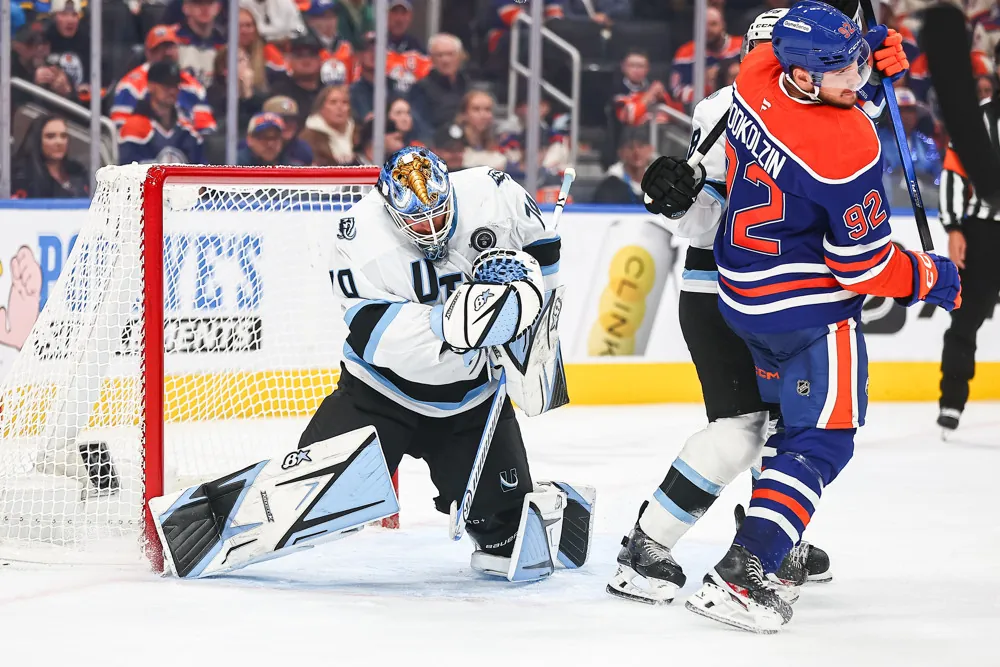
Utah lost 3-1 at home to Minnesota on Tuesday in a game with three fights and 52 penalty minutes, 29 of them Utah's. The Mammoth were shorthanded seven times and the Wild scored on two of them. The second, early in the third period, came after Clayton Keller was given an extra minor for abuse of officials on top of a tripping call he did not like. André Tourigny defended his captain afterwards and still said he did not want that penalty.
It was the fourth time in 13 games that Utah has given up two or more power-play goals, and it has lost three of those four games. The odd part is that the Mammoth have the most productive power play in the league and one of the best five-on-five teams in hockey. The penalty kill has been bad enough to drag a very good team back towards the pack, and the only reason it has not cost more is that the power play keeps scoring at a rate it cannot sustain.
How good is Utah at five-on-five?
Close to the top of the league. Utah has 58.0 per cent of the expected goals at five-on-five, behind only New Jersey and Carolina, and 56 per cent of the shot attempts, also third. It creates 3.00 expected goals per 60 minutes, tied for third, and allows 2.18, seventh. That is a team controlling games in both directions.
The depth is the reason. Barrett Hayton has 69 per cent of the five-on-five expected goals when he is on the ice, Kailer Yamamoto 70, Anders Lee 65 and Vincent Trocheck 59. Lee is generating 1.31 individual expected goals per 60 at five-on-five, tied for sixth among forwards with two hours played. On the back end Mikhail Sergachev plays 23.4 minutes a night with a 59 per cent share.
The goals have not fully followed. Utah has outscored opponents 27-24 at five-on-five while finishing 4.5 goals below what its chances were worth. That is the part we argued in early October, when we said Utah was underpriced at a 96.5-point season total. Sixteen points from 13 games is a 103-point pace over this season's 84 games, and the five-on-five numbers say the pace is earned. The same piece said Dylan Guenther was not a 50-goal scorer. He has five in 13, a 32-goal pace, on 39 shots.
Is the power play really this good?
It is a good power play running well above its own chances. Utah has scored 16 power-play goals, more than any team, and 14.88 per 60 minutes at five-on-four, also first. The chances it creates on the man advantage are worth 9.07 expected goals per 60, which ranks eighth. Over the 64.5 minutes Utah has played at five-on-four, that rate predicts about ten goals. It has 16.
| Utah five-on-four, 2026-27 | Minutes | Goals | Assists | Individual expected goals |
|---|---|---|---|---|
| Logan Cooley | 50.0 | 1 | 7 | 0.9 |
| Clayton Keller | 49.6 | 2 | 8 | 1.1 |
| Dylan Guenther | 49.3 | 4 | 3 | 2.4 |
| Nick Schmaltz | 47.9 | 5 | 1 | 2.3 |
| Mikhail Sergachev | 44.3 | 1 | 5 | 0.4 |
Nick Schmaltz has five power-play goals from chances worth 2.3, and Guenther four from 2.4. The top unit has been on the ice for 12 or 13 of the 16. Logan Cooley and Keller are running it well, and a five-man unit this skilled will score more than average. It will not keep scoring at more than 60 per cent above its chance rate for a whole season. No power play does.
That matters because the power play is the only thing keeping Utah's special teams in the black. Utah is plus-3 on special teams, 16 goals for and 13 against. By the chances on both sides, it should be closer to plus-2. When the power play drifts back towards ten goals per 64 minutes, the penalty kill is what is left.
What is wrong with the penalty kill?
Three things, and they stack. Utah takes too many penalties, allows slightly too many chances once it is shorthanded, and has been getting poor saves on those chances.
The volume first. Utah has taken 58 penalties, tied with Montreal and Ottawa for the third-most in the league behind Florida and Toronto, and has spent 56.5 minutes at four-on-five. Tuesday's seven shorthanded situations were the extreme, but the pattern was set long before.
The chances are next. Utah allows 8.55 expected goals per 60 at four-on-five, 23rd in the league. That is below average without being a disaster, and over 56.5 minutes it adds up to about eight goals. Utah has allowed 13. Its goaltenders have stopped 38 of 51 shots on the penalty kill, a .745 save percentage that ranks 28th, and 5.0 goals below expected, the second-worst figure in the league after Vegas.
The pairing on the ice for most of it is the same one.
| Utah four-on-five, 2026-27 | Minutes | Goals against | Expected goals against |
|---|---|---|---|
| Mikhail Sergachev | 27.7 | 10 | 4.6 |
| MacKenzie Weegar | 26.8 | 10 | 4.6 |
| Kevin Stenlund | 26.3 | 8 | 4.2 |
| Nate Schmidt | 26.2 | 3 | 3.2 |
| Lawson Crouse | 22.7 | 5 | 3.6 |
| Andrew Peeke | 22.2 | 3 | 2.8 |
Sergachev and MacKenzie Weegar have been on the ice for ten of the 13 power-play goals against, on chances worth 4.6. Nate Schmidt and Andrew Peeke have killed nearly as many minutes and allowed three, roughly what their chances predict. Some of that is the shooting luck that comes with any small sample, but some of it is about who Utah sends out against the other team's best unit. Sergachev is already Utah's most-used defenceman and a fixture on the first power play. He is also absorbing the hardest penalty-kill minutes, and it is showing.
Last season Utah allowed 6.92 power-play goals per 60 while shorthanded, 13th in the league. This season it is 13.80, 30th.
Is Vejmelka the problem?
Not at five-on-five, and that distinction matters. Karel Vejmelka has a .907 save percentage at five-on-five and is 0.6 goals below expected there, which is close to exactly average. Shorthanded he has stopped 36 of 46 shots, .783, and is 2.5 goals below expected. Sebastian Cossa has faced five shots on the penalty kill and allowed three.
| Utah goaltending, 2026-27 | Shots faced | Goals | Save % | Goals saved above expected |
|---|---|---|---|---|
| Vejmelka, five-on-five | 194 | 18 | .907 | -0.6 |
| Vejmelka, shorthanded | 46 | 10 | .783 | -2.5 |
| Cossa, five-on-five | 43 | 6 | .860 | -0.5 |
| Cossa, shorthanded | 5 | 3 | .400 | -2.4 |
Across all situations Utah's goaltending is 8.1 goals below expected, 30th in the league, and that headline number makes it sound like a crease crisis. Only about a goal of it comes at five-on-five. Most of the rest is on the penalty kill. Vejmelka played 64 games last season with a .896 save percentage and was 6.9 goals above expected, and Utah's team goaltending ranked tenth. There is no reason in his five-on-five work to think he has forgotten how to do that.
The case for patience, stated fairly
The argument for leaving it alone is mostly about sample size. Fifty-one shorthanded shots is nothing, and penalty-kill save percentage is one of the noisiest numbers in hockey. The chances Utah allows on the kill are only a little worse than average, the system was mid-pack last season, and a few more saves would bring the results back into line without a single change. Utah is also 8-5 and second in the Central on points, which is not the record of a team in trouble.
The other side is that two of the three problems are not luck. Utah takes penalties at one of the highest rates in the league, the chances it allows when shorthanded are 23rd, and the power play that has been covering both is running far above its own chances. When it comes back to normal, Utah's special teams will cost it games unless the kill improves.
Our view is that Utah should treat this as a discipline and deployment problem first. Cut the penalty count, which starts with the captain, and give Schmidt and Peeke more of the top penalty-kill minutes so that Sergachev is not playing every hard shift at both ends of the special teams. The five-on-five team is good enough to win the division. It should not need its power play to keep outscoring its own chances to do it.
What to watch
Utah plays in Pittsburgh on Thursday. Watch the penalty count first, then who starts the first penalty kill. If Utah goes another week taking four or five minors a night, the power play will not be able to keep paying for it. Every Mammoth number is on the team stats page, and the Central race is on the standings.