

 Utah Mammoth
 Toronto Maple Leafs
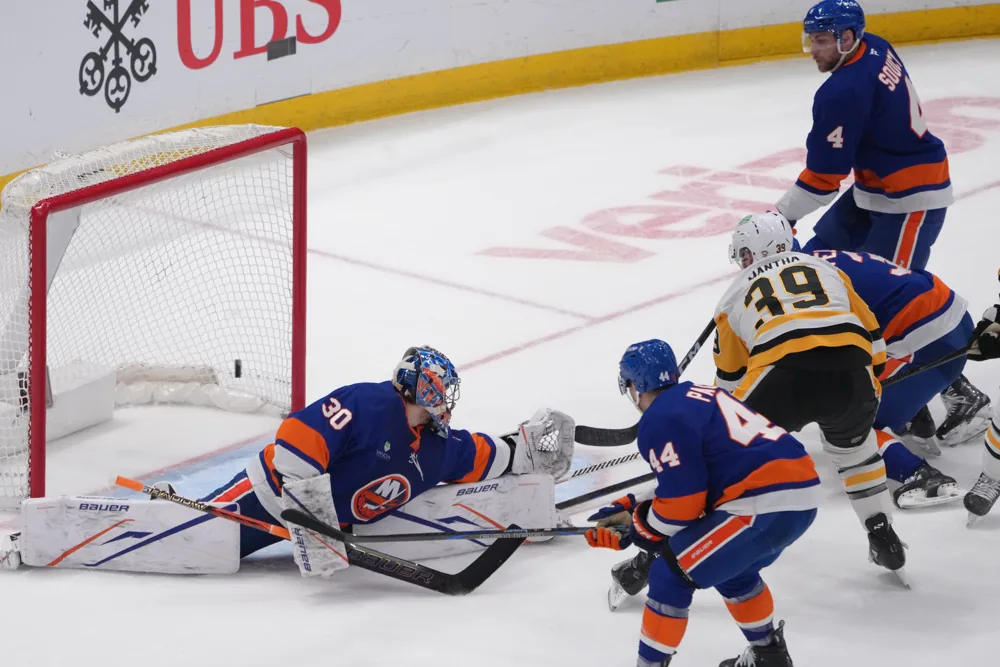
Ilya Sorokin faced 169 expected goals last season and allowed 144. Twenty-five goals saved above what the quality of the shots said he should have allowed, fourth in the NHL, second in Vezina voting, a franchise shutout record along the way. At 5-on-5 the New York Islanders got 21.8 goals of goaltending above expected, fourth in the league.
They finished 43-34-5, sixth in the Metropolitan, and missed the playoffs for the third year running.
The reason is the other end of the same ledger. At 5-on-5 the Islanders scored 20.7 goals fewer than the quality of their chances said they should have, 31st of 32 teams. One number cancelled the other almost exactly: their actual goal differential came out 1.1 goals better than their expected goal differential, which is to say the 91 points were earned, honestly, by a 48 percent team that allowed chances at the 30th-worst rate in the league. There is no bounce waiting to happen here. This is a roster that got elite goaltending and finished like nobody else in the league, and those two things landed it exactly where it deserved to be.
Who could not score
The finishing gap was not spread evenly. It had a name, and the name was the captain.
That is a remarkable number, and it comes with an obvious question: was Anders Lee unlucky, or was he finished?
The Islanders decided it was decline, not variance. Lee signed with Utah for three years at $5.4 million on July 1, ending 14 seasons and a captaincy, and New York did not match. On the evidence of the age curve that is defensible. On the evidence of the chance data it is a genuine loss: Lee was on the ice for 3.02 expected goals for per 60 at 5-on-5, the highest of any Islanders forward. The team's most productive chance-generator was also its worst finisher, and general manager Mathieu Darche chose to lose both at once.
What replaced him
Nothing, in the sense that matters. Every external signing the Islanders made was a one-year contract. Matias Maccelli at $2.25 million is the notable one: 25 years old, 14 goals and 39 points for Toronto, a 49 percent player. Vitek Vanecek at $1 million backs up Sorokin. Matt Kessel and Mitchell Chaffee are depth.
Darche has been explicit that this was the point. His summer bought flexibility, not players: no term, no risk, and a clean set of books heading into 2027. That is a coherent position for a team stuck where the Islanders are stuck, which is not good enough to win a round and not bad enough to draft at the top.
What is genuinely good
Matthew Schaefer is the reason to watch this team. The first overall pick in 2025 scored 23 goals and 59 points as an 18-year-old defenceman, tied Brian Leetch's rookie record for goals by a defenceman, played 2,024 minutes, posted a 54 percent expected-goal share on a 48 percent team, and won the Calder unanimously, the first unanimous winner since Teemu Selanne in 1992-93. At 5-on-5 he was on the ice for 2.74 expected goals for per 60 and finished plus-13 in goal differential on a roster where almost nobody was positive.
Around him: Bo Horvat, now the captain, scored 18 goals at 5-on-5 on 13.6 expected and led the team with 31 overall. Adam Pelech was a 53 percent defender. Alexander Romanov, signed through 2033 at $6.25 million, played 15 games and is back skating, which is close to a free addition. Victor Eklund, Cole Eiserman and Kashawn Aitcheson are the pipeline behind Schaefer.
The problems the summer did not touch
Three of them. The Islanders allowed 2.69 expected goals per 60 at 5-on-5, 30th in the league, and the blue line beyond Schaefer and Pelech is Ryan Pulock at 47 percent, Tony DeAngelo at 47 and Scott Mayfield at 46. The power play finished 30th at 16.5 percent and the response was a new assistant coach rather than new personnel. And behind Sorokin the backup job now belongs to a 38-year-old coming off knee injuries that cost him most of two seasons, or to a goaltender who posted an .883 in Utah.
Peter DeBoer, who took over with a week left last season, inherits all of it.
The case for the summer, stated fairly
Letting a 36-year-old captain walk rather than paying him into his late thirties is the correct call nine times in ten, and Utah gave him three years. Every dollar Darche did not spend is a dollar available next July, when the cap jumps again and this roster's young core needs paying. Schaefer's second season, a healthy Romanov, a full year of DeBoer's system and any correction at all in the finishing would move a 91-point team into the wild-card fight without a single signing. And Sorokin at $8.25 million through 2031-32 is the best-value contract on the roster.
Where this lands
No bad term added, a Calder winner entering year two, Sorokin locked up cheaply for six more seasons, and $3 million of space now that becomes real money next July. Lee at 36 was the right player to let go.
A team that allowed chances at the 30th-worst rate and ran the 30th-worst power play answered with four one-year contracts. It lost its best chance-generating forward and replaced him with a perimeter winger, and the backup goaltending behind a 31-year-old workhorse is a 38-year-old and an .883.
What it means
The finishing will improve, because minus-20.7 does not repeat, and some of that improvement will be mistaken for progress. It is not the number to watch. Watch expected goals against per 60, which was 2.69 and needs to be under 2.55 for this roster to matter, and watch Schaefer's minutes, which will tell you how fast DeBoer thinks the 19-year-old can become the best defenceman on the ice every night. And watch Sorokin's workload. He is 31, he played 55 games behind the 30th-ranked defence in the league, and the plan for lightening that load is a 38-year-old's knees.