
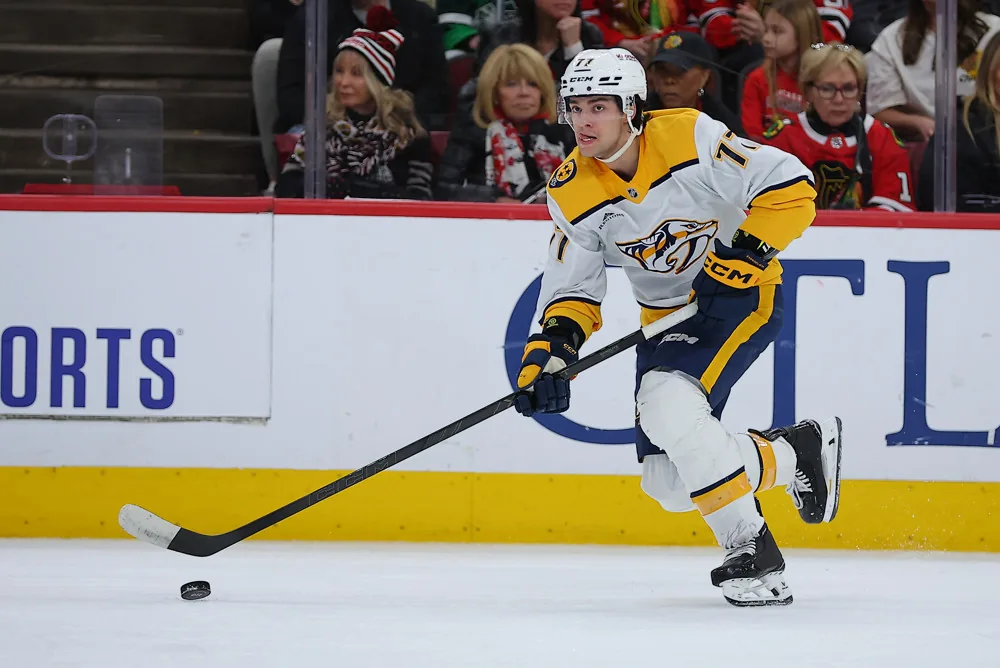

 Nashville Predators
 Pittsburgh Penguins
The New Jersey Devils missed the playoffs with 87 points last season, and the reason is not complicated. At 5-on-5 they generated 170 expected goals and scored 136. That gap, 34 goals below what the quality of their chances should have produced, was the worst in the league, and it was not close: the next-worst finishing teams, the Islanders and the Canucks, were 21 goals under. The Devils broke even on chances at even strength and lost by 47 goals anyway, because the pucks did not go in, and I made the case in July that this was the best news a bad team could get, since shooting luck is the one thing in hockey that reliably comes back on its own.
So it is worth looking closely at what the Devils' front office did about it, because the two forwards it bought sit at opposite ends of the exact variable that sank the team. On July 15 New Jersey signed Anthony Mantha, who scored 33 goals for Pittsburgh on 18.3 expected, the third-largest overperformance by any shooter in the NHL. On September 1 it paid a conditional 2028 first-round pick and a 2028 second to Nashville for Luke Evangelista, who scored 12 goals on 19.4 expected and was one of the most underperforming finishers in the league. One of those players is about to regress. So is the other, in the opposite direction, and the Devils have priced them exactly backwards.
The problem was luck, and luck was the whole problem
Start with how singular New Jersey's season was. Every team has finishing variance. Most of it washes out over 82 games. The Devils' did not.
That minus-34 was not a bad-roster number. Jesper Bratt was on the ice for 3.03 expected goals per 60 at 5-on-5 and a 55 percent share. Nico Hischier was at 55. Jack Hughes, in 61 games, was at 54. The Devils' top line drove play like a top line. Bratt scored 12 goals at 5-on-5 on 13.4 expected, Hischier 12 on 14.8, and the Devils as a group were outscored 183-136 at even strength while splitting the chances almost exactly evenly. Whether you blame the coach for that is a separate argument, but the arithmetic is not in dispute. New Jersey did not need to create more chances. It needed the chances it created to go in at a normal rate, and normal rates return by themselves.
Which is why the summer's shopping list is so strange. New Jersey bought finishing, in two different forms, for a team whose finishing was going to fix itself.
Mantha: three seasons over 20 percent, and a model that does not believe any of them
Mantha's 2025-26 in Pittsburgh was, on the surface, a career year at 31: 33 goals, 64 points, 81 games, on a one-year deal, on a Penguins team that itself finished plus-20 in even-strength shooting luck, the fourth-luckiest in the league. He shot 21.7 percent on 152 shots. MoneyPuck's model looked at where those 152 shots came from and assigned them 18.3 goals. He scored 33. The 14.7-goal gap was the third-largest in hockey, behind only Cole Caufield and Morgan Geekie, and the Geekie case has already been argued on this site as the strongest version of a fluke that still fails.
Here is where Mantha is more interesting than a one-year outlier, and where honesty is required. This was not one hot season. He shot 20.4 percent in 2023-24, on 113 shots for Washington and Vegas. He shot 26.7 percent in the 13 games he managed in 2024-25 before his knee went. Then 21.7. Three seasons running above 20 percent, after seven seasons in which he never cleared 13.
There are two readings. The generous one is that Mantha, at 30, changed how he plays: fewer shots from the perimeter, more from the crease, a net-front role that turns a 6-foot-5 body into a tip-and-rebound machine, and a shooting percentage that is high because his shots are close rather than because they are lucky. His shot volume supports part of that. He took 152 shots last season, 1.9 a game, well under the 2.9 he averaged at his Detroit peak, and a player who shoots less and scores more has usually changed where he shoots from.
The problem with the generous reading is that expected goals already accounts for shot location. A rebound from the crease carries a high expected value, and 152 of them would produce far more than 18.3 expected goals. The model says his shots were not, on average, from the crease. It says they were ordinary shots that went in at an extraordinary rate, for the third year running. Three years is a long streak. It is still a streak, and the Devils have signed him for two more years at $4.75 million on the assumption it continues. If he shoots 13 percent, which is what he shot for the first seven years of his career and what the league's forwards shot last season, 152 shots produce 20 goals.
Evangelista: the box score is the disguise
Now the other purchase, which is the better one and which cost far more. Evangelista's 2025-26 line at Nashville reads like a second-line passenger: 12 goals, 44 assists, 56 points, 6.8 percent shooting. Nashville is a team at a crossroads that had every reason to sell, and a 24-year-old with 12 goals looks like an easy player to let go.
Look underneath it. Evangelista generated 19.4 expected goals on his own shots and scored 12, a 7.4-goal shortfall that puts him among the unluckiest finishers in the league. At 5-on-5 he was on the ice for a 55 percent expected-goal share on a Nashville team that was 49 percent overall, which is the profile of a genuine play-driver rather than a beneficiary. Across all situations his share was 59 percent and the Predators outscored opponents by 32 goals with him on the ice, on a team that finished minus-25 overall. And 27 of his 44 assists were primary, the pass that directly produced the goal, which is elite playmaking volume for a winger and is not luck.
Put the two side by side and the shape of it is obvious. The Devils bought a 32-year-old whose 33 goals were built on a 21.7 percent shooting year, and a 24-year-old whose 12 goals were built on a 6.8 percent one. Regression is going to move both numbers toward 13. That is roughly 20 goals for Mantha on his shot volume and roughly 22 for Evangelista on his, before any growth from a player who does not turn 25 until February. The Devils will have paid a first and a second for the winger who ends up scoring more, and $4.75 million for the one who ends up scoring less, and the trade will still be the better piece of business.
What was actually fixed
Two other things happened this summer that matter more than either forward, and both were right. Jacob Markstrom went to Florida on June 30, in a trade I argued Florida got wrong precisely because Markstrom was 12 goals worse than expected last season. The Devils' other goaltender, Jake Allen, was six goals better than expected in 37 games. New Jersey's even-strength goaltending cost it about ten goals last year; moving the goaltender responsible for most of that is a real, if unglamorous, improvement. And Simon Nemec and Maxim Tsyplakov went to Calgary for Etienne Morin, the 35th pick and two conditional firsts, one of which is what bought Evangelista. That is a defenceman the Devils had stopped developing turned, two steps later, into a 24-year-old play-driving winger with a year of team control.
So the summer is not incoherent. It is a team that correctly identified goaltending as a problem and fixed it, correctly identified that it had assets it was not using and converted them, and then, in the two moves aimed at the forward group, bought finishing for a roster whose finishing was the one thing it did not need to buy.
The case for the Mantha signing, stated fairly
Two years and $4.75 million is not a bet-the-franchise number, and there is a version of Mantha where the three-year streak is real. He is enormous, he goes to the net, and the three seasons since his role changed have produced 60 goals in 168 games. If a 6-foot-5 winger has found a way to score from places the model undervalues, the Devils have bought a 30-goal scorer at a third of the going rate, and on a team that generates chances the way New Jersey does, a net-front finisher is the natural complement to Hughes and Bratt. The downside is a 20-goal middle-six winger on a short deal, which is not a disaster. It is a reasonable gamble. It is just a gamble on the wrong variable.
Where this lands
Markstrom out and Allen in fixes the crease. Nemec converted into Evangelista, a 24-year-old 59 percent play-driver with 27 primary assists, on a $3 million cap hit. Mantha is a cheap, short swing at a net-front finisher who has scored 60 goals in his last 168 games.
New Jersey's problem was minus-34 in finishing luck, which corrects itself, and its two forward purchases were the league's third-luckiest shooter and one of its unluckiest. Mantha's 33 goals came on 18.3 expected and a 21.7 percent shooting year; at his career rate he is a 20-goal player. The first-round pick went on the right winger; the narrative went on the wrong one.
What it means
New Jersey is going to look like a bounce-back team in October, and it will be, for the reason it was always going to be: 34 goals of finishing luck do not stay negative for two seasons. The question is who gets the credit. If Mantha scores 30 again, he will get it, and the Devils will face a decision on a 33-year-old with three years of shooting percentages nobody can explain. If he scores 20 while Evangelista scores 22 with 45 assists and drives the second line, then New Jersey bought the right player with the picks and the wrong one with the cheque, and only one of those mistakes costs anything. Watch Evangelista's shooting percentage. If it climbs toward 10, the Devils have a 60-point winger for $3 million and a first-round pick well spent.