
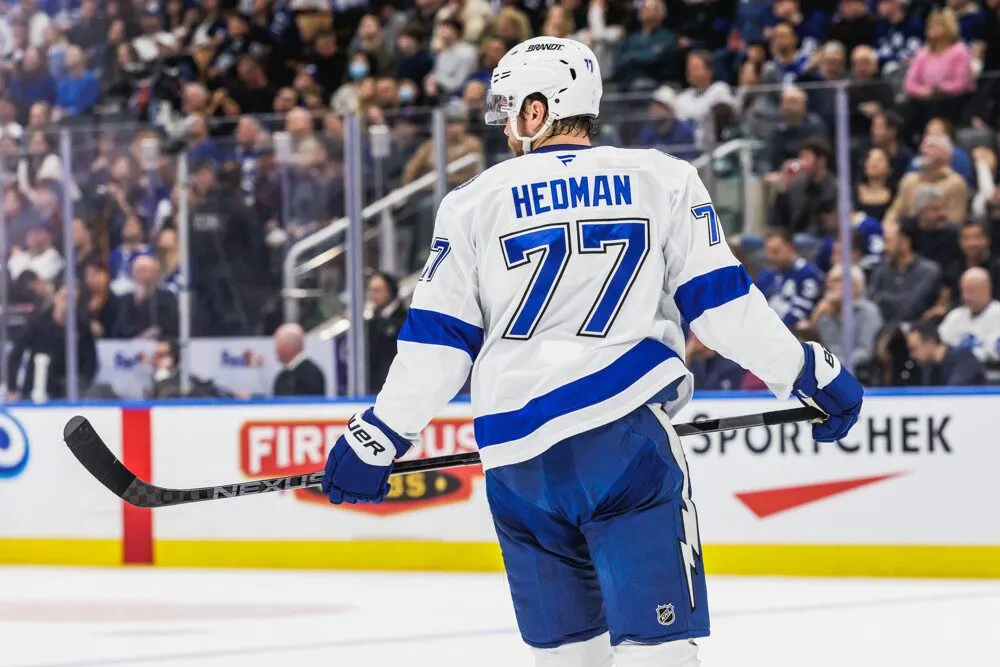

The Lightning captain appeared in 33 games last season, having been away from the team on personal leave, which deserves to be met with straightforward respect rather than analysis. What follows is not about that. It is about the hockey problem his absence exposed, which Tampa's offseason has, if anything, made sharper: a contending roster whose blue line is built around a 35-year-old who played fewer than half a season.
| Element | Number | The read |
|---|---|---|
| Team 5-on-5 share | 54% | A genuine contender |
| Goals for and against | 286 and 229 | Strong on both sides |
| Victor Hedman games | 33 | Available for well under half the year |
| Darren Raddysh points | 70 | The blue line carried by someone else |
The remarkable thing is how well the Lightning held up. Tampa controlled 54 percent of the expected goals and finished plus-57 on goal differential without its captain for most of the year, which speaks to a deep, well-coached group. Darren Raddysh produced 70 points from the back end, a genuinely excellent season, and the forward group did what it always does. The structure did not collapse. That is the encouraging half.
The load that got absorbed
The sobering half is where the absorption actually happened. When Hedman plays, Tampa has a legitimate number one to lean on in the minutes that decide playoff games; when he did not last season, the burden shifted to Raddysh and to a crease that was already doing extraordinary work. Andrei Vasilevskiy saved nearly 25 goals above expected, and I argued at the time that he is the load-bearing wall of this franchise. A season with a thinner blue line in front of him is exactly the scenario that puts more weight on that wall, and with Raddysh now in Toronto the blue line is thinner than it was.
The backup problem compounds it
There is a related vulnerability nobody discusses because Vasilevskiy makes it invisible. Jonas Johansson finished 10.4 goals below expected in 25 games, meaning Tampa's results in the games its starter did not play were considerably worse than the season totals suggest. A team leaning on one elite goaltender, with a struggling backup behind him and a blue line missing its anchor for half a season, is a team with three interlocking dependencies. Any one holding is fine. All three failing at once is how a 54 percent contender misses.
What Tampa actually needs
The requirement is straightforward and unglamorous: another defenceman who can play real minutes, and a backup who can hold serve for 25 games. Neither is a blockbuster acquisition, and both are the kind of addition that a cap-strapped contender finds hardest to make, because the money is committed to the top of the roster. Tampa did move on the second of those: on July 1 it acquired goalie Dennis Hildeby from Toronto, along with a 2027 fourth-round pick and a 2028 third, for Nick Paul. Whether Hildeby holds serve is an open question, but the need has at least been acknowledged, at the cost of a forward. The Lightning have spent years managing exactly this squeeze, deferring depth to keep their stars, and the Hedman situation converts a theoretical vulnerability into a live one.
The forwards remain extraordinary
None of this is a case that Tampa is in trouble, and the top of the lineup keeps the ceiling high. Nikita Kucherov's 130 points trailed only Connor McDavid, Jake Guentzel added 88, and Brandon Hagel remains among the best two-way wingers alive at 74 points. A team with that forward group and that goaltender is dangerous in any format. The question is not whether the Lightning are good. It is whether the margins hold when the schedule stretches to 84 games and the depth gets tested again.
The honest counter
The optimistic reading has real support: Tampa proved it can win at a high level without its captain, which arguably makes the roster more robust than it appeared, not less. Raddysh stepping up suggested the blue line had more internal answers than the depth chart implied, even if that particular answer now plays in Toronto; the forward group is deep enough to cover a lot, and a healthy, available Hedman would be an upgrade on last season rather than a requirement. Teams that survive an absence and still post plus-57 have usually shown you something durable.
What 84 games changes
The schedule expansion is not a footnote for a team in Tampa's position, and it deserves specific attention. Two extra games sounds trivial until you consider where the cost lands: on the players logging the heaviest minutes and on the goaltender taking the most starts. I wrote earlier this summer about how the 84-game schedule and its back-to-backs fall unevenly across the league, and a roster already leaning hard on two or three individuals absorbs that unevenness worst.
For the Lightning the specific pressure point is Vasilevskiy's workload. If Hildeby does not settle the backup situation, a longer season means either more starts for a goaltender already carrying an enormous load or more starts for one performing the way Johansson did, at 10.4 goals below expected. Neither is good, and the second is genuinely costly: across an 84-game season, giving 25 starts to a netminder performing at that level is worth several standings points, which in a tight Atlantic Division is the difference between home ice and a wild card.
The blue line faces the same arithmetic. A defence group that leaned on Darren Raddysh for 70 points and needed him to absorb top-pair minutes now has to do it without him, because Tampa traded Raddysh to Toronto on June 19 for a 2026 fifth-round pick, a sign-and-trade completed after he signed an eight-year contract, and the depth defencemen asked to play above their level across 84 games tend to break down or get exposed by March. Tampa's coaching has been excellent at hiding these seams, but coaching mitigates structural problems rather than solving them, and the seams are more visible than they were.
The optimistic version is that a healthy, available captain changes all of this at once, restoring the top-pair minutes, reducing the load on whoever inherits Raddysh's minutes, and lowering the volume of chances reaching the crease. That is genuinely how it could go, and it is why Tampa remains a contender on paper. But planning around it is a bet on availability that last season did not support, and contenders that bet on the best case usually find out in April whether they were right.
Where this lands
Tampa spent most of last season without its captain and remained a genuine contender, which is a testament to the roster and the coaching. It also left a question unresolved heading into a longer season: what this blue line looks like across 84 games if the same circumstances repeat, with a backup who is new to the job and a goaltender already carrying more than any one player should. The Lightning have the talent to win regardless. They have added a backup in Hildeby and subtracted a top-pair defenceman in Raddysh, which does not make it comfortable.
Correction, September 7, 2026: An earlier version of this article described Darren Raddysh as a current option for Tampa Bay's blue line in two places, and elsewhere stated that he had signed in Toronto as a free agent. Tampa Bay traded Raddysh to Toronto on June 19, 2026 for a 2026 fifth-round pick in a sign-and-trade after he signed an eight-year contract, before this article was published. The article also did not reflect Tampa Bay's July 1 acquisition of goalie Dennis Hildeby from Toronto, with a 2027 fourth-round pick and a 2028 third, for Nick Paul, which bears on the backup goaltending question the article raises. The relevant sentences have been revised and the table caption has been updated. The statistical analysis of the 2025-26 season is unchanged.