
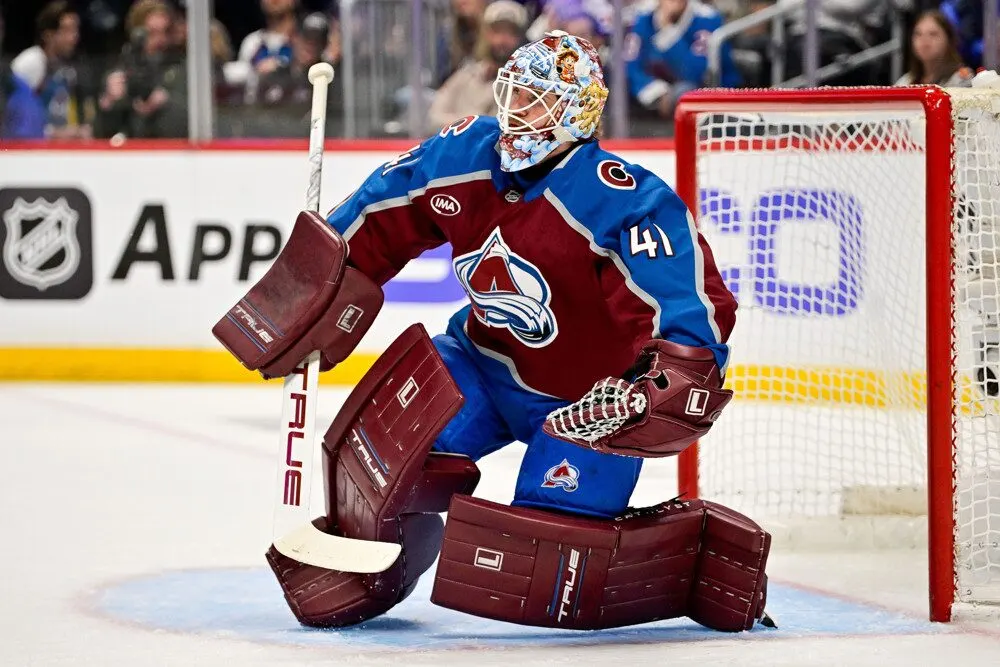

It has become the default caveat of the season-preview genre. Colorado is loaded, Colorado is terrifying, Colorado will go as far as its goaltending allows, and the crease is the soft spot that could undo everything. The line appears in nearly every list, delivered with the confidence of settled fact. It is worth checking against what actually happened last season, because the numbers say the opposite, and they are not close.
| Goaltender | Games | Goals saved above expected | League context |
|---|---|---|---|
| Scott Wedgewood | 45 | +23.1 | Fifth best in the NHL |
| Mackenzie Blackwood | 38 | +8.3 | Comfortably above average |
Scott Wedgewood saved 23.1 goals above expected across 45 games, the fifth-best mark of any goaltender in the league and ahead of names that headline every list of elite netminders. Mackenzie Blackwood added 8.3 in 38 games. Between them, Colorado's tandem saved more than 31 goals above expectation, which is not a weakness, a question mark or a soft spot. It is one of the better goaltending seasons any team got.
The rest of the picture is absurd
Set that alongside the skater group and the case for Colorado becomes almost uncomfortable. The Avalanche controlled 57 percent of the expected goals, the best figure in hockey, and outscored opponents 298 to 197, a plus-101 differential. Nathan MacKinnon remains the best player in the world, Cale Makar is heading toward a market-resetting contract, and the supporting cast is deep. A team with that profile and above-average goaltending has no obvious flaw at all.
So why does the narrative persist
Because the Avalanche keep losing in ways that feel like goaltending, and because neither name in the crease carries the reputation of an established star. Wedgewood and Blackwood are journeymen by pedigree, not lottery picks or Vezina finalists, and preview writers reach for the position where the names look weakest rather than the position where the numbers are. It is pattern-matching on résumés instead of performance, and it produces a confident, widely repeated conclusion that last season's data flatly contradicts.
The real question is different
What has actually undone Colorado is not the crease but the conversion. I wrote in August about the best team that cannot finish, a group that dominates territorially and then runs into hot goaltenders and cold stretches in the spring. That is a genuinely hard problem, and it is not solved by acquiring a goaltender. If the Avalanche fall short again, the postmortem will almost certainly be about special teams, finishing luck or a seven-game series going sideways, not about the netminders who saved 31 goals above expected.
The regression caveat, honestly stated
There is one legitimate version of the worry and it deserves stating properly. Wedgewood's 23.1 is well above his career baseline, goaltending is the most volatile position in the sport, and a tandem that overperforms this dramatically usually gives some of it back. A reasonable projection has Colorado's crease as average-to-good rather than elite, which is a real step down from last season even if it is nowhere near a weakness. The honest version of the preview line is not that the goaltending is bad; it is that it is unlikely to be this good again.
What that actually costs
Even granting full regression, the arithmetic still favours Colorado enormously. A 57 percent team with average goaltending is a Cup contender; the plus-101 differential has an enormous cushion built into it. Losing 15 goals of netminding performance would move the Avalanche from historically dominant to merely excellent, which is a distinction that matters to nobody outside a spreadsheet. The margin here is so large that the pessimistic case still describes one of the two or three best teams in hockey.
How the narrative got built
It is worth tracing how a consensus this wrong forms, because the mechanism repeats every year across every sport. Colorado lost in the spring, playoff exits demand explanations, and goaltending is the most available explanation in hockey because a single bad goal is more legible than a systemic finishing problem. Once that story attaches to a team, it survives independently of new evidence, and each subsequent preview inherits it from the last rather than rechecking the numbers.
The names compound it. Wedgewood and Blackwood have journeyman résumés, and the human instinct is to trust pedigree over performance, particularly at a position where reputation is currency. Had the identical seasons been posted by two former first-round picks with Vezina votes on their records, the same writers would be describing Colorado's crease as a strength. The numbers would be unchanged; only the names would differ, which tells you the analysis was never really about the numbers.
There is a practical cost to this beyond bad previews. Narratives influence front offices, and a team told repeatedly that its goaltending is a weakness may be tempted to spend assets fixing a position that is already performing. Colorado's actual needs, to the extent it has any, sit in the depth scoring and the special teams that go cold in the spring, and every dollar or pick spent on a goaltender is one not spent there. Believing your own bad press is expensive.
The useful discipline is simply to check. Goals saved above expected is a public, widely available measure, and it takes about ten seconds to establish that Colorado's tandem was among the more productive in the league. That nobody bothered before repeating the line is a small illustration of how much of preview season is inherited rather than examined, and why the most valuable analysis available in August is often just reading the numbers everyone assumes they already know.
Where this lands
Preview season runs on received wisdom, and the Colorado goaltending line has been repeated so often it stopped being checked. The Avalanche got the fifth-best goaltending season in the league from Scott Wedgewood, solid work from Blackwood behind him, and combined it with the best possession numbers and goal differential in hockey. If something stops this team, it will be the same thing that has stopped it before: a spring where the finishing deserts a group that creates more than anyone. The crease has been the least of Colorado's problems, and last season it was one of its strengths.