
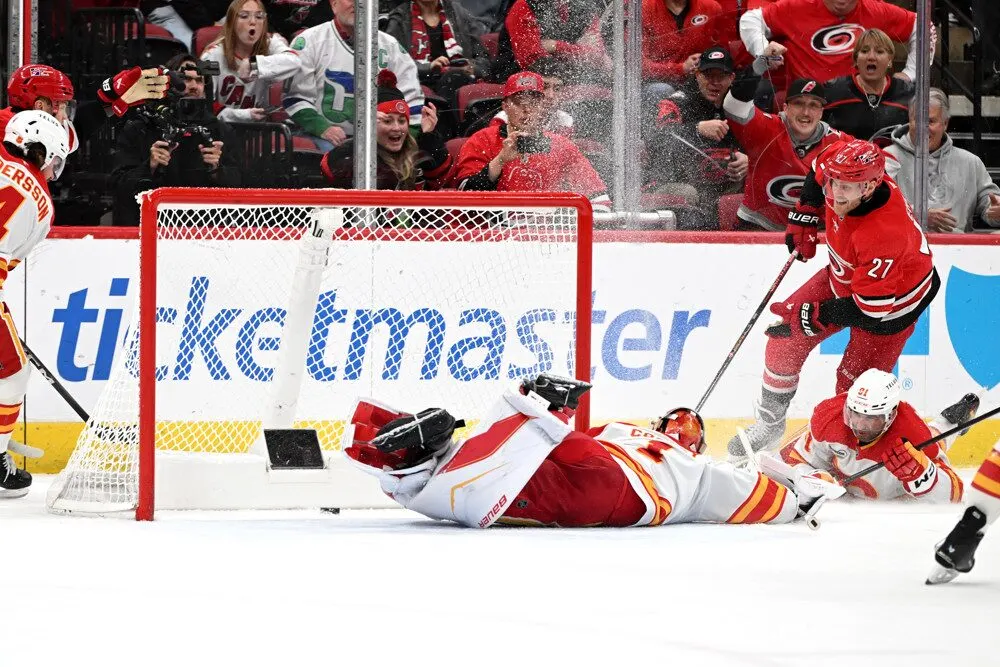

The Flames have organised their rebuild around a premise that has gone almost entirely unexamined: that the goaltending is the settled part. Dustin Wolf is the young franchise netminder, the position is handled, and the work ahead is finding players who can score. It is a comforting story for a team that scored 208 goals. It also does not survive contact with last season's numbers, which say the best goaltending in Calgary came from the other end of the bench.
| Goaltender | Games | Goals saved above expected | Per-game read |
|---|---|---|---|
| Devin Cooley | 31 | +17.3 | Elite rate work |
| Dustin Wolf | 57 | -1.8 | Below league average |
The gap is not subtle. Devin Cooley saved 17.3 goals above expected in 31 appearances, a rate that would rank among the best in hockey over a full season. Dustin Wolf, in nearly twice the workload, finished 1.8 goals below expected, which is to say slightly worse than a league-average goaltender. One of these players was carrying a bad team. It was not the one the organisation has built its plans around.
Why this matters more for Calgary than most teams
Context makes the finding sharper. The Flames were a 46 percent team that scored 208 goals, among the fewest in the league, and were outscored 256 to 208. A club that cannot score is entirely dependent on its crease to keep games within reach, which means goaltending performance is not one input among many; it is close to the whole margin. Calgary spent last season getting league-average work from its starter in the one area where it could least afford it.
The uncomfortable question
Nobody in Calgary is asking it out loud, so it is worth putting plainly: on what evidence is Wolf the starter? The pedigree is real, he has been excellent in the minors and flashed at this level, and 57 games of slightly-below-average work at his age is not a career verdict. But the organisation is allocating the most important job on a bad roster based on projection rather than production, while a goaltender who outperformed him substantially sits behind him. That is a defensible development decision and an indefensible competitive one.
The case for Wolf anyway
The counterargument is genuinely strong and deserves its space. Sample size cuts hard here: 31 games from Cooley is a third of a season, goaltending numbers swing wildly across samples that small, and backup goaltenders routinely post gaudy rates in limited, often favourable, usage before regressing when handed a real workload. Wolf's 57 games is the more meaningful sample, his underlying skill set has always projected as a starter, and young goaltenders frequently need a season or two of ordinary results before settling. Abandoning him on one below-average year would be an overreaction.
But the workload should be earned
The reasonable middle is the one Calgary has not adopted. Nothing about the evidence justifies handing Wolf 57 games again by default. A genuine competition, with Cooley given enough starts to establish whether his rate work survives volume, costs the Flames nothing in a season where they are not contending and answers the most important question on the roster. Rebuilding teams have the luxury of finding out. Calgary has instead behaved as though the answer were already known.
What it says about the rebuild
There is a wider pattern here worth naming. The Flames are a team with a genuine scoring problem, built around Matt Coronato's 45 points and a thin supporting cast that produced the fewest goals in the league. A rebuild that has misidentified its settled positions is a rebuild spending its resources in the wrong places, and if the crease is actually an open question rather than a closed one, Calgary's timeline and its shopping list both change. Getting this wrong is expensive in a way that does not show up for two or three seasons.
What a real competition would look like
The practical version of this argument is not "bench Wolf." It is that Calgary should stop assigning starts on the basis of who the organisation hopes is better and start assigning them on the basis of who is stopping pucks. A genuine competition means something close to an even split through the first quarter of the season, with the workload following results rather than depth-chart position, and it means being honest internally about what the numbers say when they arrive.
The Flames are perfectly positioned to run that experiment. They are not contending, the standings consequences of a slow start are minimal or arguably beneficial, and the information gained is enormously valuable to a franchise that has to decide whether its most important position is solved or open. Teams in playoff races cannot afford to find out; rebuilding teams cannot afford not to. Calgary has been behaving like the former while occupying the latter's position.
There is a development argument on both sides worth acknowledging. Wolf's supporters would say a young goaltender needs volume and organisational confidence to grow into a starter, and that yanking his workload after one middling season undermines exactly the belief he needs. That is fair, and it argues for giving him a genuine share rather than exiling him. But it does not argue for handing him 57 games by default while a teammate posting far better numbers watches, which is what happened last season.
The worst outcome for Calgary is not discovering that Cooley is better. It is spending two more seasons never asking, arriving at the end of the rebuild with a scoring problem it knew about and a goaltending question it never tested, and then having to spend assets solving a position it already had answers for. Information is the cheapest thing a bad team can buy, and the Flames have been declining to purchase it.
Where this lands
Devin Cooley saved 17.3 goals above expected and Dustin Wolf saved fewer than none, on a team so short of offence that every save mattered double. The sample is small, the pedigree favours Wolf, and none of this proves the Flames have their depth chart upside down. What it does prove is that they have not tested it, and a rebuilding team with a genuine question at the most important position on the ice should want an answer far more than it wants a comfortable story.