
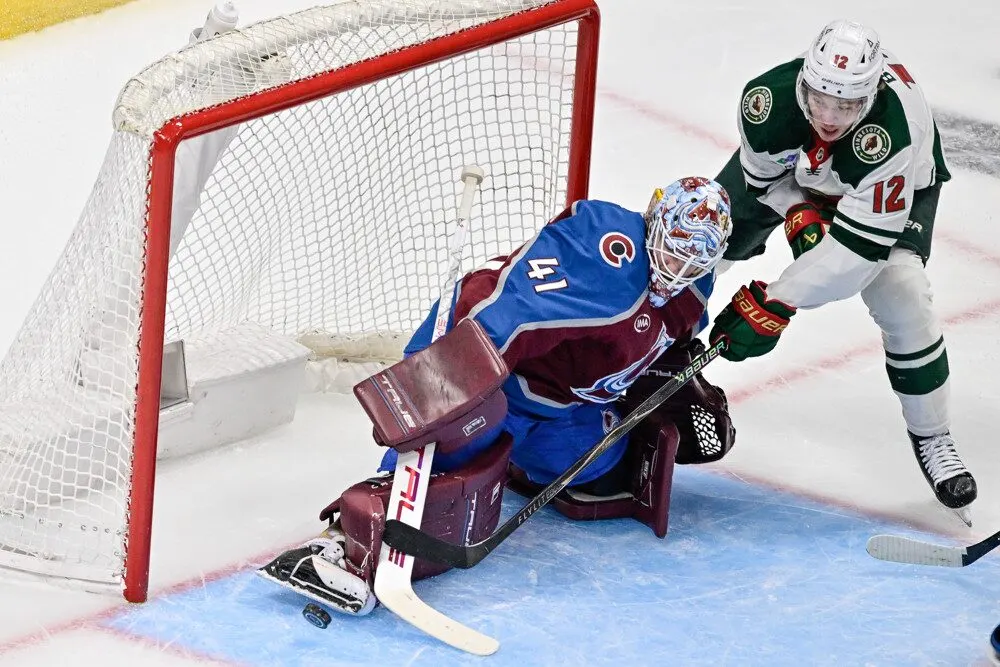

Every conversation about the Wild this summer runs through money. Kirill Kaprizov's future, the contract window I wrote about in August, and now Quinn Hughes heading toward unrestricted free agency with a number that will reset the blue-line market. It is a genuinely frightening set of bills. What gets lost in the accounting is the reason Minnesota should pay them: this roster is very good, and the player who quietly made it that way scored 42 goals last season and is barely mentioned.
| Player | Goals | Points | On-ice xGF% |
|---|---|---|---|
| Kirill Kaprizov | 45 | 89 | 63% |
| Matt Boldy | 42 | 85 | 58% |
| Quinn Hughes | 5 after the trade | 53 in 48 games | 60% |
| Mats Zuccarello | 15 | 54 | 63% |
| Joel Eriksson Ek | 19 | 51 | 58% |
Two 40-goal wingers on the same team is not a common thing, and Minnesota has it. Hughes is listed by what he produced as a Wild after the midseason trade rather than his 76-point full season, 23 points of which came in 26 games in Vancouver. Boldy scored 42 and put up 85 points at a 58 percent on-ice share against a team that ran 48 without him, a plus-10 swing that marks him as a genuine driver rather than a passenger on Kaprizov's line. The Wild controlled 52 percent of the expected goals and out-scored opponents 268 to 235. This is a legitimately strong hockey team, and its second-best forward would be the best forward on a dozen rosters.
Why the Boldy season matters more than it looked
Forty-two goals gets noticed. What did not is the shape underneath it. Boldy is not a finisher living off a superstar's passes; his own shifts tilt the ice, his production held up across usage, and at 25 he sits precisely in the years where wingers add rather than lose. That distinction decides whether the Wild's cap crunch is worth enduring, because a team paying enormous money to Kaprizov and potentially Hughes needs its third expensive forward to be genuinely elite rather than merely productive. Boldy is the former, and the on-off numbers say so.
The cap math, stated plainly
Here is what Minnesota faces. Kaprizov is the franchise player and will be paid like one. Hughes, if he re-signs, will command a number near the top of what any defenceman has ever earned, and the Wild traded real assets to get him, which makes walking away close to unthinkable. Layer Boldy's next deal on top and Minnesota is committing an enormous share of its cap to three players. That is the hardest kind of problem in a flat-ceiling sport, and there is no clever accounting that makes it disappear.
Why it is still the right bet
But look at what the money buys. Three players who each drive play at an elite level, two of whom score 40, on a team that already out-chances opponents and has a settled second-line centre situation despite the discourse insisting otherwise. Teams with this much high-end talent do not usually also have Brock Faber and Joel Eriksson Ek filling out the spine. Minnesota's alternative to paying is losing one of them for nothing or for futures, and rosters this close to contention do not get better by subtracting stars. The bill is brutal. The product is worth it.
The depth question is the real risk
The honest worry is not whether these three are worth the money; it is what the rest of the lineup looks like once they are paid. Minnesota's supporting cast just got thinner, with Mats Zuccarello gone to Los Angeles in free agency and Vladimir Tarasenko a year older, and a roster with three enormous contracts has to fill the bottom nine with cheap, young, useful players or it hollows out fast. That is the actual test of the front office, and it is where cap-heavy teams usually fail. The stars will be fine. The fourth line and the third pair are where this gets decided.
The Boldy contract is the lever
Which makes the timing of Boldy's next deal the most controllable variable Minnesota has. Locking him in early, before another 40-goal season prices him at the top of the winger market, is exactly the kind of move that makes the rest of the math survivable. Wait, and the Wild will be negotiating with a two-time 40-goal scorer who knows precisely what he is worth. The teams that survive cap crunches do it by signing their good players a year early. The ones that drown wait for certainty and pay for it.
The two-scorer advantage, quantified
It is worth being precise about why having both Kaprizov and Boldy matters more than the raw point totals suggest. A team with one elite scorer is solvable in the playoffs: the opposing coach assigns his shutdown pair, tilts the matchups, and forces the supporting cast to beat him. A team with two, on separate lines, presents a problem with no clean answer, because whichever one gets the hard minutes leaves the other facing a second pair. Minnesota controlled 52 percent of the expected goals last season in part because opponents could never concentrate their defensive resources.
That structural advantage is exactly what the cap bills are buying, and it explains why the Wild should be less anxious than the discourse. Kaprizov at 45 goals and a 63 percent share is a genuine superstar. Boldy at 42 goals and a plus-10 swing is the piece that makes him unsolvable. Paying both is not redundancy; it is the specific roster construction that wins series, and teams routinely trade first-round picks and prospects trying to acquire the second scorer Minnesota already developed.
The Quinn Hughes dimension adds a third layer, because an elite puck-mover changes how both wingers get the puck. A defenceman who exits the zone cleanly and quarterbacks a power play multiplies the value of finishers, and the Wild's 268 goals reflect that interaction rather than three players producing independently. Break up the trio and the whole is worth less than the parts, which is the strongest argument against the "trade one to afford the others" logic that inevitably surfaces when cap panic sets in.
What Minnesota must avoid is the classic error of cap-heavy teams: filling the remaining roster spots with expensive veterans on declining deals rather than cheap young players. The Wild have Brock Faber at 51 points and a supporting cast that skews older, and the next two drafts matter more than the standings will suggest. Contending teams with three enormous contracts survive on entry-level production in the bottom six. That, not the star salaries, is where this either works or falls apart.
Where this lands
The Wild's summer has been framed as a warning, a franchise about to be crushed by its own payroll. The framing is half right and misses the point. Minnesota's bills are enormous because Minnesota's players are excellent, and Matt Boldy's 42-goal, play-driving season is the clearest evidence that this is a roster worth paying to keep together rather than a cautionary tale in progress. The Wild have a top six that can beat anyone and a cap sheet that will test everyone in the building. Given the alternative, that is a problem most teams would take gladly.