
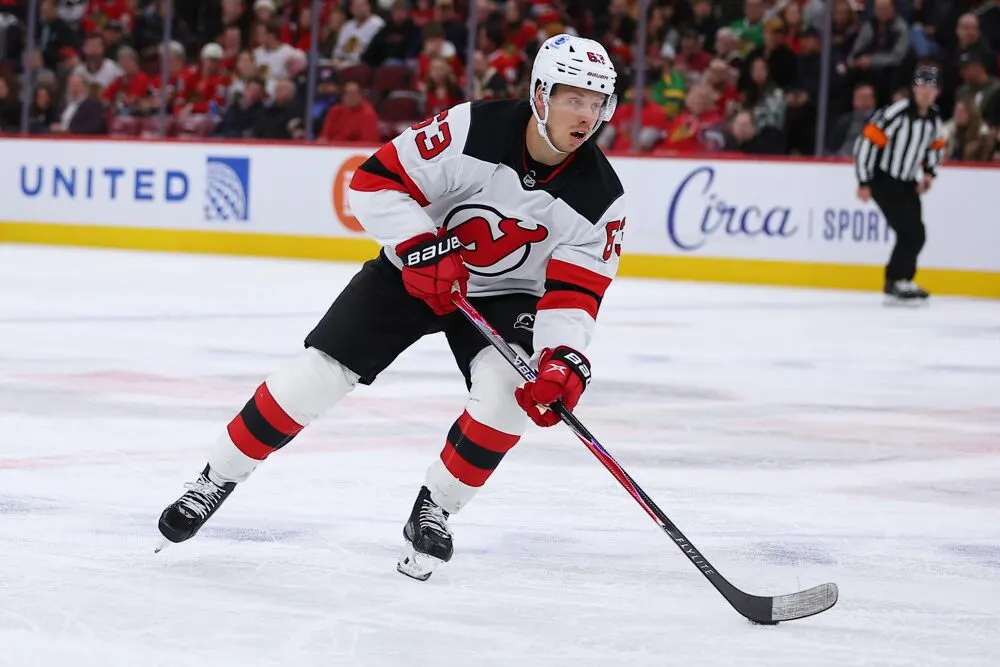

Preview season is list season, and Jesper Bratt has made a career of missing them. Too smooth to generate highlights, too consistent to qualify as a breakout, too quietly excellent to trend, he has become the best winger in hockey that no ranking remembers. This is the season the omission gets expensive for anyone making predictions, because New Jersey's entire bounce-back case, the one I have been making since July, runs directly through him, and the numbers underneath his season are the strongest on the roster.
| Player | Games | Points | On-ice xGF% |
|---|---|---|---|
| Jack Hughes | 61 | 77 | 60% |
| Jesper Bratt | 82 | 71 | 61% |
| Nico Hischier | 82 | 66 | 57% |
| Timo Meier | 77 | 44 | 57% |
Start with the two numbers that define him. Bratt played all 82 games and posted 71 points at a 61 percent expected-goals share, the best on-ice mark on the team, on a Devils side that ran 45 percent without him, a plus-16 swing that puts him in the league's top tier of play-drivers. Jack Hughes produced more per game; nobody in New Jersey tilted the ice more reliably across a full season. Durability plus drive is the rarest winger combination in the sport, and Bratt has now stacked seasons of both while the lists kept scrolling past his name.
The bounce-back math, restated
New Jersey's failed season was the league's clearest good-team-bad-luck story: a 51 percent share alongside 226 goals for and 253 against, the profile of a team that controlled play and finished nothing while its net leaked. I argued when the Keefe hot-seat chatter started that the fix is health and goaltending, not a scapegoat, and Bratt is the evidence underneath that argument. A team whose best full-season player drives 61 percent hockey is not broken; it is under-converted. When the finishing normalizes, the engine that was running all along starts showing up on the scoreboard, and the engine has a name the lists keep forgetting.
Why he never makes the lists
The omission has a logic worth naming. Bratt's game is built from small, unphotogenic excellences: exits that beat the first forechecker, entries with possession, a release that arrives earlier than it looks, defensive routes that never require a highlight recovery. He has never scored 40, never had a viral month, never been the story. Lists reward peaks and narratives; Bratt produces floors and process. But roster-building runs on exactly what he provides, which is why the analytics community rates him among the most valuable wingers alive while the mainstream ranks keep him honorable-mention. One of those two groups has been right about this player for five years.
The Hughes interaction
The doubters' best argument is proximity: it is easy to drive play adjacent to Jack Hughes, and some of Bratt's share reflects the ecosystem. The rebuttal is in the splits and the seasons. Bratt's numbers held through Hughes's 21 missed games, held across linemate shuffles, and his plus-16 swing measures the team with and without him, not his linemates' talent. If anything, the correct read runs the other way: New Jersey's stars amplify each other, and the winger who never misses a game is the constant that lets the ecosystem survive the injuries that keep hitting its centres. Constants are worth more than they rank.
The honest hedge
What would falsify the thesis: a second straight season of team-wide finishing drought would suggest something structural rather than unlucky, Bratt at 28 means the fade, when it comes, arrives without much warning, and if the goaltending stays leaky no amount of 61 percent hockey converts into a playoff berth. The Devils' bounce-back is a probability, not a promise, and Bratt is its strongest input rather than its guarantee. But betting on full-season elite play-drivers to matter is the safest wager preview season offers, and this one comes at a discount because nobody ranks him.
The valuation gap as strategy
For New Jersey's front office, Bratt's invisibility is not a grievance; it is leverage, and smart organizations weaponize exactly this kind of mispricing. A winger whose public reputation runs two tiers below his measured impact is the asset you never trade, because the market will structurally underpay, and the contract you extend early, because reputation-lagged players sign for reputation-lagged numbers. The Devils have quietly done the second part already, and the result is one of the best value contracts among elite wingers in the league, the kind of surplus that funds aggression elsewhere on the roster. Teams built around properly priced stars have no margin; teams built around underpriced ones get to make mistakes and survive them.
The deployment lesson runs the same direction. Because Bratt's game degrades nothing, no zone he cannot start in, no matchup he needs shelter from, no linemate he cannot elevate, the coaching staff holds a piece of rare tactical flexibility: he can stabilize a struggling line without weakening the top one, absorb the toughest matchup when Hischier needs relief, or supercharge Hughes when the game demands a push. Rosters usually pay for that kind of Swiss-army value in specialists, three players doing what Bratt does alone. In a season where the Devils' margin for error is thin and the bounce-back thesis needs every edge, having the league's most flexible elite winger is not a luxury item. It is the load-bearing one.
And there is a market-wide lesson in his career worth stating plainly: the lists are lagging indicators. Every measurement system that looks past goals, from on-ice shares to swing values to the contract decisions of the people paid to know, has rated Bratt among the league's best wingers for years, while the reputational economy waits for a 40-goal season that his pass-first game may never produce. When impact and fame disagree this long, impact is the one telling the truth.
Where this lands
Every preview list this week will name the Devils' bounce-back candidates and lead with the stars who missed time, and the actual foundation will keep being the winger who never does. Jesper Bratt at 61 percent across 82 games is the reason New Jersey's underlying numbers stayed contender-shaped through a lost season, and the reason the recovery case is math rather than hope. The lists will catch up eventually; they always do, one season after it mattered. For anyone paying attention now, the best winger nobody ranks is about to be the reason a team everyone doubted comes all the way back.