
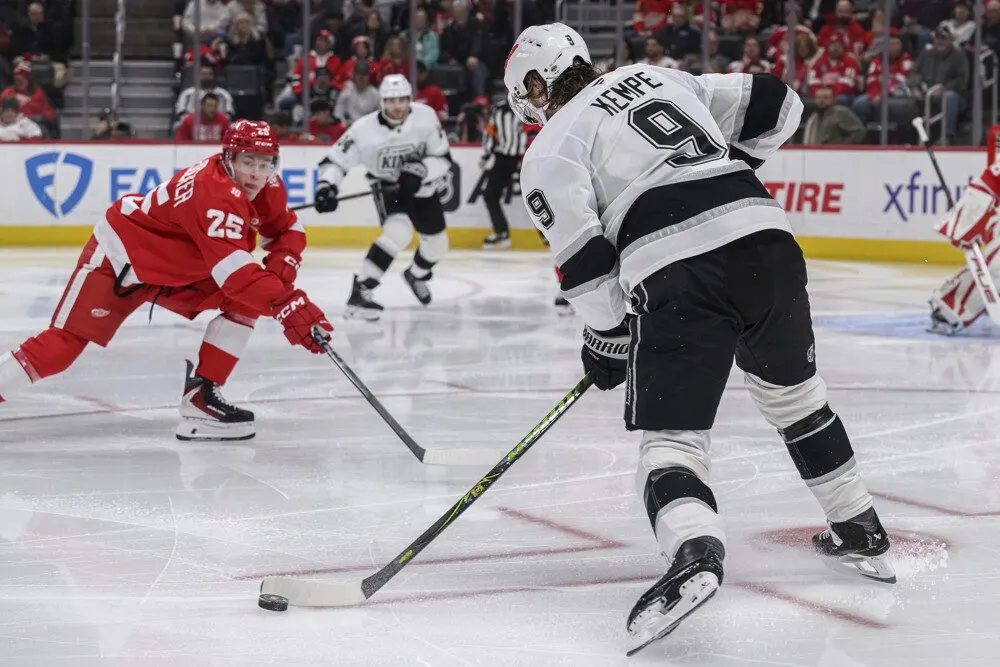

Successions in hockey usually get announced after the fact, once the letter changes sweaters and the tribute video runs. The real handoff happens earlier, quietly, in the shift-by-shift reality of who actually drives the team. In Los Angeles it has already happened. Anze Kopitar's two-decade era is winding down in plain sight, and the player carrying the Kings through the transition is not a prospect or a big signing. It is Adrian Kempe, and the succession he is bridging is not one ending era but two, because the aging star Los Angeles imported at midseason, Artemi Panarin, is renting his own twilight on the same roster.
| Player | Points | The read |
|---|---|---|
| Adrian Kempe | 73 | Led the team with 36 goals |
| Artemi Panarin | 27 in 26 games as a King | 84 across the season after a midseason trade |
| Quinton Byfield | 49 | The swing piece |
| Kevin Fiala | 40 in 56 games | A 62% on-ice share |
| Anze Kopitar | 38 | The closing era |
The numbers tell the story with unusual bluntness. Kempe scored 36 goals and 73 points to lead the team, on a club that managed just 220 goals all season, among the worst offences in the league. Panarin arrived from New York at midseason and produced 27 points in 26 games as a King, the point-per-game close of an 84-point season, brilliant work that is also a lease, because he is deep into his thirties and renting the same twilight Kopitar occupies. Strip those two wingers out and the group is not merely below average; it is barren. And only one of them is part of the future.
What Kopitar still is, and what he is not
There is no joy in writing down a great player's decline, so let the numbers do it gently. Kopitar posted 38 points at a still-respectable 56 percent on-ice share, which is to say he remains a smart, structurally sound two-way centre who no longer produces like a first-line one. Twelve goals from the franchise icon is not a slump; at his age it is a trajectory, and the Kings have quietly stopped asking him to be the engine. What he still provides, defensive intelligence and 20 minutes of stability, matters. What he no longer provides is the thing Kempe now supplies alone.
The problem with a borrowed offence
Here is where the succession story stops being sentimental and starts being strategic. LA's scoring rests on one winger in his prime and one deep into his thirties, and the aging half arrived at midseason producing at a point-per-game clip. The 220 goals on a respectable 51 percent expected-goals share already expose a conversion problem, the Kings create chances adequately and finish them terribly, and the roster is full of players who tilt the ice without scoring, Kevin Fiala's injury-shortened year excepted. When Panarin's production goes the way veteran production eventually goes, the entire load lands on Kempe overnight. The structure that Kopitar's prime once animated still works. The talent inside it is thinning on a schedule.
Byfield is the swing piece
Which brings the conversation to Quinton Byfield, because every LA succession plan eventually does. I wrote about the centre hole he is supposed to fill, and the update is mixed: 24 goals and 49 points is real progress, but a 51 percent share on a 51 percent team means he is not yet driving anything. The Kings' future asks Byfield to inherit Kopitar's position and Kempe to hold the scoring line until he does. If Byfield makes the leap, this transition looks orderly. If he does not, LA will eventually be asking one 36-goal winger to replace Panarin's playmaking and Kopitar's minutes at once, and that is not a plan; it is a prayer with good special teams.
The honest fragility in Kempe's case
To keep the succession story honest, Kempe's season carries one soft spot: his 55 percent on-ice share, solid as it is, ran only slightly ahead of the team's baseline, which says he finishes brilliantly but does not tilt the ice the way elite play-drivers do. He is a converter more than a creator, the inverse of his roster's problem, which is precisely why the fit works but also why calling him a franchise player overshoots. He is the bridge, and an excellent one. He should not have to be the destination too.
What the Kings should do with the truth
Accepting the handoff has practical consequences. It means building the power play and the top line around Kempe's shot now, not out of loyalty rotation. It means treating Kopitar's minutes as a finite resource to be spent on matchups and mentorship rather than obligation. And it means being ruthless about the actual deficiency: finishing talent around the roster. The Kings have cap room and a win-now veteran core; a genuine successor to Panarin's playmaking, whether a healthy Fiala, a Byfield leap or an addition, has to be identified before the need turns desperate. What they cannot do is keep describing themselves as Kopitar's team while the present is split between Kempe and an aging Panarin, because rosters built on nostalgia miss their own windows.
The roster math of a graceful transition
The Kings' situation rewards a colder look at the assets, because the pieces for a graceful handoff are genuinely present. Kempe's prime has three or four seasons left, Byfield's development window overlaps it exactly, Panarin's 84-point season buys the transition another productive year or two even as the clock on it runs, Fiala's 62 percent share in his injury-shortened year says a healthy version solves part of the finishing drought internally, and the defensive structure that Kopitar's system-intelligence anchored remains among the league's stingiest, 238 goals against on a roster that scored 220. Teams with that profile are one scorer away from relevance, not one rebuild away, and LA's cap sheet can buy the scorer. The transition fails only if management misreads which era it is living in and spends like the old one is still running.
The Kopitar management question is its own delicate art. The worst version of a legend's final seasons is the one where deference sets the lineup: first-unit power-play time as a lifetime achievement award, top-six minutes that belong to the future spent honoring the past. The best version is the one where the role shrinks honestly, the matchup shifts get lighter, and the icon's genuine remaining value, the faceoffs, the penalty kill, the apprenticeship of Byfield, gets maximized precisely because nobody is pretending it is 2016. Kopitar has never been a vanity player, and nothing in his game suggests he would resist the honest version. The question is whether the organization offers it.
And the Byfield timeline deserves its own urgency, because succession plans have expiry dates. He is past the age where potential alone carries a projection; the 24 goals were real progress, but the play-driving leap has to come in the next two seasons or the Kings must shop for the Kopitar replacement externally, at external prices. LA's whole decade turns on which of those futures arrives, and this season is the one that tells them.
Where this lands
Anze Kopitar earned the slow goodbye he is getting, and nothing about the succession diminishes two decades of being the Kings' spine. But eras end whether or not teams admit it, and by every measure that matters on the ice, this one already has. Kempe owns the goals the Kings get to keep, Panarin's point-per-game hands are on a clock of their own, Byfield is auditioning to carry the middle, and the Kings' immediate future depends on management building around that reality instead of the memory. The handoff is happening in plain sight. The only question left is whether Los Angeles builds around its present or keeps honoring its past.