
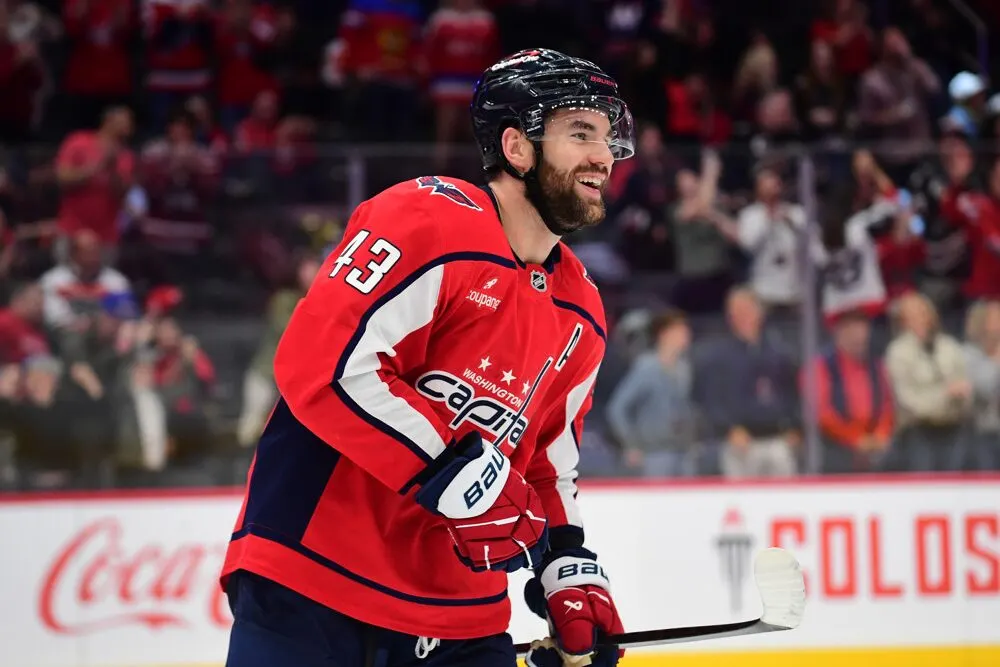

The end of an era rarely announces itself. It arrives quietly, in the gap between what a legend used to be and what he is now, and in the scramble to figure out who fills the space he leaves. Washington is living in that gap. Alex Ovechkin is still productive and still beloved, but the seasons left are few, and the Capitals' most important question is no longer about him. It is about who leads when he is gone, and the answer, increasingly, is Tom Wilson.
| Player | Goals | Points | On-ice xGF% |
|---|---|---|---|
| Alex Ovechkin | 32 | 64 | 61% |
| Tom Wilson | 30 | 62 | 54% |
| Jakob Chychrun | 26 | 60 | 57% |
| Dylan Strome | 19 | 58 | 59% |
The surprise is that Washington is not a team in decline waiting to happen. The Capitals controlled 51 percent of the expected goals and out-scored opponents 261 to 238, a genuinely solid two-way club, and I have written about how Ovechkin's late-career run has been propped up by strong goaltending and a better supporting cast than people assume. This is not a farewell tour dragging a bad team; it is a good team with a transition looming, which is a far more interesting and manageable problem.
Wilson has quietly become a scorer
The heart of the story is Wilson's transformation. Once known almost entirely for his physicality, he scored 30 goals and 62 points and drove a 54 percent share, the profile of a legitimate top-line forward rather than an agitator who chips in. That evolution is what makes him the natural successor to lead the post-Ovechkin Capitals: he already plays the heavy, north-south game the franchise is built on, and now he does it while producing like a first-line winger. The identity does not have to change. It just changes hands.
The next core is already here
What makes the transition survivable is that Washington is not starting from scratch. Jakob Chychrun scored 26 goals from the blue line, Dylan Strome anchored the middle at 58 points and a 59 percent share, Aliaksei Protas gives the lineup useful young legs, and rookie Ryan Leonard chipped in 20 goals in his first look. That is a functioning core, not a rebuild, and it means the Capitals can absorb Ovechkin's eventual exit without falling off a cliff, provided the pieces keep developing.
The challenge is the goals he takes with him
None of that erases the hard part. Ovechkin still scored 32 goals and drove a 61 percent share, the best on-ice number on the team, and replacing that kind of production and presence is not a formality. Wilson can lead the room and Strome can run a line, but nobody on the roster replaces a first-ballot goal-scorer one for one, and the Capitals will have to make up his output by committee. The transition is manageable, but it is not free, and pretending the team simply slots someone into his spot underrates what he still provides.
The honest counter
There is a real limit to the Wilson-as-successor story, and it is worth stating. He is not young himself, and a player who leans on a physical game can age unpredictably, so betting the next era on him is not the same as building around a 23-year-old ascending star. Washington may find that Wilson is the leader of the transition rather than the centerpiece of the next contender, and that the true future faces, Ryan Leonard chief among them, still have to prove they can carry more than they have. Succession is messier than naming one man.
Why the timing actually works
Still, the Capitals have managed this better than most teams in their position. By staying competitive while Ovechkin winds down, they have bought themselves the luxury of a gradual handoff rather than a cliff, letting Wilson grow into a scoring role and the younger pieces develop under a veteran core. That is the ideal way to navigate the end of a franchise-player era, and it is why Washington's next few years look more like continuity than collapse.
Replacing Ovechkin, by the numbers
The specific challenge is easy to state and hard to solve: Ovechkin scored 32 goals and drove the best on-ice share on the team, and nobody replaces that with a single player. Washington's path is to make it up by committee, and the roster is actually built for it. Wilson's 30 goals, Chychrun's 26 from the blue line, Strome's playmaking and the finishing of Protas and a developing Ryan Leonard add up to a group that can, collectively, absorb the loss of one great scorer, even if no one of them does it alone.
The cushion that makes the transition survivable is goaltending. I wrote about how Logan Thompson has been among the best goaltenders in the league, and a genuinely elite crease is exactly what lets a team weather the loss of offence at the top of the lineup. A club that gives up fewer goals needs to score fewer to win, and Washington's netminding buys it time to develop the next wave without falling out of the picture. The end of an era is far less painful when the goaltending holds the floor up.
The risk is that committees are less reliable than stars, and depend on several players holding their level at once. If Wilson slips as he ages, or the younger pieces do not develop on schedule, the by-committee plan can fray, and the goals Ovechkin took with him do not get fully replaced. That is the honest vulnerability in Washington's transition: it works if the whole group performs, and it wobbles if even a couple of the pieces underdeliver. Depth is a strength until it is asked to be a substitute for a superstar.
Still, the Capitals have engineered about the best version of this that a franchise in their position could hope for. They stayed competitive, grew a scoring leader in Wilson, secured elite goaltending, and gave their young forwards time to arrive, all while their legend wound down gracefully. Replacing Ovechkin was never going to be a clean one-for-one, but Washington has built the conditions for a soft landing rather than a hard fall, and that, more than any single successor, is why the next era looks like continuity.
What it means
Washington is running out of Ovechkin seasons, and that fact would sink a lot of franchises. Instead the Capitals have quietly built a good team around him and grown a successor in plain sight, and Tom Wilson's evolution from enforcer to 30-goal leader is the bridge from one era to the next. The goals Ovechkin takes with him will have to be replaced by committee, and the youngest pieces still have to arrive. But the transition has a plan and a face, and in a league where the end of a legend usually means the bottom falls out, Washington has made its farewell look like a handoff.